
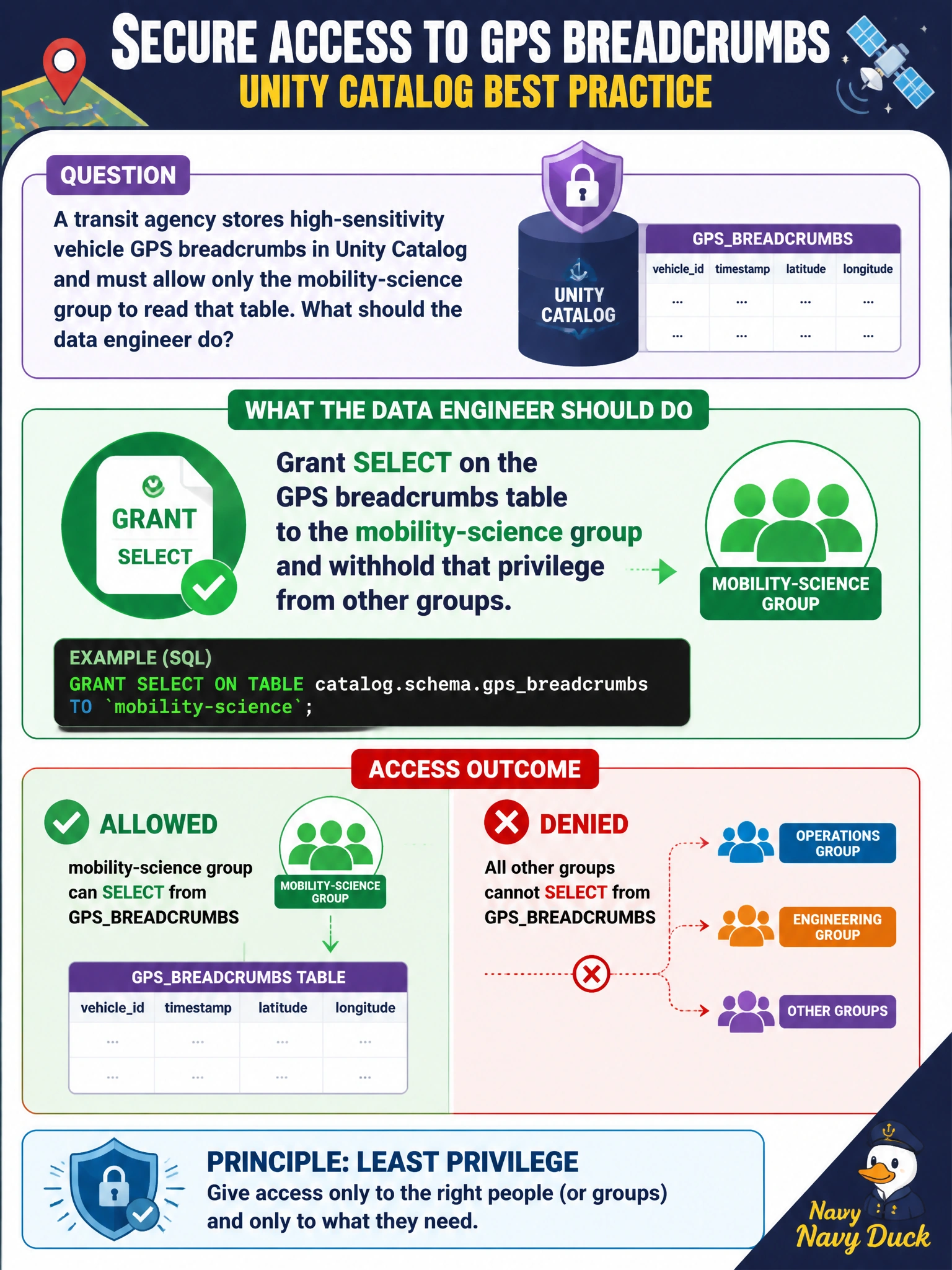
A transit agency stores high-sensitivity vehicle GPS breadcrumbs in Unity Catalog and must allow only the mobility-science group to read that table. What should the data engineer do?
Select an answer to reveal the explanation.
Short Explanation
Picture the breadcrumbs table as a locked equipment bay—only the mobility-science crew gets a key for SELECT, while everyone else stays outside the door.
Full Explanation
Granting SELECT on the high-sensitivity vehicle GPS breadcrumbs table only to the mobility-science group is the correct Unity Catalog least-privilege pattern for a transit agency. Privileges are assigned on securable objects to principals; withholding SELECT from other groups keeps breadcrumbs out of ad-hoc analyst sessions while still enabling authorized mobility-science reads. Table-scoped SELECT matches the stem: read access for one civic science group, not broader write or catalog-wide rights.
Granting MODIFY on the GPS breadcrumbs table to the mobility-science group and withholding that privilege from other groups confuses write with read: MODIFY permits altering, updating and deleting records but grants no ability to read the breadcrumbs, so the authorized group would still lack the SELECT access the stem requires while holding excessive write power that violates least privilege. Granting SELECT on a summary view of GPS breadcrumbs to the mobility-science group and withholding table access from other groups changes the securable and the data: the stem requires direct read access to the high-sensitivity breadcrumbs table itself, so limiting the authorized group to an aggregated summary view denies them the detailed records they need and does not satisfy the table-level SELECT requirement. Privilege withholding (limiting SELECT grants) is the prerequisite control. Granting USE CATALOG and USE SCHEMA on transit objects to the mobility-science group and withholding SELECT from other groups only sets up catalog and schema navigation: those USE privileges let a principal traverse the namespace but carry no ability to read table contents on their own, and because SELECT is never granted to mobility-science the breadcrumbs table would remain unreadable; navigation privileges are a prerequisite for using SELECT, not a substitute for it.
Exam caveat: MODIFY for writes, USE CATALOG and USE SCHEMA for navigation, and SELECT on a different view or object operate at different layers than table-level SELECT; they do not substitute for privilege withholding on the required table. SELECT is not interchangeable with USE CATALOG, USE SCHEMA, or MODIFY. A summary view can be useful later for broader sharing, but only after least-privilege table SELECT for mobility-science is locked down inside Catalog.
Operational check: In Catalog Explorer, confirm the breadcrumbs table lists SELECT for the mobility-science group only, verify other groups lack SELECT on that object, run a query as a non-member principal and expect denial, and confirm audit logs record both authorized and denied access attempts against the municipal GPS table.
Prefer to study offline? Printable PDF study book + test engine ($7.50, unofficial). These questions stay free here.