
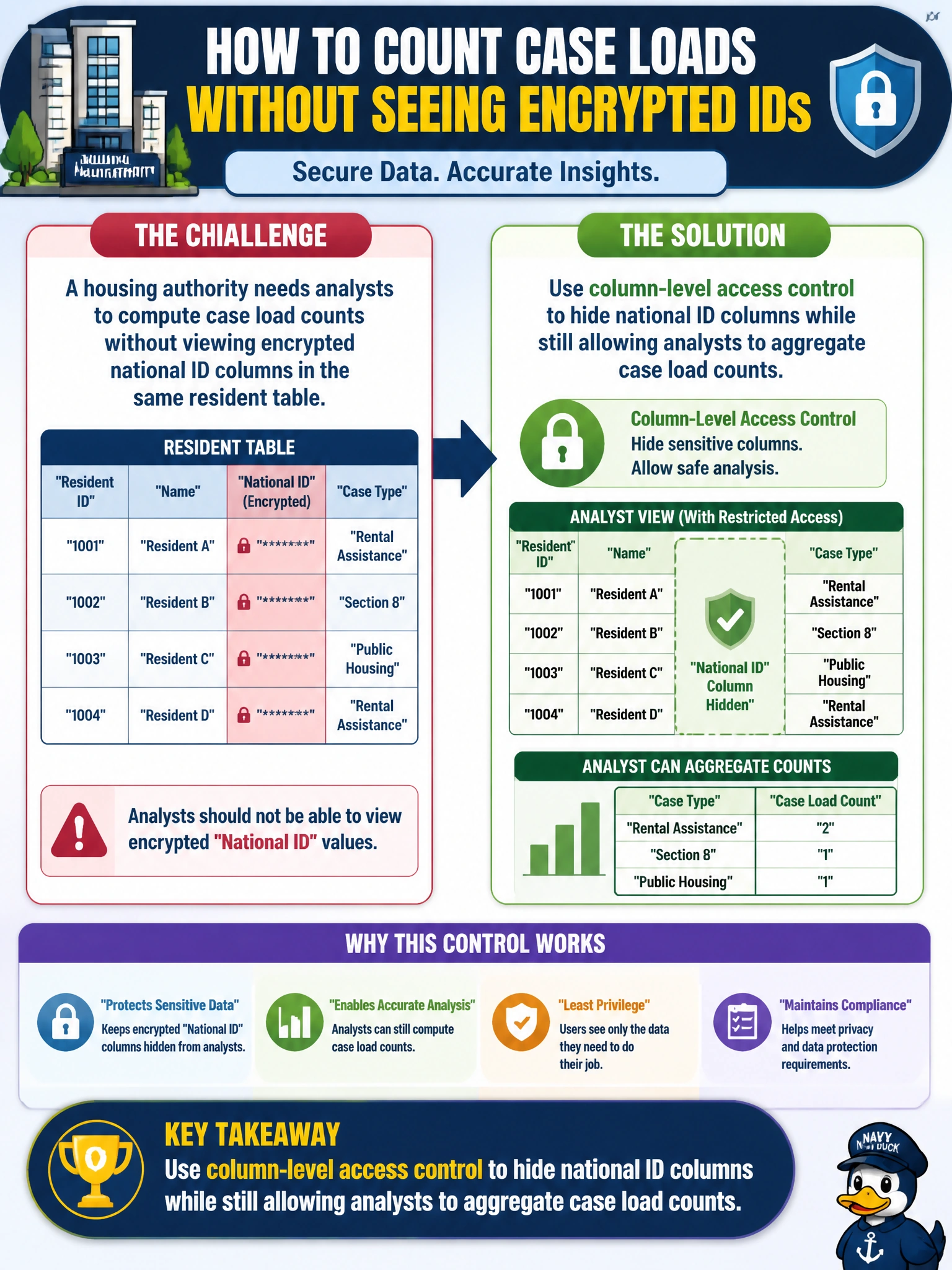
A housing authority needs analysts to compute case load counts without viewing encrypted national ID columns in the same resident table. Which control should they select?
Select an answer to reveal the explanation.
Short Explanation
Hide the national ID column like covering the SSN line on a printed form while still letting analysts tally how many cases are open. Full SELECT on IDs is not required just to count caseloads.
Full Explanation
Column-level access control lets the housing authority hide encrypted national ID columns while still allowing analysts to aggregate case load counts on non-sensitive attributes. Analysts tally open cases as if the SSN line on the printed form were covered: counts and statuses remain available; national identifiers stay concealed. That meets reporting needs without granting full SELECT over PII fields in the resident table.
Granting analysts full SELECT including national ID fields for complete case reporting overshares PII when counts do not require those columns. Dropping case load metrics entirely so IDs never need protection abandons a legitimate operational metric instead of applying the right control. Mirroring national IDs into an unmanaged public gold table for dashboard convenience creates a new ungoverned PII exposure.
Exam caveat: encryption at rest does not replace query-time column ACLs/masking—engine users with SELECT still see decrypted values unless column policies intervene. Combine with row filters if analysts should only see their assigned caseloads. Operational check: apply column mask or deny on national ID, grant analysts SELECT for metrics columns, run COUNT/GROUP BY case load queries successfully, confirm ID projection is blocked/masked, and review policies in change control before housing dashboards go live.
Prefer to study offline? Printable PDF study book + test engine ($7.50, unofficial). These questions stay free here.