
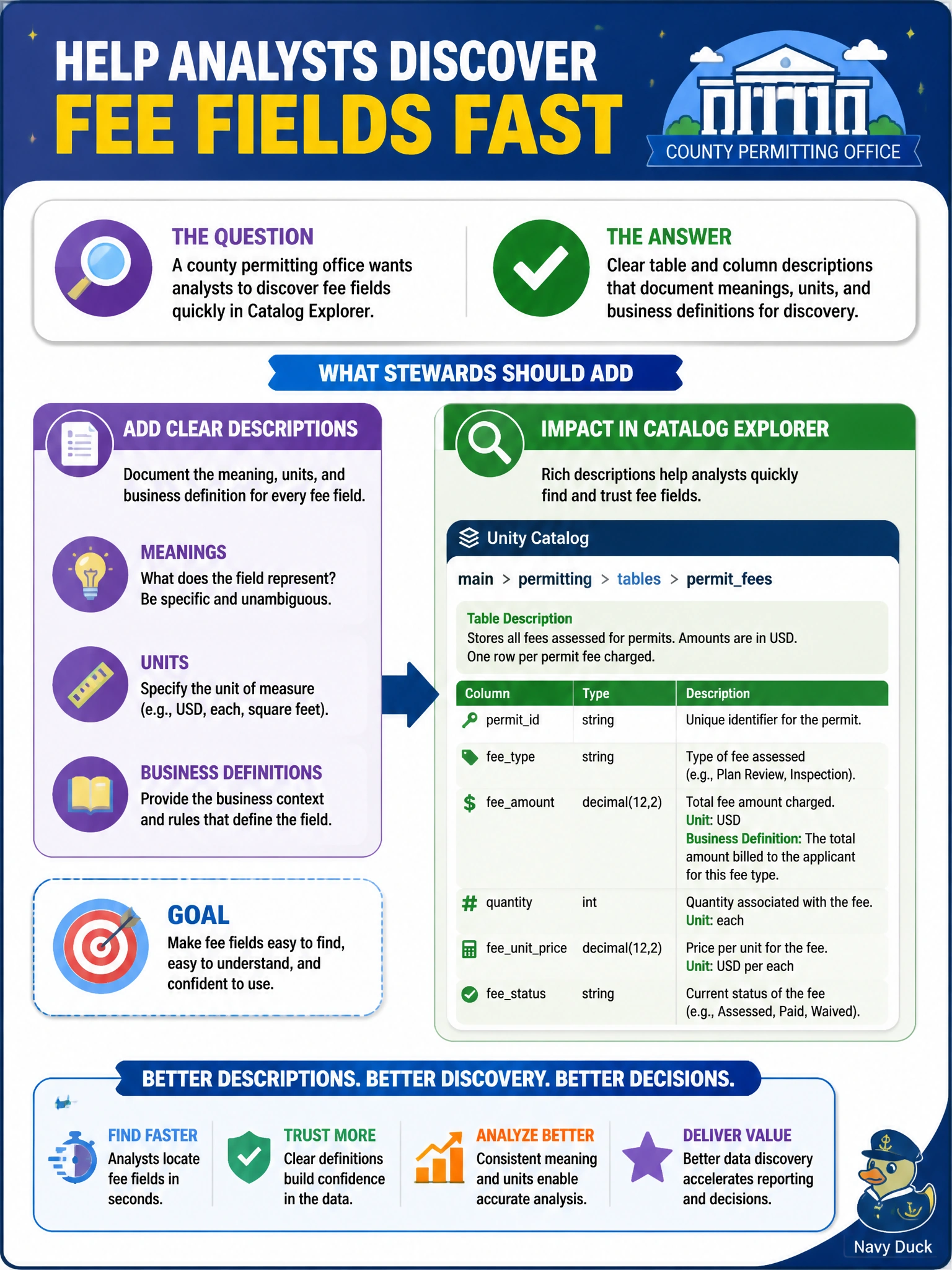
A county permitting office wants analysts to discover fee fields quickly in Catalog Explorer. What should stewards add to the Unity Catalog tables and columns?
Select an answer to reveal the explanation.
Short Explanation
Think of descriptions as the county’s trail markers in Catalog Explorer—good labels on tables and columns keep you from wandering into the wrong fee field. Sorting records with clustering keys by filing date and region won’t help you search by business meaning, and lineage panels tracing tables to cleansed pipelines and jobs won’t tell you what a fee field means. Row filters and masks controlling access to fee amounts cover governance, but they won’t help you discover what the fields mean.
Full Explanation
Clear table and column descriptions that document meanings, units, and business definitions are the correct metadata that stewards should add to Unity Catalog tables and columns. Descriptions in Catalog Explorer enable analysts to discover fee fields and understand what values represent without consulting external wikis or the source OLTP system.
Standardized Unity Catalog clustering keys sorting permit records by filing date and region improve query performance through physical ordering but do not add searchable business meanings that analysts can use to discover fee fields. Relying on clustering by filing date and region for faster scans still leaves analysts without definitions and defeats Catalog Explorer's discovery purpose entirely. Detailed Unity Catalog lineage panels tracing fee tables to cleansed ETL pipelines and jobs show where data came from for discovery, but they do not document business meanings or help analysts discover what fee fields represent in Catalog Explorer. Consistent Unity Catalog row filters and masks controlling analyst access to fee amounts support governance for discovery, but they do not document business meanings or help analysts discover specific fee fields in Catalog Explorer.
Exam caveat: Descriptions differ from column comments in a source database: Catalog descriptions are intended for analyst discovery and business context, while source comments often contain technical lineage or archive notes. Descriptions should be human-readable and complete, not standardized Unity Catalog clustering keys sorting permit records by filing date and region.
Operational check: In Catalog Explorer, search for 'fee' and confirm clear descriptions surface fee-related columns; query a column that lacks description and confirm an analyst cannot infer its contents from detailed Unity Catalog lineage panels tracing fee tables to cleansed ETL pipelines and jobs alone; verify governance requires descriptions on public-facing tables.
Prefer to study offline? Printable PDF study book + test engine ($7.50, unofficial). These questions stay free here.