
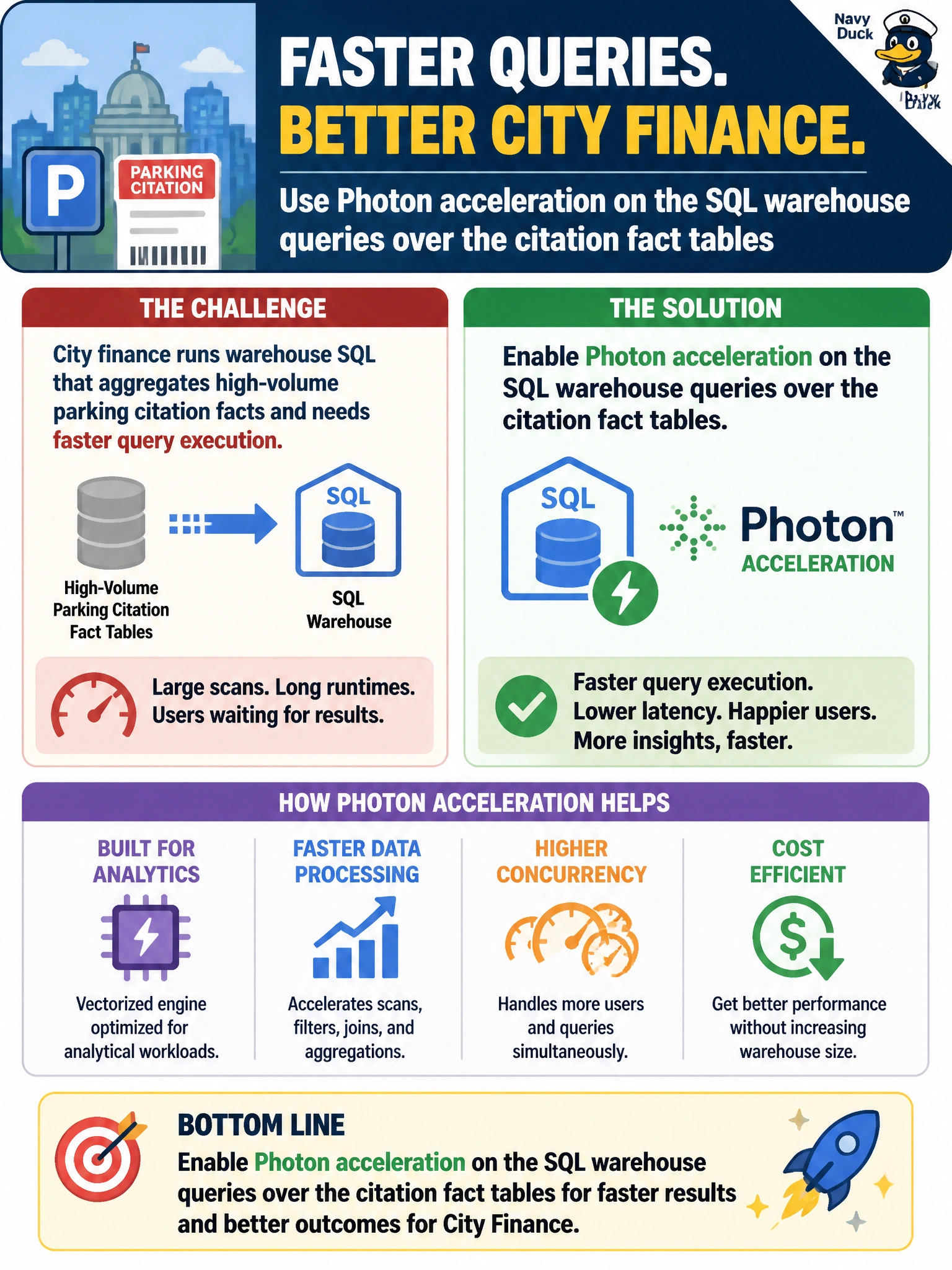
City finance runs warehouse SQL that aggregates high-volume parking citation facts and needs faster query execution. Which feature should they enable?
Select an answer to reveal the explanation.
Short Explanation
Photon is the turbocharger on the SQL warehouse—same parking citation facts, snappier aggregations. You do not need to export CSVs or spin GPUs just to make GROUP BY feel alive for finance dashboards.
Full Explanation
City finance aggregating high-volume parking citation facts on warehouse SQL should enable Photon acceleration on the SQL warehouse queries over those fact tables. Photon is Databricks’ vectorized query engine that speeds many SQL aggregations, filters, and joins on Delta tables—exactly the pattern of SUM/GROUP BY dashboards over large citation fact volumes—without redesigning the civic data model or exporting data out of the lakehouse.
Deletion vectors on temporary notebook views are a Delta storage feature for efficient deletes/updates; they are not a query-acceleration switch for warehouse aggregations and do not apply meaningfully to ephemeral temp views used only in notebooks. Manual single-partition CSV export before each dashboard refresh destroys lakehouse benefits, creates stale extracts, and usually slows—not speeds—finance reporting. Classic GPU ML runtimes are for machine learning training/inference, not the default engine for SQL SUM/GROUP BY on citation facts; forcing GPUs for warehouse BI is costly mis-sizing.
Exam caveat: Photon is available on supporting runtimes/warehouses; if a distractor says “enable Photon on a GPU ML cluster for SQL,” prefer the SQL warehouse + Photon pairing. Photon helps many queries but is not magic for badly skewed designs—still partition/Z-order thoughtfully. Do not confuse Photon with caching or materialized views; those are complementary performance tools.
Operational check: enable Photon on the finance SQL warehouse, rerun representative parking-citation aggregations, compare query history duration and cost, and confirm dashboards hit Photon-enabled warehouses rather than ad-hoc classic clusters.
Prefer to study offline? Printable PDF study book + test engine ($7.50, unofficial). These questions stay free here.