
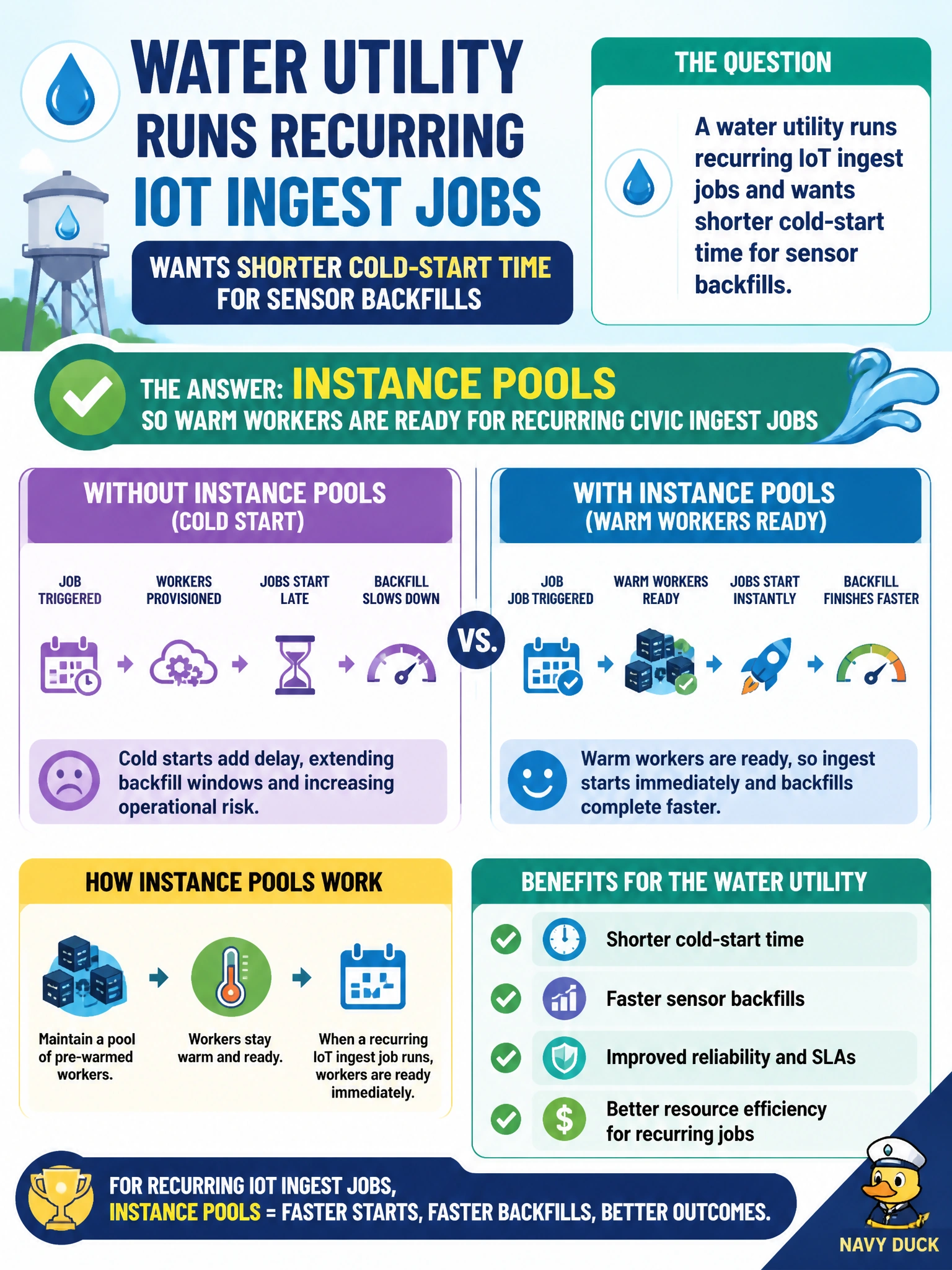
A water utility runs recurring IoT ingest jobs and wants shorter cold-start time for sensor backfills. Which compute feature should they use?
Select an answer to reveal the explanation.
Short Explanation
Pools are like keeping a few spare utility trucks already fueled at the yard—when the sensor backfill job starts, workers attach faster instead of waiting for a cold delivery from the shop. That cuts the cold-start wait on recurring IoT jobs.
Full Explanation
A water utility running recurring IoT ingest jobs that wants shorter cold-start time for sensor backfills should use instance pools so warm workers are ready for recurring civic ingest jobs. Pools keep idle instances pre-allocated (within pool configuration) so when a backfill or scheduled ingest job starts, executors attach faster than provisioning fresh VMs from cold cloud capacity. That reduces time-to-first-task for repetitive municipal sensor workloads without permanently dedicating a full always-on interactive cluster to each job. Enabling autoscaling so warm nodes stay ready for recurring civic ingest jobs does not shorten cold-start time; autoscaling adds or removes workers after the cluster is already running based on load, so it does not keep warm nodes pre-provisioned and the initial VM provisioning wait for backfills remains. Using single-node clusters so workers stay warm for recurring civic ingest jobs does not provide warm distributed workers; single-node clusters run only a driver with no executors and suit small local testing, so they cannot keep workers warm, parallelize sensor backfills or reduce VM acquire time. Enabling auto-termination so restarts stay ready for recurring civic ingest jobs does not warm the next start; it saves cost by shutting down idle clusters, so restarts are cold and the following backfill still provisions cold VMs rather than attaching to pre-allocated instances. Exam caveat: pools improve acquire time for compatible node types but still incur pool idle cost—size the pool to recurring demand, not an unbounded warm fleet. Pools are not a substitute for autoscaling during extreme bursts; they complement job clusters. Do not confuse pools with SQL warehouses or serverless (which address different spin-up models). Operational check: create an instance pool matching the IoT job’s node family, point recurring ingest/backfill job clusters at that pool, measure time-to-running versus cold starts, and tune pool min idle instances against utility budget and backfill frequency.
Prefer to study offline? Printable PDF study book + test engine ($7.50, unofficial). These questions stay free here.