
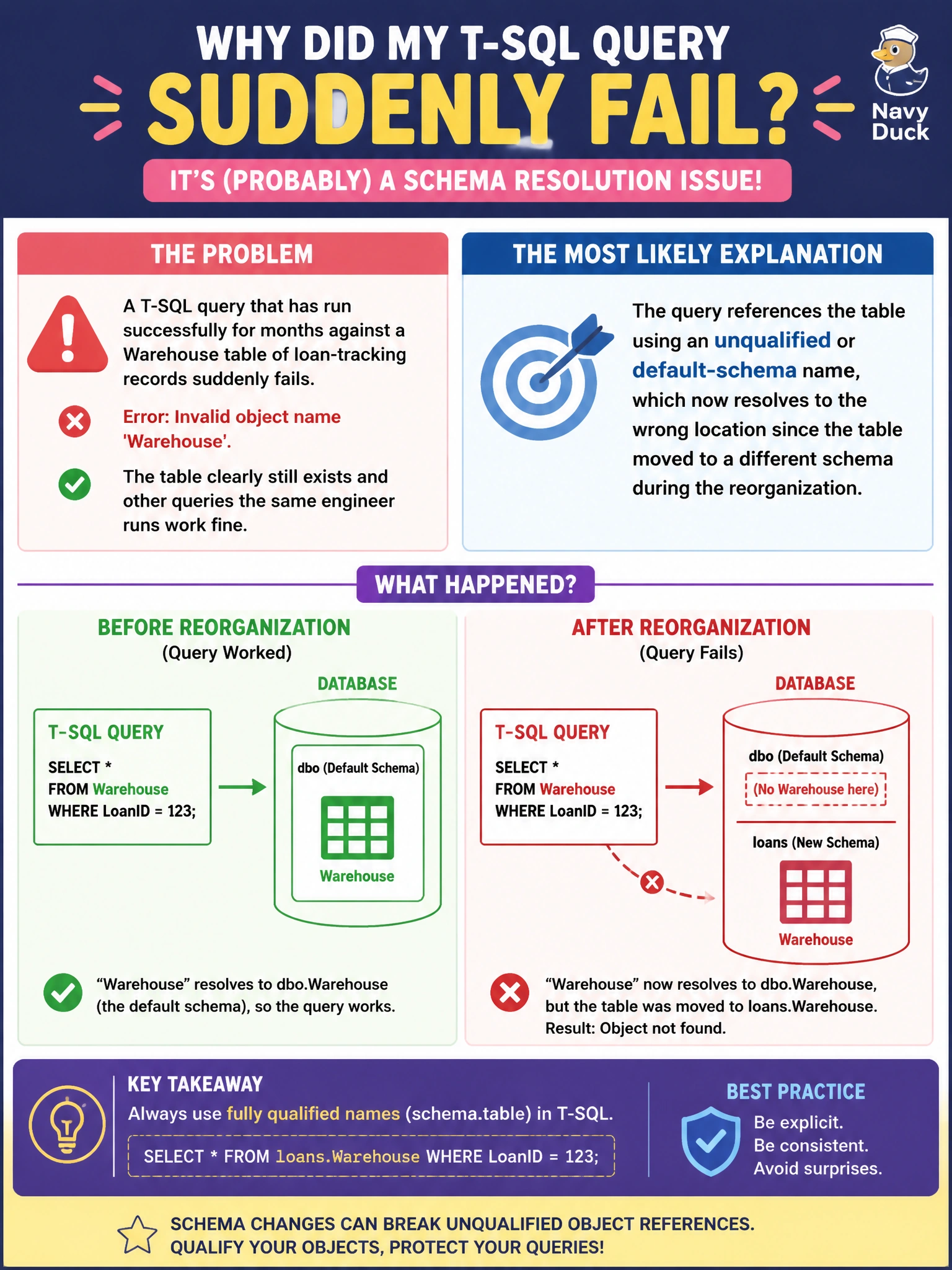
A T-SQL query that has run successfully for months against a Warehouse table of loan-tracking records suddenly fails, reporting that the object cannot be found, even though the table clearly still exists and other queries the same engineer runs work fine. After a recent reorganization, tables were moved into a new schema. What is the most likely explanation?
Select an answer to reveal the explanation.
Short Explanation
T-SQL doesn't just look for a table by its short name floating in space — it resolves that name against a schema, and if you don't say which one, it assumes a default. Move the table to a different schema and a query that used to find it in the default spot suddenly comes up empty, even though the table itself never went anywhere.
Full Explanation
When a T-SQL query references a table without explicitly qualifying it with a schema name, the engine resolves that reference against the caller's default schema, and if a reorganization relocates the table into a different schema, a previously working unqualified reference will no longer find it there, producing an object-not-found error even though the table still exists and is fully intact under its new schema. This explains every detail in the scenario: the table clearly exists, other queries the same engineer runs still succeed because they may reference different, unaffected objects or already use full schema qualification, and the failure began right after the reorganization that moved tables between schemas. A disabled login would block all of that engineer's queries uniformly, not just ones touching this specific table, and would produce an authentication or permission-denied error rather than an object-not-found one. Storage corruption is a far more severe and rare condition that would typically affect data integrity broadly and surface differently than a clean object-resolution error. An outright rename to a different name is a plausible general cause but is less consistent with the scenario's specific detail about a schema reorganization, which points squarely at qualification rather than renaming. The concrete fix is to qualify the reference with the table's new schema name, or query the system catalog views to confirm exactly which schema the table now lives under.