
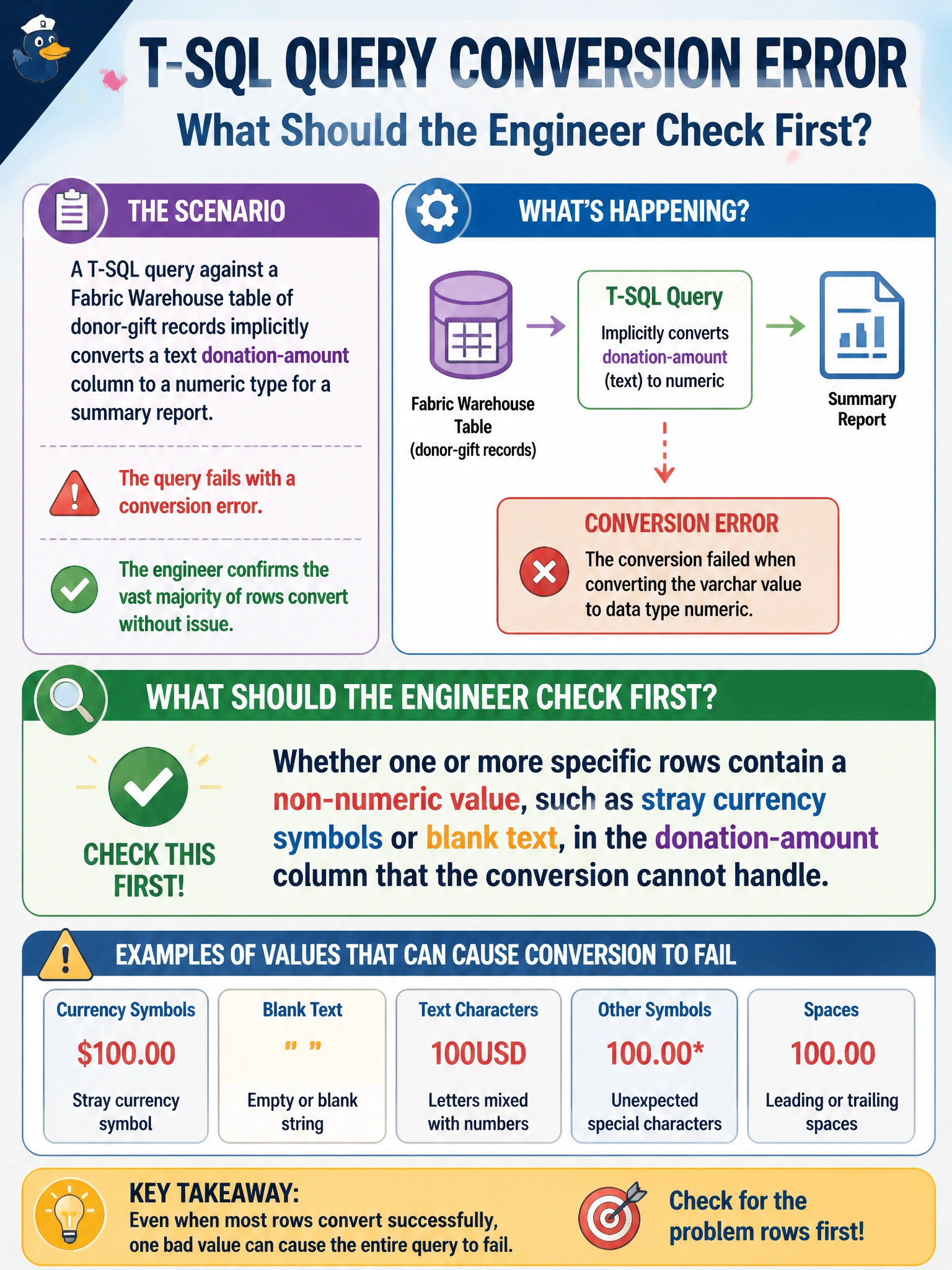
A T-SQL query against a Fabric Warehouse table of donor-gift records implicitly converts a text donation-amount column to a numeric type for a summary report. The query fails with a conversion error, and the engineer confirms the vast majority of rows convert without issue. What should the engineer check first?
Select an answer to reveal the explanation.
Short Explanation
A type conversion either works row by row or it doesn't, and when almost every row converts fine, the problem was never the conversion logic — it's a handful of oddball values hiding in the data. Somewhere in that donation column is a value with a stray character or symbol that just refuses to become a number.
Full Explanation
An implicit or explicit conversion from text to a numeric type fails as soon as it encounters a single value that cannot be interpreted as that numeric type, and the fact that most rows convert successfully strongly indicates the data itself, not the conversion logic, is the problem: a small number of rows likely contain something like a stray currency symbol, thousands separator, trailing space, or blank entry that breaks the cast. Isolating the offending rows, for example by attempting a safe conversion function that returns null instead of erroring and then filtering for those nulls, is the direct path to finding exactly which values are malformed. A missing semicolon would be a syntax error caught before the query ever executes against data, not a conversion failure tied to specific row content. Under-provisioned compute affects how long a query takes or whether it gets throttled, not whether a text value can be cast to a number. Outdated statistics affect the query optimizer's chosen execution plan and potential performance, but have no bearing on whether a specific value's characters are numeric. The concrete check is to run a query that isolates rows failing the conversion and review their raw text values directly before deciding whether to clean the source data or adjust the loading process that populated it.