
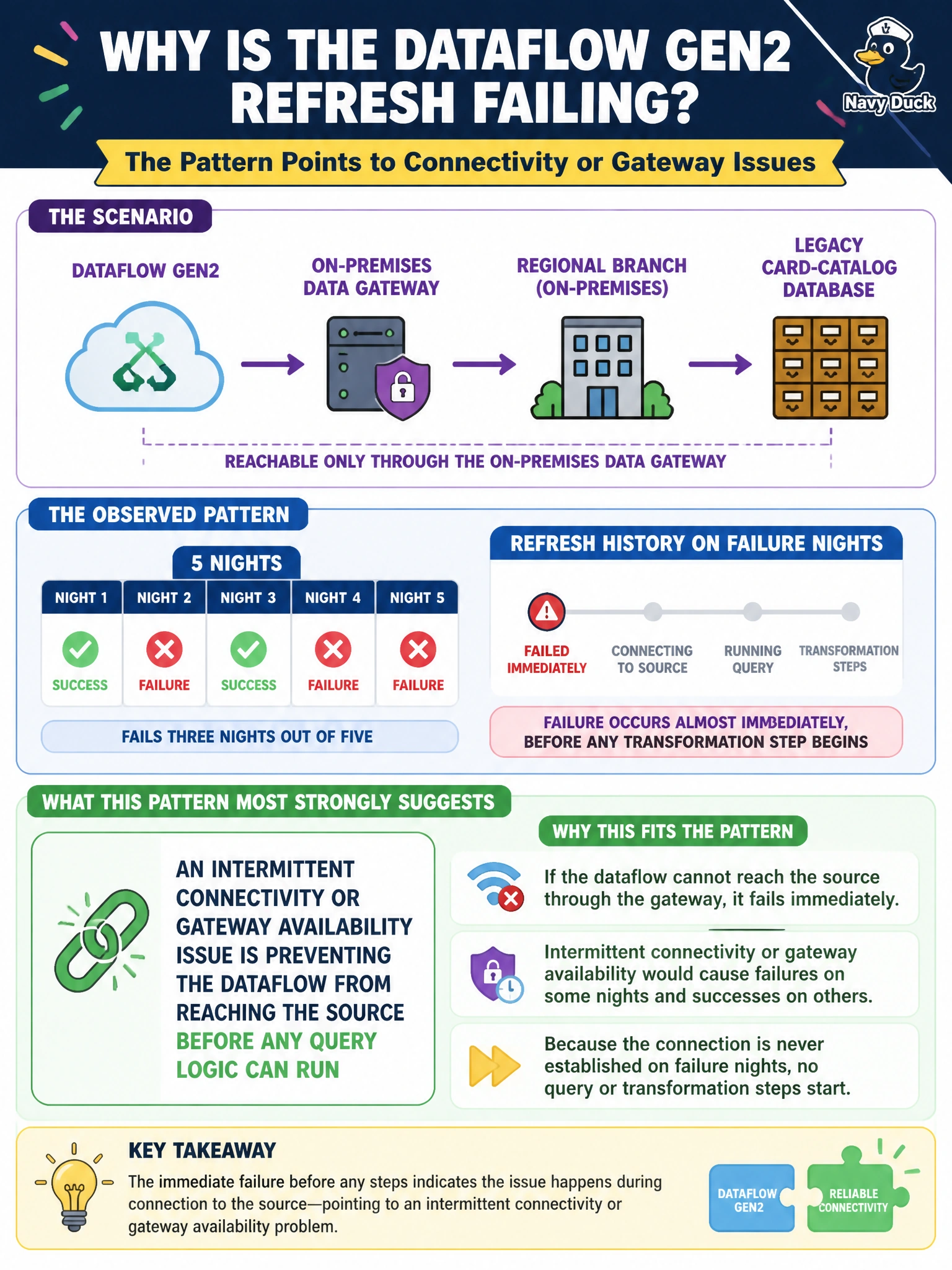
A Dataflow Gen2 that pulls a legacy card-catalog database, reachable only through an on-premises data gateway at one regional branch, fails to refresh three nights out of five, with no changes to the query logic. On the nights it fails, the refresh history shows the failure occurring almost immediately, before any transformation step begins. What does this pattern most strongly suggest?
Select an answer to reveal the explanation.
Short Explanation
When a refresh fails right at the starting gate, before any of your actual transformation logic even gets a turn, the problem almost never lives in that logic. Think of it like a phone call that drops before either side says a word — you don't blame what was going to be said. An unreliable path through the on-premises gateway fits that pattern exactly.
Full Explanation
A connectivity or gateway availability problem shows up in the refresh history as a failure that occurs immediately, before the dataflow ever begins evaluating its Power Query steps, because the engine cannot even open a session against the on-premises source through the gateway. That timing detail is the key diagnostic signal here: query logic errors, whether a syntax mistake or a broken step reference, only surface once the engine starts evaluating steps, and a source-side type conversion error only appears after rows have actually been read and a transform has run against them. A destination schema mismatch would only be detected once the dataflow attempts to write its output, which is the very last phase of a refresh, not the first. Since the query logic has not changed and the failure is intermittent rather than constant, an unreliable gateway connection or an occasionally unavailable on-premises host explains both the timing and the inconsistency far better than a code-level cause. The concrete check is to correlate the failed refresh timestamps against the on-premises gateway's own status and connectivity logs on that branch's machine, since a gateway that is periodically restarted or resource-constrained produces exactly this three-out-of-five pattern.