
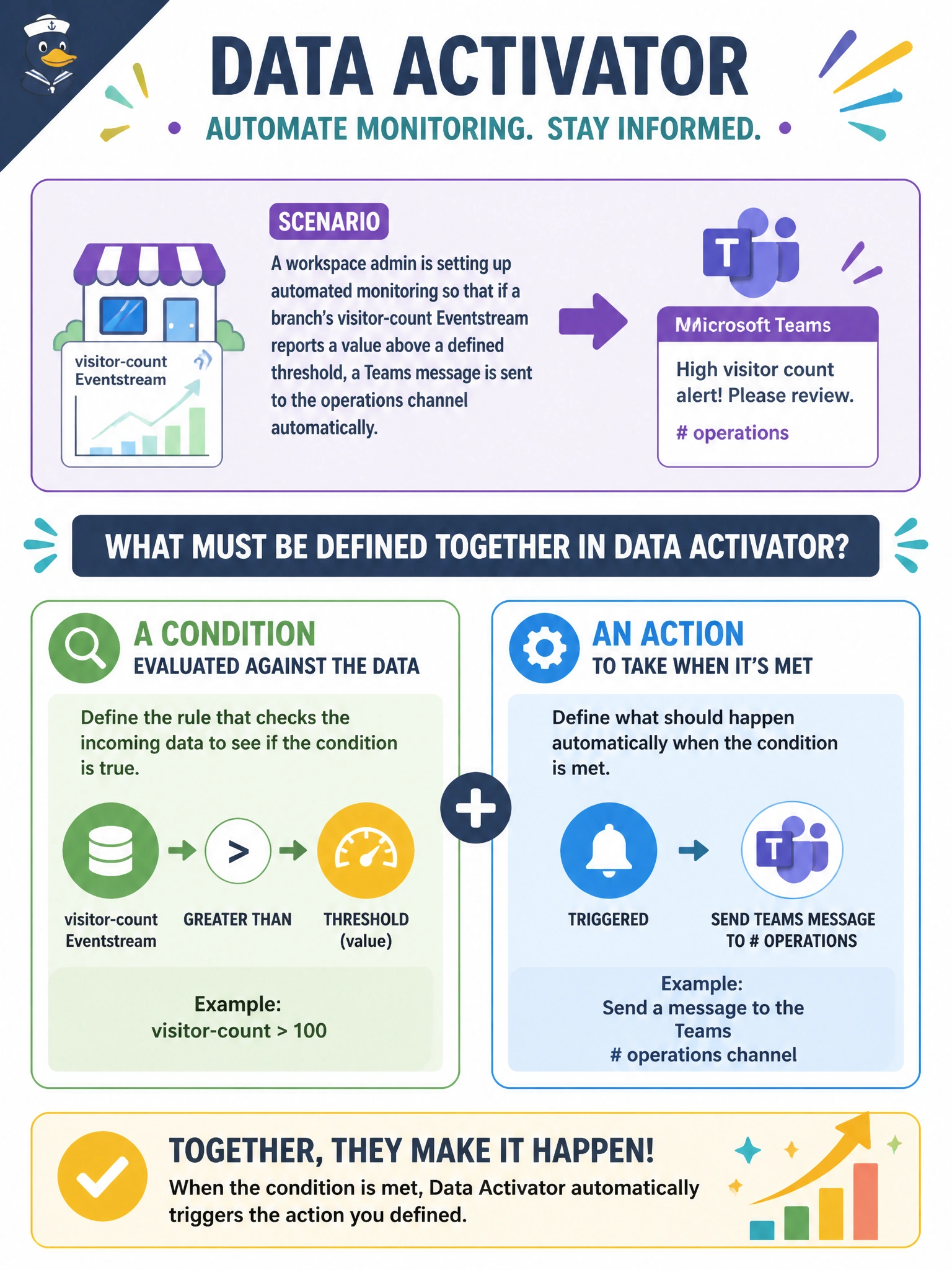
A workspace admin is setting up automated monitoring so that if a branch's visitor-count Eventstream reports a value above a defined threshold, a Teams message is sent to the operations channel automatically. Conceptually, what two things must be defined together for this to work in Data Activator?
Select an answer to reveal the explanation.
Short Explanation
A Data Activator rule always comes in a pair: a watch condition and a response. It's a thermostat, not just a thermometer, since it's wired to do something the moment a number crosses a line.
Full Explanation
Every Data Activator rule pairs a condition, evaluated continuously against incoming data such as an Eventstream's visitor-count values, with an action that fires automatically once that condition is met, such as sending a Teams message to an operations channel; both halves are required, since a condition without an action would just observe silently and an action without a condition would fire constantly or never. Sensitivity labels and endorsement levels are governance and trust concepts applied to items themselves; they don't evaluate live data values or trigger notifications. Deployment pipeline stages and Git branches belong to Fabric's lifecycle-management tooling for promoting and versioning item definitions, an entirely different concern from reacting to live telemetry. Row-level security roles and column masks are data-access controls that restrict what a given user can see in a table; they have no role in defining a monitoring rule or its response. Once the pair is defined, it's worth testing the threshold against a realistic range of past visitor counts so normal daily peaks don't trigger the alert constantly.