
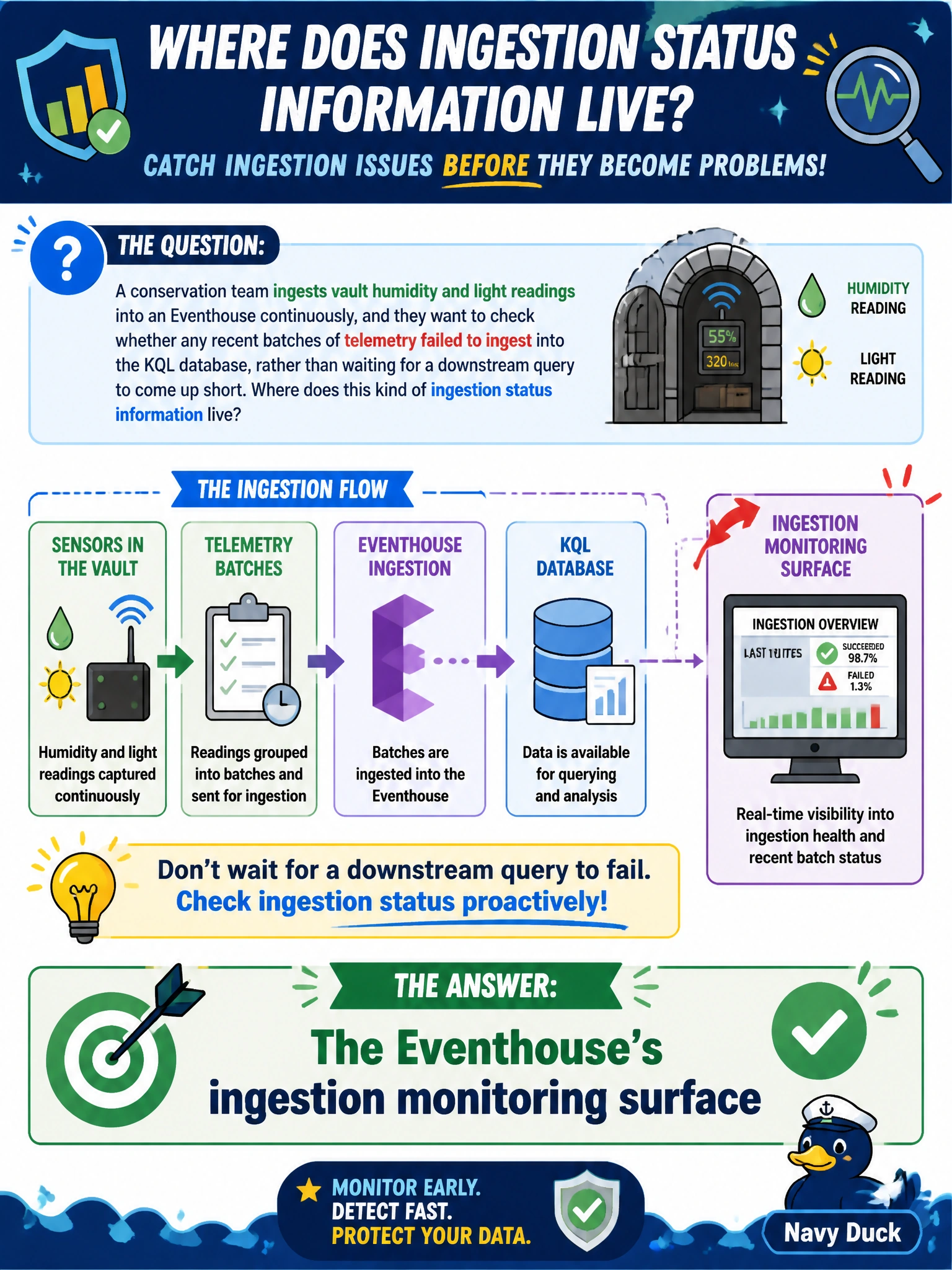
A conservation team ingests vault humidity and light readings into an Eventhouse continuously, and they want to check whether any recent batches of telemetry failed to ingest into the KQL database, rather than waiting for a downstream query to come up short. Where does this kind of ingestion status information live?
Select an answer to reveal the explanation.
Short Explanation
Think of the Eventhouse's ingestion monitoring like a loading dock's intake log: it records whether each batch of humidity and light readings actually made it onto the shelf. Nobody has to notice a gap by accident days later.
Full Explanation
An Eventhouse exposes ingestion monitoring that reports on recent ingestion activity into its KQL databases, including successes and failures, which directly answers whether telemetry batches actually landed rather than forcing the team to infer a problem from a downstream query returning fewer rows than expected. A semantic model's refresh history is scoped entirely to Power BI or Direct Lake dataset refreshes and has no visibility into an Eventhouse's streaming ingestion pipeline. The workspace's sensitivity label list is a governance artifact tracking which items carry which classification, unrelated to whether data actually arrived anywhere. A Lakehouse's lineage view shows upstream and downstream dependencies for that Lakehouse's tables, not ingestion status for a separate Eventhouse item. Checking ingestion status directly, rather than waiting for a query to look wrong, catches a quiet sensor or a broken connector the same day instead of after a gap has already grown for a while.