
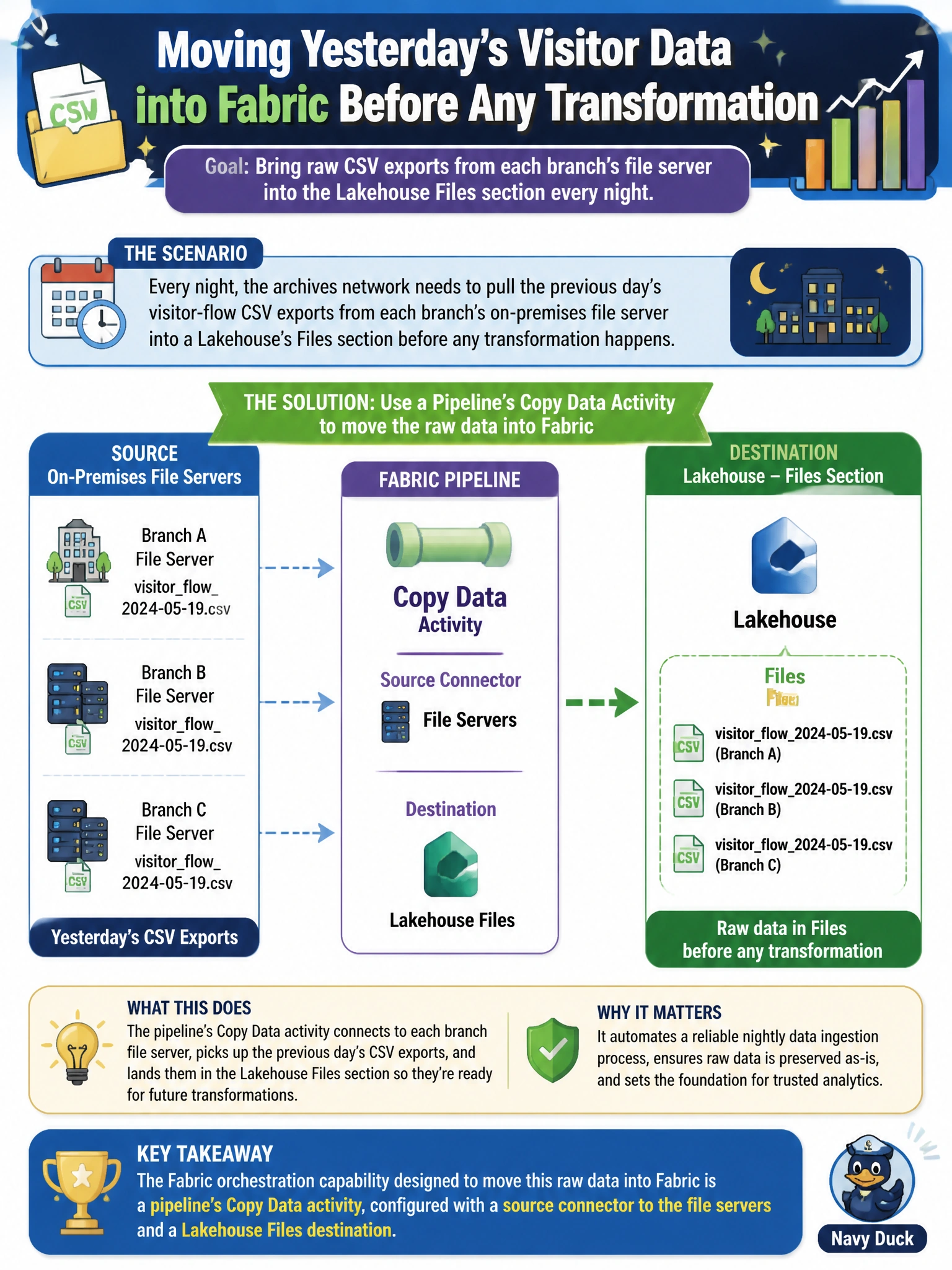
Every night, the archives network needs to pull the previous day's visitor-flow CSV exports from each branch's on-premises file server into a Lakehouse's Files section before any transformation happens. Which Fabric orchestration capability is designed to move this raw data into Fabric?
Select an answer to reveal the explanation.
Short Explanation
Think of the Copy Data activity like a nightly courier route: it picks up the same boxes from the same branches on a schedule and drops them at the same loading dock every time. That's exactly what moving raw CSV exports into a Lakehouse's Files area needs.
Full Explanation
A pipeline's Copy Data activity is Fabric's dedicated mechanism for moving raw data from a source system — including on-premises file servers, typically reached through a gateway — into a Fabric destination like a Lakehouse's Files section, on a schedule, without applying transformation logic along the way. That matches the requirement precisely: move the files in, untouched, before any cleanup happens. A KQL update policy operates inside an Eventhouse, transforming data that has already arrived there; it has no role in reaching out to an on-premises file server and pulling files into a Lakehouse. Running a Dataflow Gen2's preview pane manually each morning is neither an ingestion mechanism nor an automated, scheduled process — it's an ad hoc, human-triggered action that doesn't scale to a reliable nightly job. A VACUUM command cleans up old Delta file versions in an existing table; it doesn't ingest anything and would have nothing to act on until after the copy already landed. Before relying on the nightly copy, verify the on-premises gateway connecting the file servers to Fabric is online and current, since a stale gateway silently breaks the schedule.