
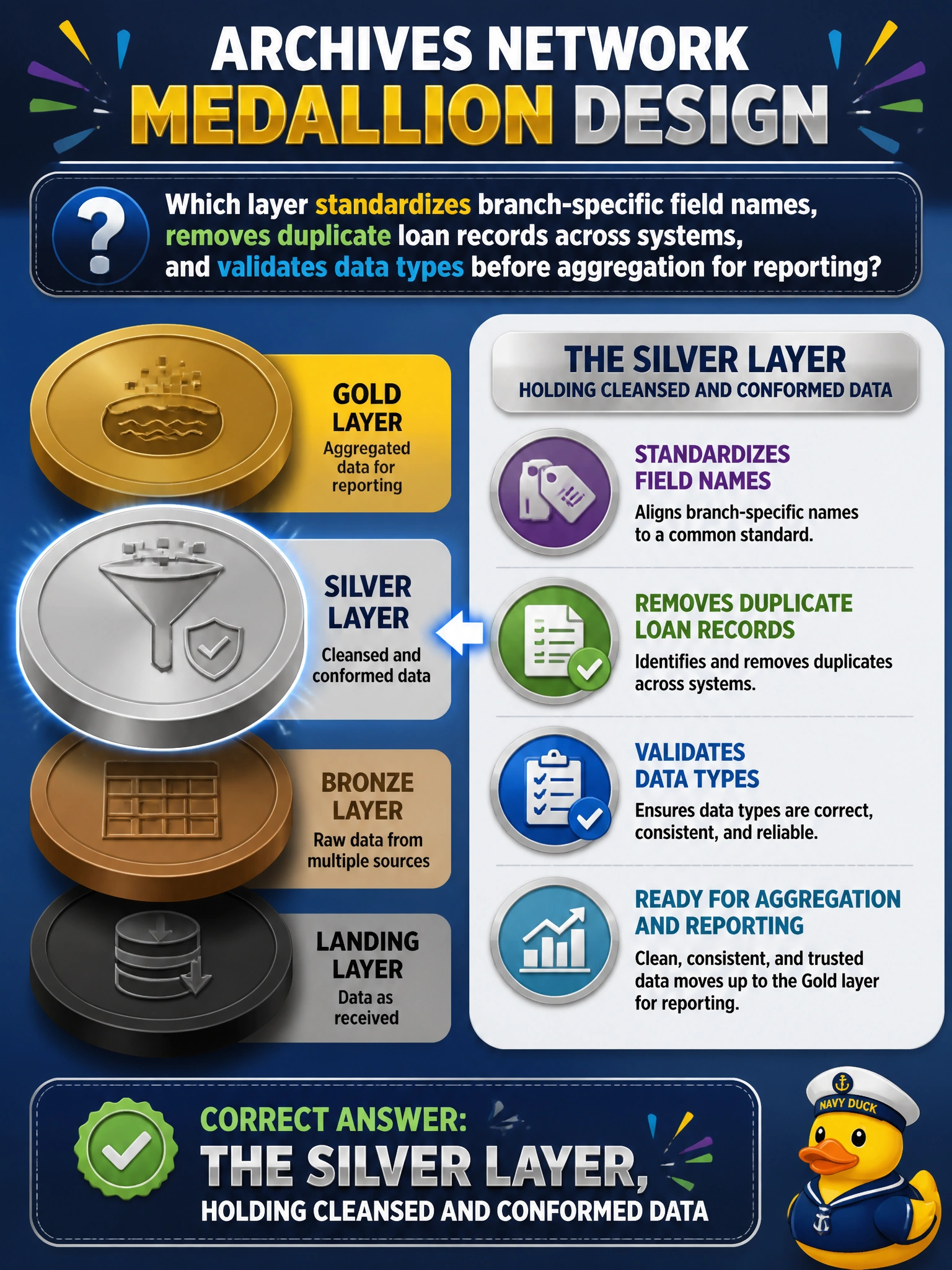
Continuing the archives network's medallion design, the team wants a layer where branch-specific field names are standardized, duplicate loan records across systems are removed, and data types are validated before anything is aggregated for reporting. Which layer is this?
Select an answer to reveal the explanation.
Short Explanation
Once the raw intake pile is sorted, standardized, and the duplicates pulled out, it moves to the workbench. That's the silver layer: cleansed, conformed, validated data, sitting between raw bronze and the polished gold reports.
Full Explanation
The silver layer sits between bronze and gold in a medallion architecture and is where cleansing and conforming happen: standardizing field names across sources, removing duplicate records, validating and correcting data types, and applying business rules that make disparate branch data comparable. This is exactly the work described, standardizing branch-specific fields and deduplicating loan records, which makes silver the correct layer. The bronze layer holds raw, unmodified data straight from the source and deliberately does not perform this kind of standardization, since its purpose is preserving an unaltered copy for reprocessing. The gold layer sits downstream of silver and holds business-level, aggregated data shaped for direct consumption by reports and dashboards; it assumes the conforming and cleansing described here has already happened, so pushing that work into gold would mean aggregating on top of inconsistent data. A staging table inside the source system is not part of the Fabric medallion pattern at all; the source system's own internal staging, if it has one, is outside the analytics pipeline's control and doesn't perform cross-branch conforming. When building the silver transformation, add explicit checks that catch schema drift from any one branch's collection-management system, since a renamed source field can silently produce nulls instead of a load failure.