
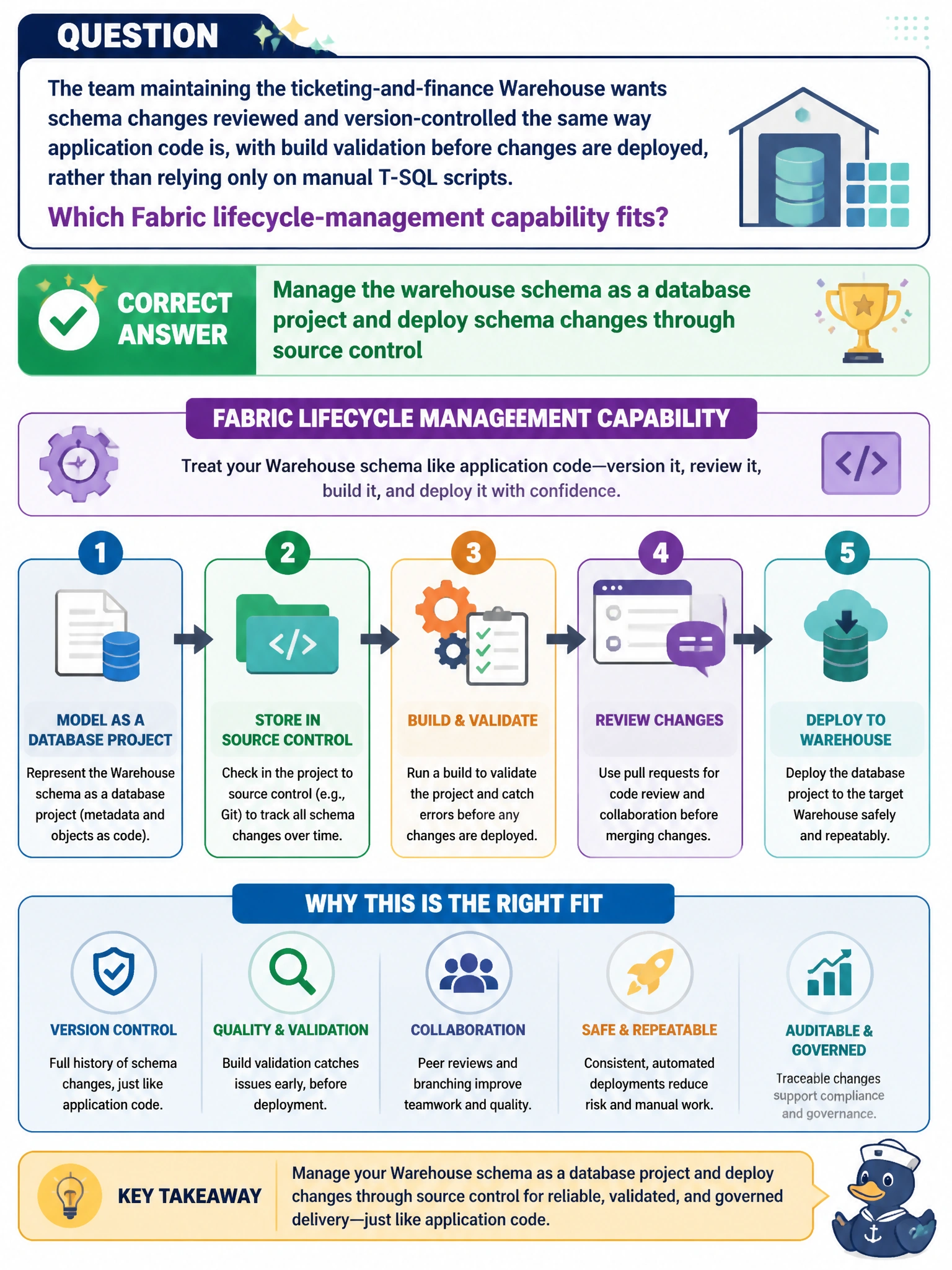
The team maintaining the ticketing-and-finance Warehouse wants schema changes reviewed and version-controlled the same way application code is, with build validation before changes are deployed, rather than relying only on manual T-SQL scripts. Which Fabric lifecycle-management capability fits?
Select an answer to reveal the explanation.
Short Explanation
A database project treats your warehouse schema like source code instead of a one-off script you run and hope you remember to repeat. You get the schema in version control, changes reviewed like a pull request, and a build step that validates it before anything touches the real warehouse.
Full Explanation
Database projects bring schema-as-code practices to a Fabric warehouse: the schema is defined in source-controlled project files, changes go through a build/validation step, and deployment happens in a repeatable, reviewable way instead of engineers rerunning ad hoc T-SQL scripts by hand. Relying on deployment pipeline stage comparison alone shows differences in deployed items between stages but does not give the fine-grained, reviewable schema diffing and build validation a database project provides before anything is deployed. Dynamic data masking controls what values authorized-but-restricted users see in query results; it is a security control, not a schema source-control mechanism. Manually rerunning the same scripts in each environment is precisely the error-prone, unrepeatable pattern database projects replace -- nothing prevents drift between environments when scripts are typed by hand each time. A caveat: database projects manage schema, not row-level data, so seed or reference data still needs its own migration approach. Confirm success by checking the project's build output is clean and its structure matches what actually deployed to the warehouse.