
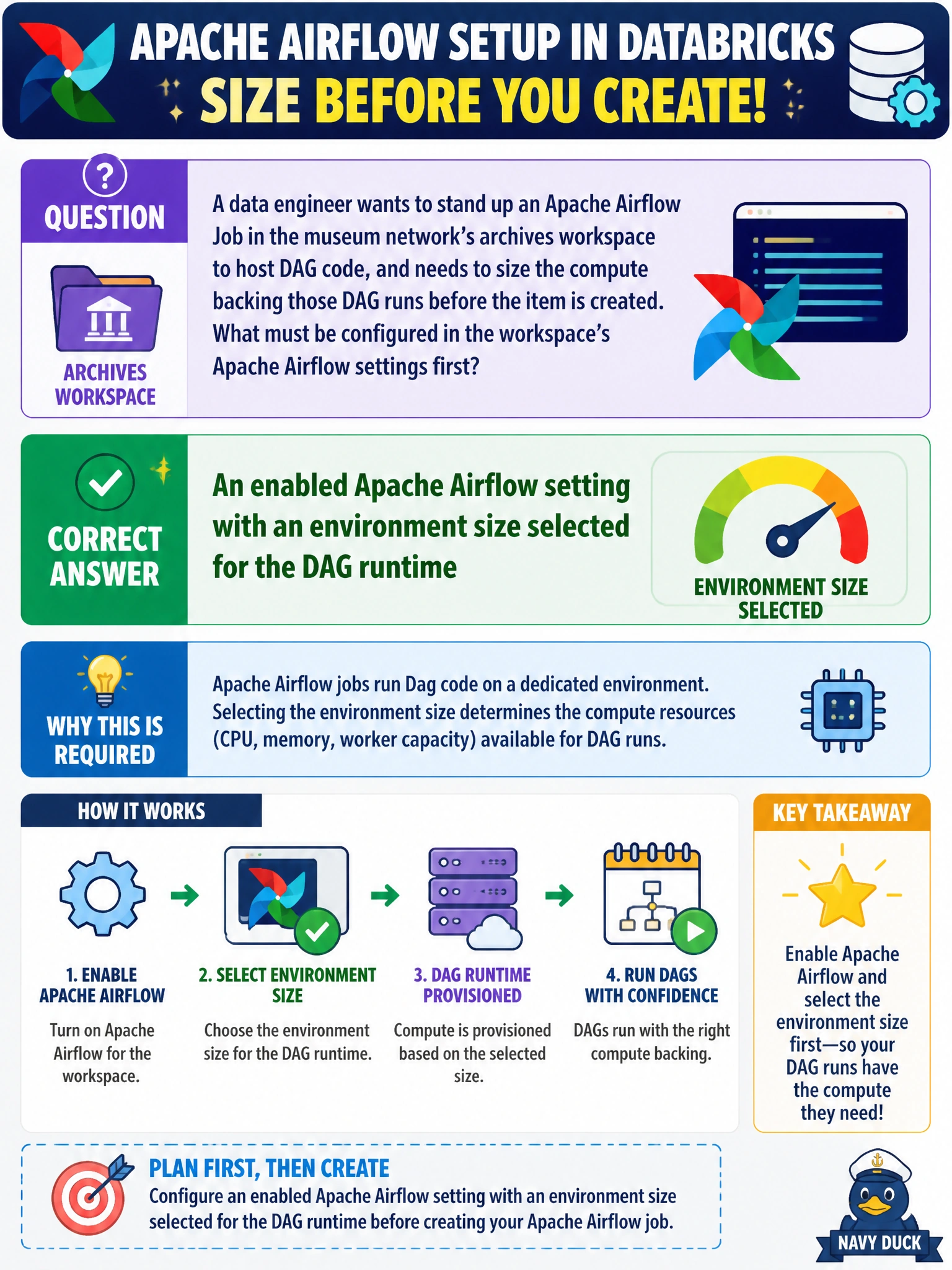
A data engineer wants to stand up an Apache Airflow Job in the museum network's archives workspace to host DAG code, and needs to size the compute backing those DAG runs before the item is created. What must be configured in the workspace's Apache Airflow settings first?
Select an answer to reveal the explanation.
Short Explanation
Think of the Airflow environment size like choosing the engine size for a car before you drive it -- too small and DAG runs strain, too big and you're paying for room you don't use. Enabling Apache Airflow in workspace settings and picking a size is what actually provisions the compute backing those DAG runs.
Full Explanation
The Apache Airflow workspace setting is where an admin turns on the Apache Airflow Job item type for that workspace and selects an environment size, which provisions the compute that backs DAG execution -- this is the prerequisite step, not an afterthought. A deployment pipeline stage is a lifecycle-promotion construct for moving items between dev, test, and production; it has no role in provisioning the compute an Airflow item runs on. A sensitivity label classifies data for governance purposes and does not provision or size any runtime. A custom Spark pool backs Spark-based compute for notebooks and Spark jobs; Airflow's DAG runtime is a separate, dedicated environment sized through its own workspace setting, not through a Spark pool. One scope note: the environment size setting is configured per workspace, so two branch archives with similar workloads can end up with different DAG performance if their sizes differ. Confirm the setup by checking that the Apache Airflow toggle is on and an environment size is selected before creating the Airflow Job item.