
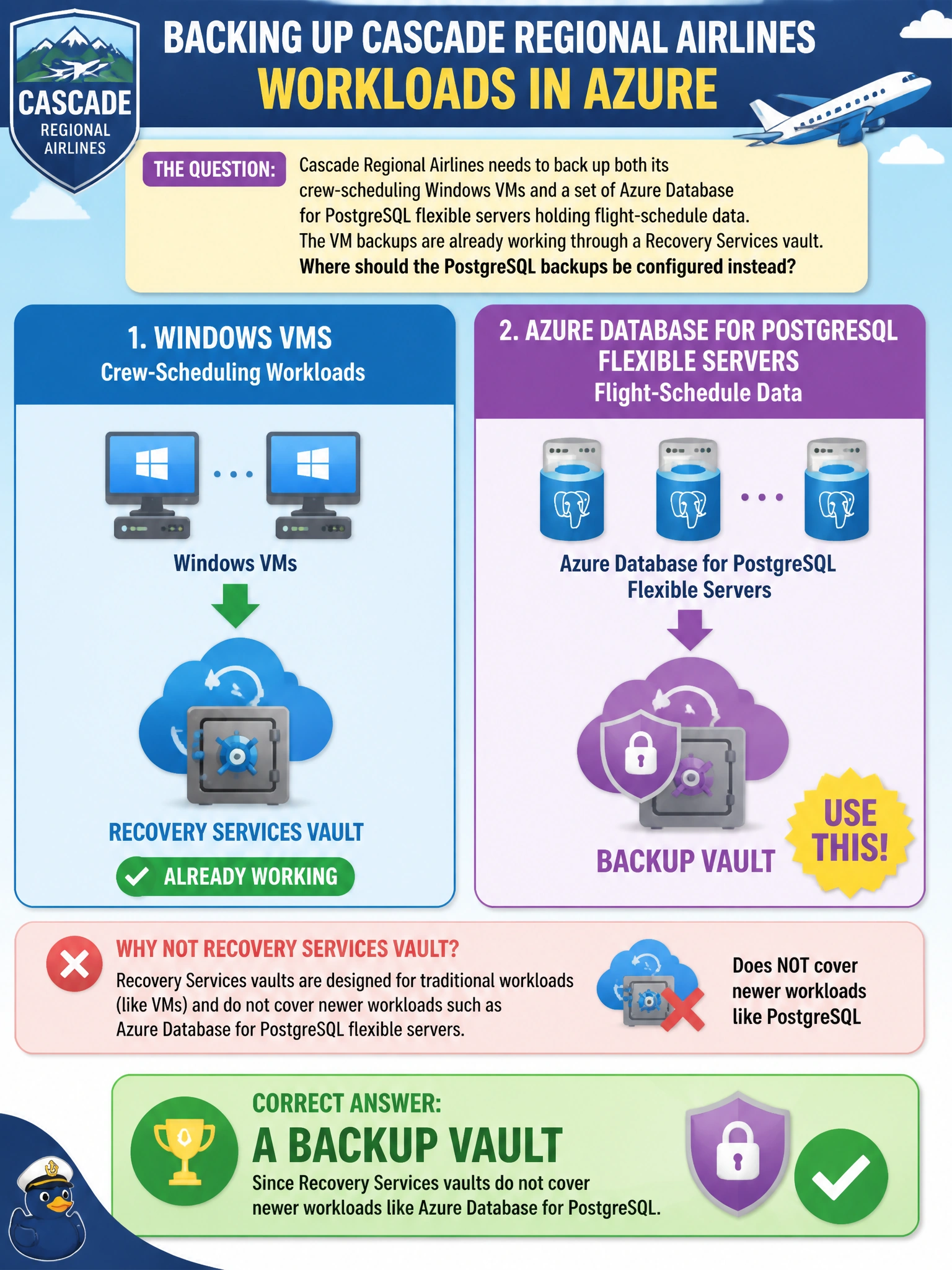
Cascade Regional Airlines needs to back up both its crew-scheduling Windows VMs and a set of Azure Database for PostgreSQL flexible servers holding flight-schedule data. The VM backups are already working through a Recovery Services vault. Where should the PostgreSQL backups be configured instead?
Select an answer to reveal the explanation.
Short Explanation
Think of these as two different toolboxes for the same trade: the Recovery Services vault handles the classic workloads like VMs, SQL Server on a VM, and file shares, while the newer Backup vault was introduced for workloads like disks, blobs, and Azure Database for PostgreSQL flexible server.
Full Explanation
Azure Backup uses two vault types depending on the workload: a Recovery Services vault covers established scenarios such as Azure VMs, SQL Server or SAP HANA running inside a VM, and Azure file shares, while a Backup vault is the newer vault type introduced for workloads including Azure Database for PostgreSQL flexible server, managed disks, and blob storage. Because the two vault types support different, non-overlapping sets of workloads, the PostgreSQL backups cannot be added to the existing Recovery Services vault and must instead be configured against a Backup vault. Azure Site Recovery is a disaster-recovery replication service for VMs and physical servers, not a backup service for databases, so it does not apply here at all. A diagnostic setting only routes operational logs and metrics; it has no ability to create or manage backup recovery points for a database. The practical step is to create or select a Backup vault in the same or a paired region, configure a backup policy for the PostgreSQL flexible servers, and confirm a successful backup job appears in that vault rather than in the Recovery Services vault used for the VMs.