
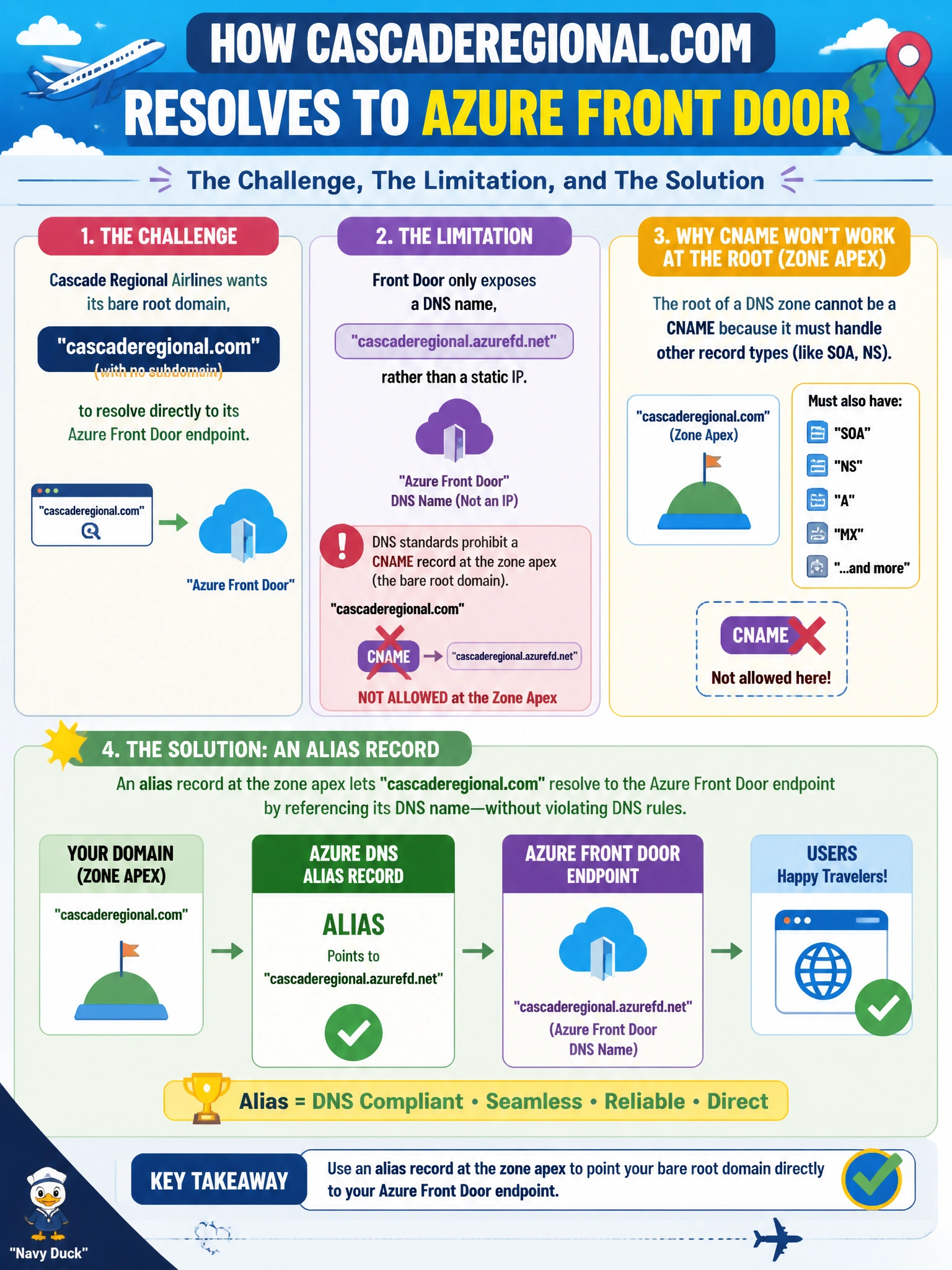
Cascade Regional Airlines wants its bare root domain, cascaderegional.com (with no subdomain), to resolve directly to its Azure Front Door endpoint, but Front Door only exposes a DNS name rather than a static IP, and DNS standards prohibit a CNAME record at the zone apex. Which Azure DNS record type solves this?
Select an answer to reveal the explanation.
Short Explanation
Normal DNS rules say the root of a domain can't point to another name the way a CNAME does — it has to be an IP. Azure's alias record gets around that by pointing the apex at Front Door's underlying resource and following it automatically whenever that endpoint's address changes.
Full Explanation
An alias record in Azure DNS is a special record type that can be set at the zone apex and points to certain Azure resources — including Front Door endpoints, Traffic Manager profiles, and public IP addresses — by resource reference rather than by a static value, and Azure automatically keeps it in sync if the underlying resource's IP or hostname changes, all while satisfying the DNS specification that forbids a standard CNAME record from coexisting with other records at the zone apex. A plain CNAME record is exactly what the specification prohibits at the apex, since the apex must also carry other record types like NS and SOA, and a CNAME cannot coexist with them. An NS record simply delegates a subdomain to other name servers and has nothing to do with pointing a domain at an application endpoint. A TXT record stores arbitrary text data, typically for domain verification or SPF/DKIM purposes, and provides no actual name resolution to an endpoint. The exam-relevant caveat: alias records only work for a specific supported set of Azure resource types, so they can't be used generically to alias any external hostname the way a CNAME can. To verify, check the apex record's type in the Azure DNS zone shows as an Alias record targeting the Front Door endpoint resource, and confirm a DNS query against the bare domain resolves successfully.