
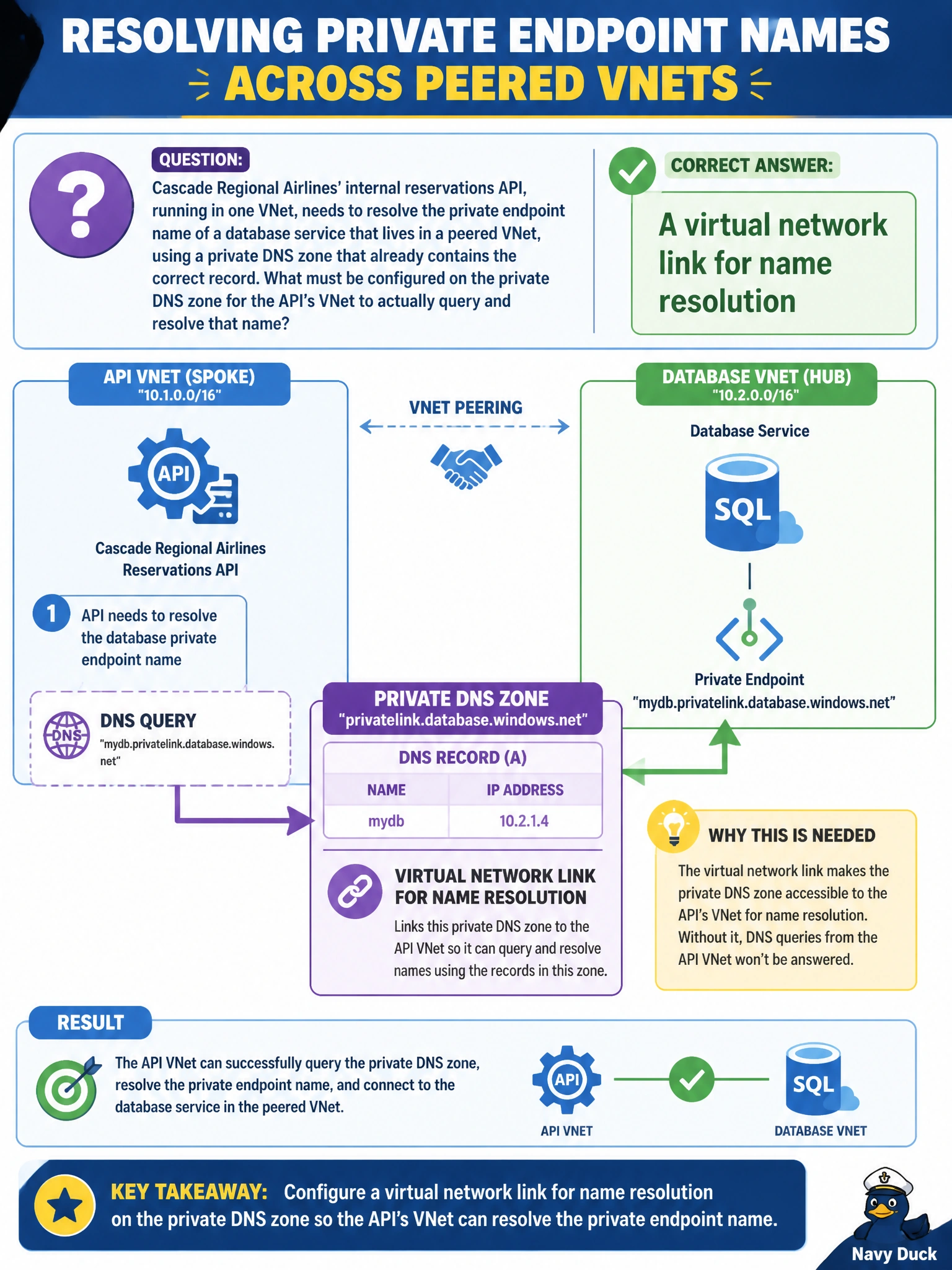
Cascade Regional Airlines' internal reservations API, running in one VNet, needs to resolve the private endpoint name of a database service that lives in a peered VNet, using a private DNS zone that already contains the correct record. What must be configured on the private DNS zone for the API's VNet to actually query and resolve that name?
Select an answer to reveal the explanation.
Short Explanation
Having the right record sitting in a private zone doesn't help if nothing's telling your VNet to ask that zone in the first place. A virtual network link is what actually connects a VNet to a private DNS zone so its resources can resolve names in it.
Full Explanation
A virtual network link associates a VNet with a private DNS zone and comes in two flavors: a resolution link, which lets resources in that VNet query and resolve records in the zone, and an optional registration link, which additionally lets Azure auto-create records for VMs deployed in that VNet. For the reservations API's VNet to resolve the database's private endpoint record, it needs at minimum a resolution-only virtual network link to the zone holding that record — VNet peering alone does not extend private DNS resolution across VNets, since peering only handles network connectivity, not name resolution. Autoregistration is the registration half of a VNet link and only controls whether VM records get created automatically; it doesn't grant resolution ability by itself and isn't needed here since the record already exists. A conditional forwarder on-premises is used to route on-premises DNS queries toward Azure DNS for Azure-hosted zones, which is unrelated to a purely intra-Azure VNet resolving a private zone record. A public NS delegation applies to public DNS zones and has no role in private zone resolution. The exam-relevant caveat: a private DNS zone can be linked to multiple VNets, and a VNet can only be linked for resolution to one instance of that specific zone's DNS suffix at a time. Operationally, verify by checking the private DNS zone's Virtual Network Links blade lists the API's VNet, then test resolution with nslookup against the private endpoint's FQDN from a VM in that VNet.