
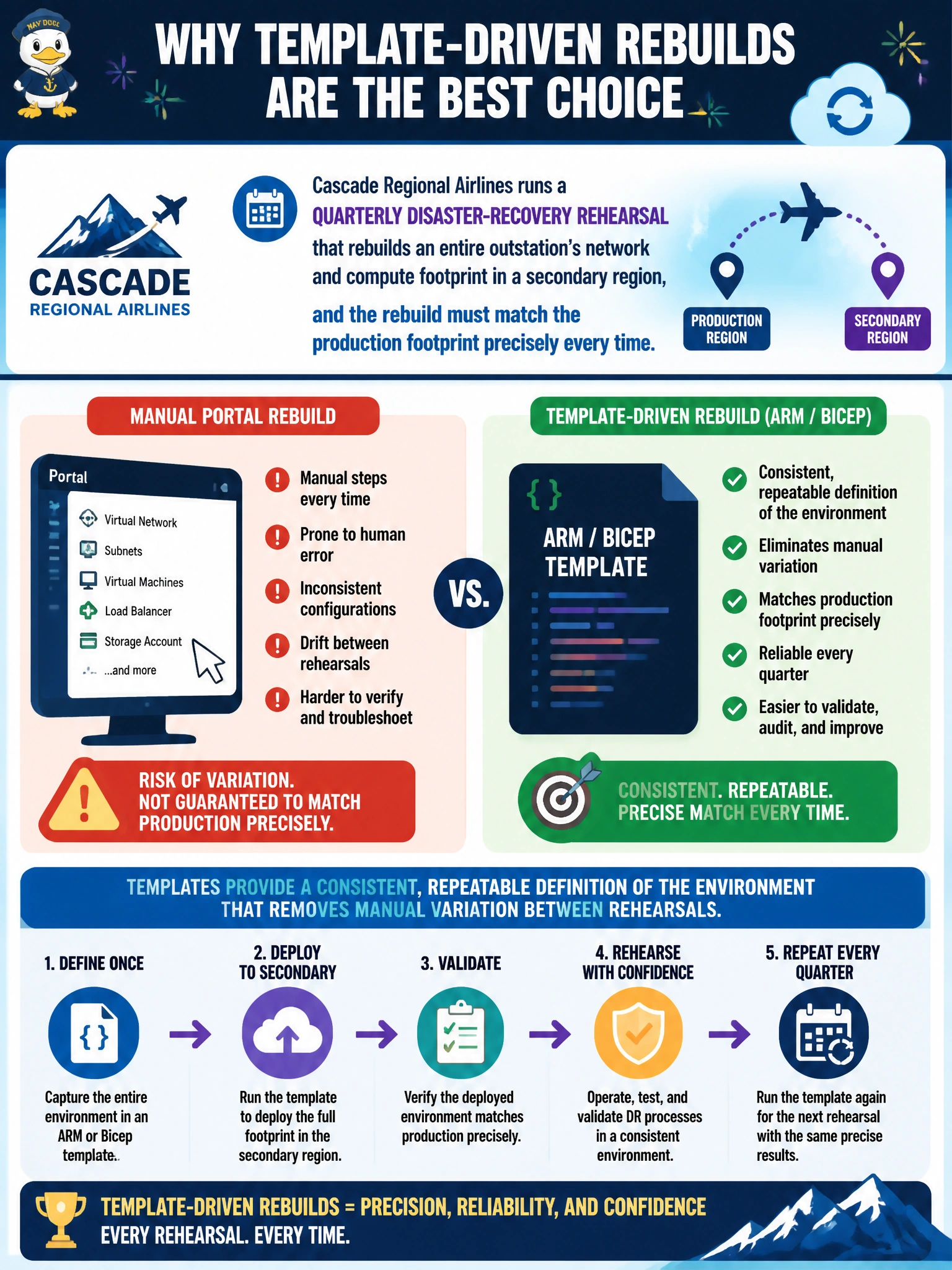
Cascade Regional Airlines runs a quarterly disaster-recovery rehearsal that rebuilds an entire outstation's network and compute footprint in a secondary region, and the rebuild must match the production footprint precisely every time. Why is an ARM or Bicep template the best-suited approach for this recurring rebuild, compared to manually recreating resources through the portal each quarter?
Select an answer to reveal the explanation.
Short Explanation
A DR rehearsal only proves anything if it rebuilds the same environment every single time. A template captures that build once as code, so quarter after quarter the rebuild isn't left to memory or manual clicking, which is exactly where drift creeps in.
Full Explanation
The value of a template for a recurring DR rehearsal is consistency: the same declarative definition is deployed every quarter, removing the risk that a manually rebuilt environment drifts from production because a step was skipped, a setting was mistyped, or a different person ran the rebuild this time. This repeatability is the entire point of testing DR readiness, since the rehearsal is only meaningful if it reflects what an actual failover would produce. Raw execution speed per resource is not the deciding factor here and is not guaranteed to differ meaningfully between the portal and a template deployment; the real advantage is process consistency across many rehearsals, not the speed of any single resource's creation. Nothing about template deployment guarantees extra capacity in a secondary region; capacity is a function of what the template specifies and what quota exists there, not an automatic property of using a template. Azure does not require a template for deployments to a secondary region; resources can be created there manually through the portal exactly as in any other region, it would just reintroduce the drift risk. A solid operational check after each rehearsal is diffing the deployed resource properties against the production footprint to confirm the template still produces a matching build.