
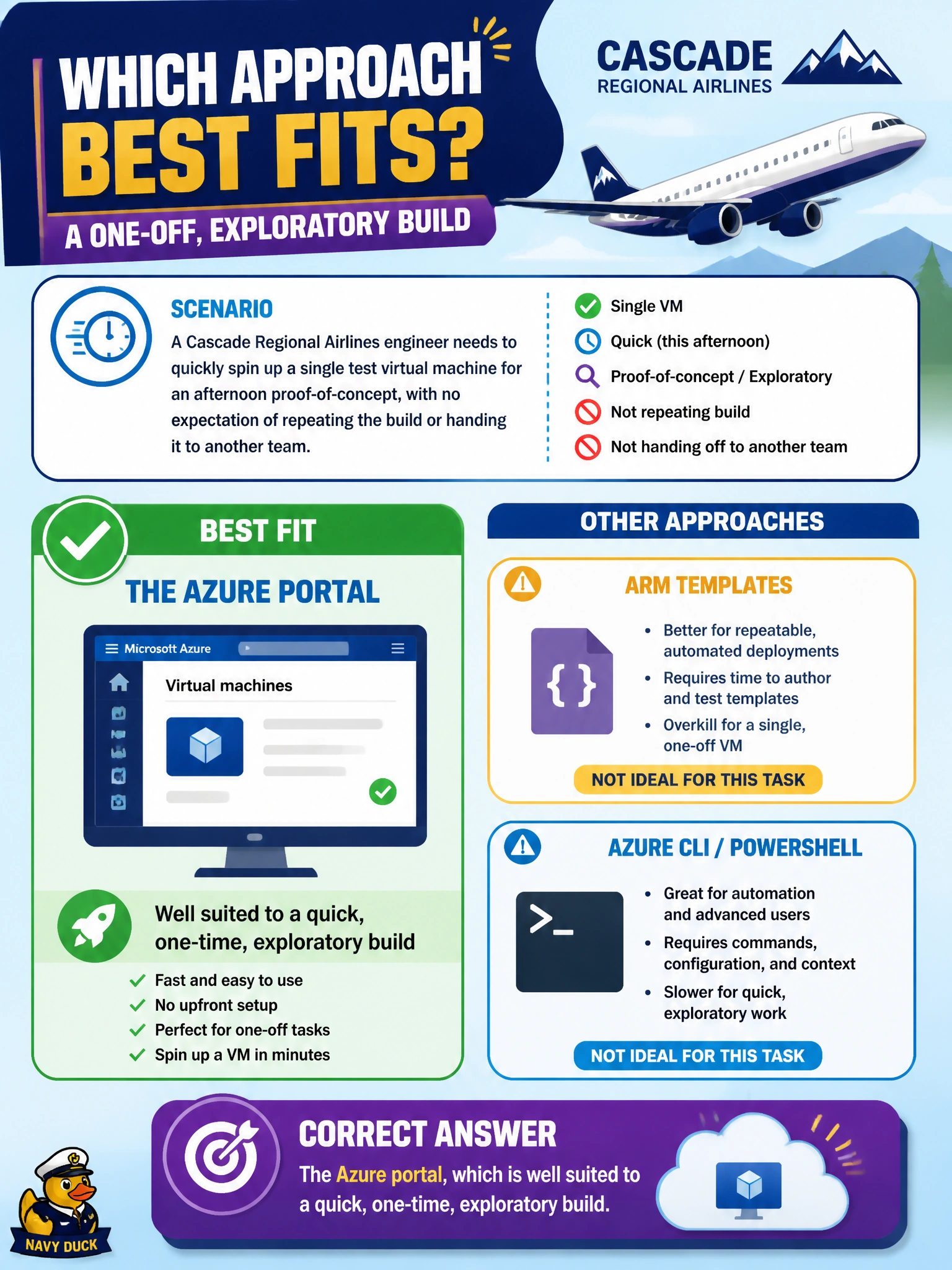
A Cascade Regional Airlines engineer needs to quickly spin up a single test virtual machine for an afternoon proof-of-concept, with no expectation of repeating the build or handing it to another team. Which approach best fits this one-off, exploratory task?
Select an answer to reveal the explanation.
Short Explanation
Not every build needs to be repeatable. For a single, disposable test VM you're building once and tearing down today, clicking through the portal is faster than authoring and validating a template you'll never use again.
Full Explanation
The portal is the right tool when a task is genuinely a one-time, exploratory action with no expectation of repetition, since it lets an engineer click through the needed settings in minutes without authoring, validating, and storing a template that will never be reused. Templates earn their cost when a build needs to be repeatable, consistent, or auditable, none of which applies to a disposable proof-of-concept VM being torn down the same day; insisting on a template here adds authoring overhead for no lasting benefit. Publishing a Bicep module to a shared registry is explicitly for content meant to be reused across future deployments, which directly contradicts the one-off nature of this task and would pollute the registry with something never meant to be called again. Subscription scope is about where a deployment targets, not about isolating a test resource from others; an ordinary resource-group-scope portal build already keeps the test VM contained to whatever resource group it is placed in. The general guideline is to reach for a template once a build becomes repeatable or shared, and to use the portal freely before that point.