
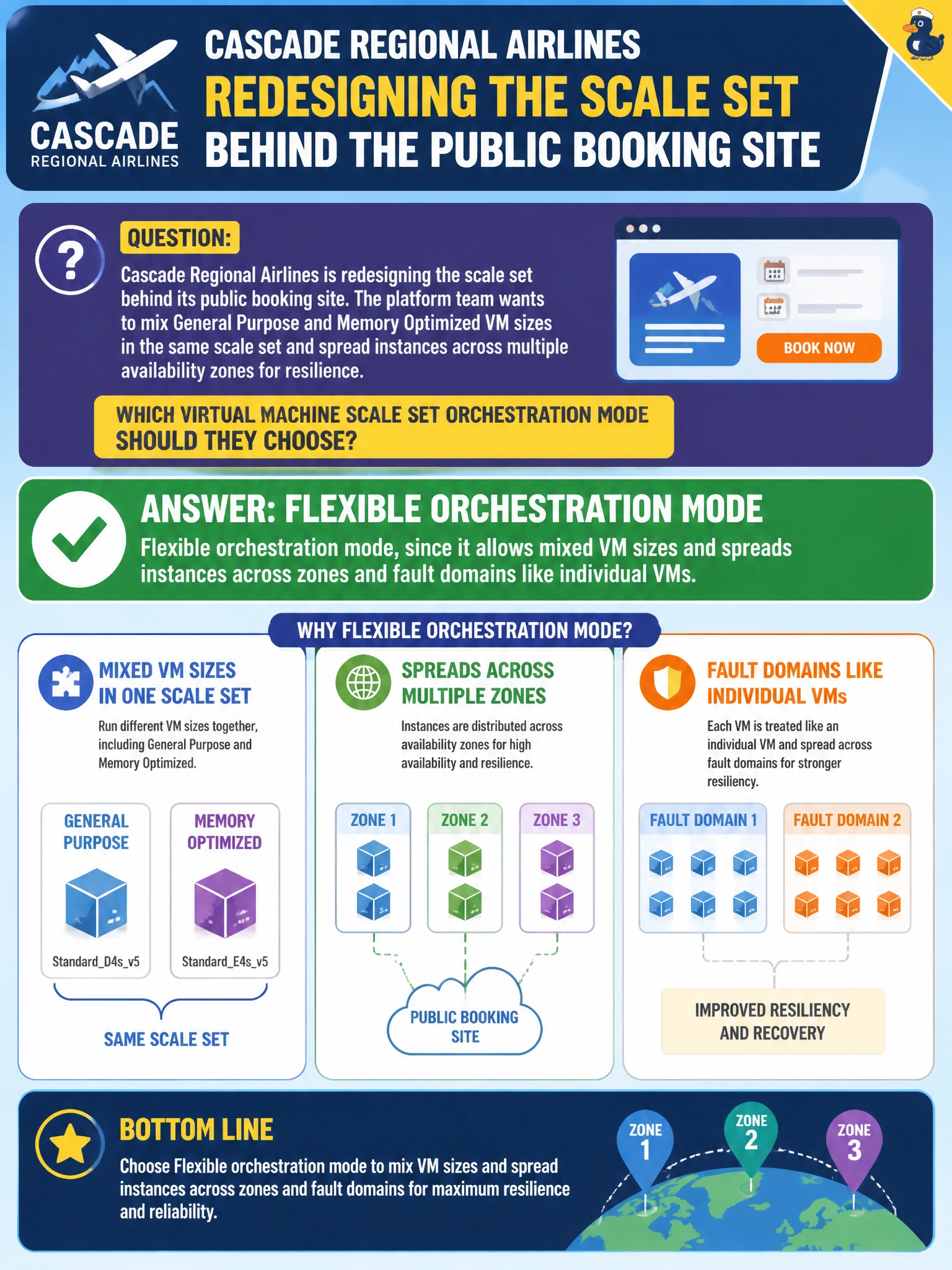
Cascade Regional Airlines is redesigning the scale set behind its public booking site. The platform team wants to mix General Purpose and Memory Optimized VM sizes in the same scale set and spread instances across multiple availability zones for resilience. Which Virtual Machine Scale Set orchestration mode should they choose?
Select an answer to reveal the explanation.
Short Explanation
Think of Uniform mode as a cookie-cutter fleet — every instance is stamped from the same template. Flexible mode drops that restriction and treats each instance more like an individually managed VM, which is exactly what you need when you want to mix VM sizes and still spread everything across zones. That flexibility is right there in the name.
Full Explanation
Flexible orchestration mode manages each instance with the same underlying VM and networking model used for standalone virtual machines, which is what unlocks mixing VM sizes within one scale set and placing instances across multiple availability zones or fault domains for higher resiliency. Uniform mode, by contrast, requires every instance to come from an identical VM configuration and is optimized for large, homogeneous, stateless workloads rather than mixed-size fleets. 'Availability set mode' is not a scale set orchestration mode at all — availability sets are a separate, older resiliency construct for individual VMs and cannot host a scale set. A proximity placement group does the opposite of what is asked here: it colocates resources to minimize network latency, which would concentrate instances rather than spread them across zones. On the exam, the signal to reach for Flexible is any requirement for mixed instance sizes or per-VM feature parity such as data disks and network interfaces attached like standalone VMs. Before deploying, confirm the target region and VM sizes are on the Flexible-mode support list, since not every SKU combination is available everywhere.