
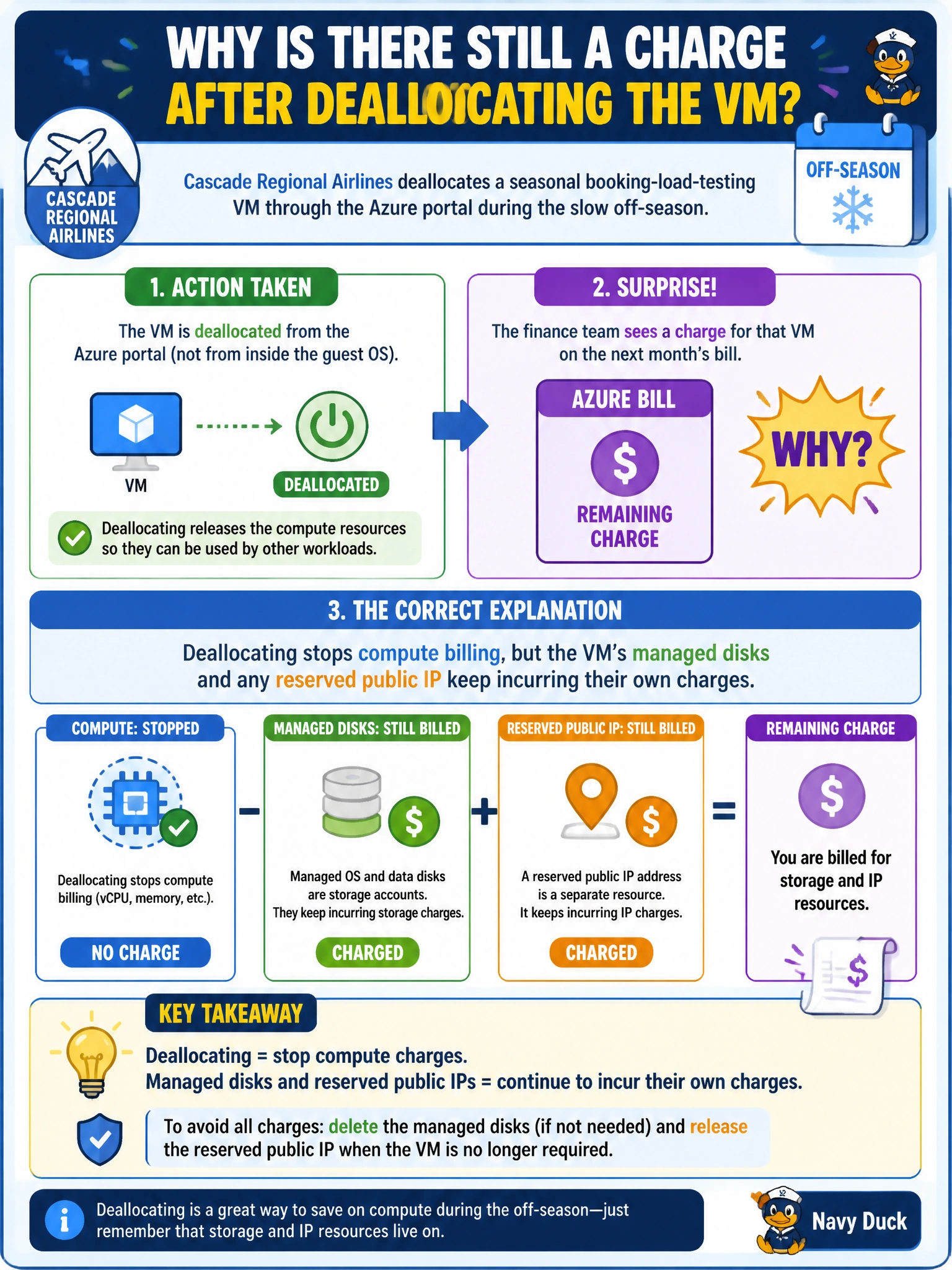
To cut costs during the airline's slow off-season, Cascade Regional Airlines properly deallocates a seasonal booking-load-testing VM through the Azure portal rather than shutting it down from inside the guest OS. The finance team is then surprised to see any charge at all for that VM the following month. What is the correct explanation for the remaining charge?
Select an answer to reveal the explanation.
Short Explanation
Deallocating stops the meter on compute, but it doesn't make the rest of the VM disappear. The managed disks are still sitting there holding data, and a reserved static public IP is still reserved, and both of those keep their own charges running. Cutting compute cost is real savings, it's just not the whole bill.
Full Explanation
Deallocating a VM releases the compute resources reserved for it and stops compute billing, which is the real, legitimate cost savings the airline achieved here. But deallocation doesn't touch the VM's managed disks — they remain provisioned, holding the OS and data, and continue to incur their own storage charges regardless of whether the VM using them is running. A reserved static public IP address, if one is attached, similarly keeps its own charge while unattached to a running VM, unlike a dynamic public IP which is released on deallocation. So a remaining charge after a proper deallocation is expected and correct, not surprising, once disk and IP costs are accounted for separately from compute. The claim that deallocation is 'only a display setting' is false — it genuinely stops the compute meter, which is the whole reason deallocation is used as a cost-saving action in the first place. The claim that a properly deallocated VM 'never generates any charges of any kind' ignores that storage and certain networking resources are billed independently of VM power state. The claim that deallocating deletes the disks is also incorrect and would be a serious misunderstanding — disks persist through deallocation specifically so the VM can be restarted later with its data intact; if disks were deleted, there would be nothing to reattach. As an operational check, review the itemized invoice to separate compute, disk, and IP charges rather than assuming any post-deallocation charge is compute.