
During disaster-recovery planning, a Cascade Regional Airlines architect reads that the airline's primary Azure region is paired with a specific secondary region, and asks what benefit that Microsoft-defined pairing itself actually provides, apart from whatever the airline configures on its own. What does the region-pair relationship provide?
Select an answer to reveal the explanation.
Short Explanation
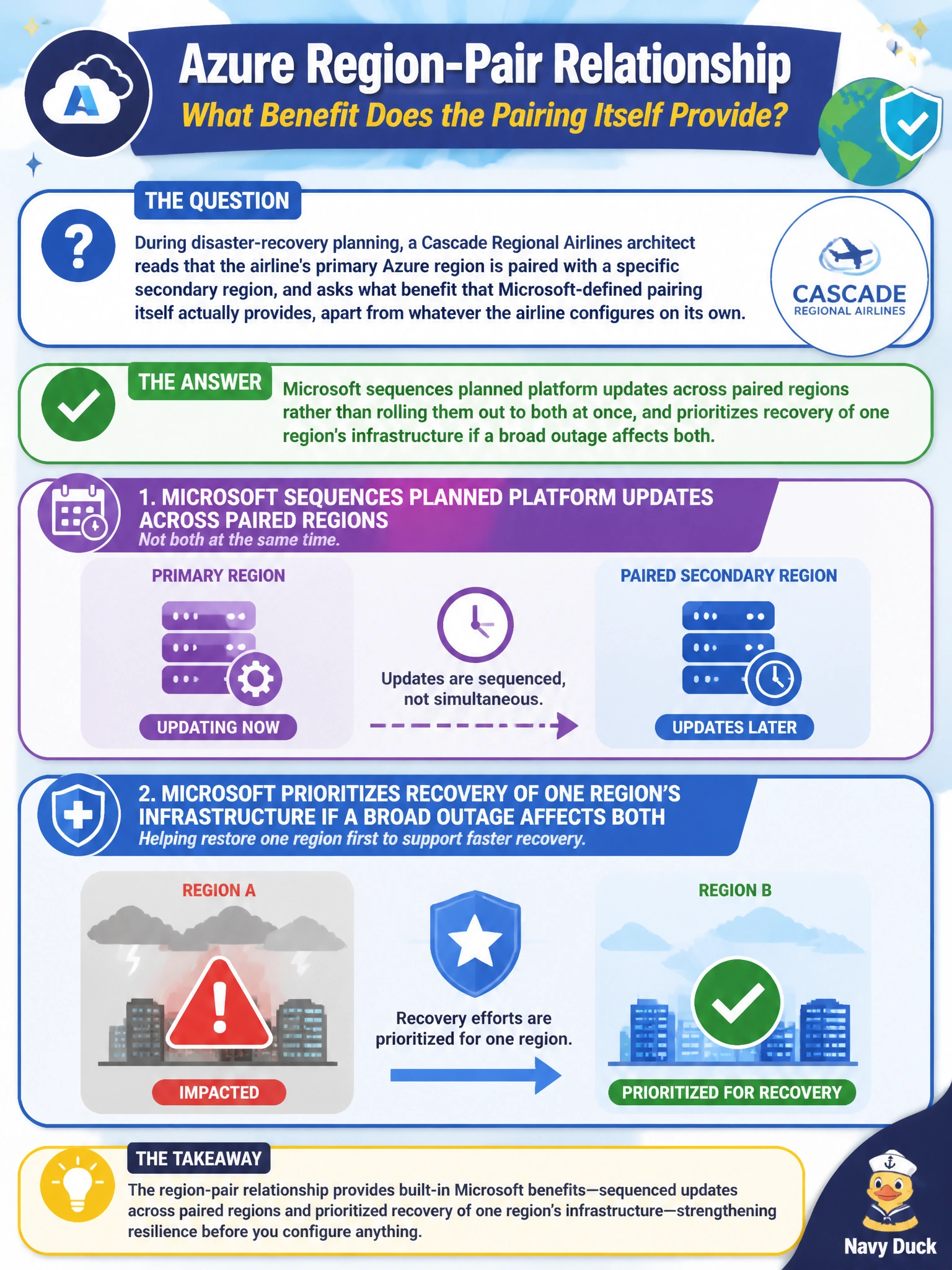
A region pair is less like an automatic safety net and more like a promise about how Microsoft rolls out changes and recovers its own infrastructure: it won't push planned updates to both halves of a pair at the same time, and if a wide outage ever hits both, one region gets prioritized for recovery. It doesn't move your data anywhere or fail over your app for you. That part is still on the airline to design.
Full Explanation
Azure region pairs are a platform-level relationship Microsoft defines between two regions in the same geography, and the benefit that comes purely from the pairing itself is operational: Microsoft staggers planned maintenance and platform updates so both regions in a pair aren't updated simultaneously, reducing the chance that a bad rollout affects both at once, and in the event of a broad outage touching multiple regions, Microsoft prioritizes restoring one region in each pair first. It does not, by itself, replicate any customer data, disks, or VMs — that requires the customer to explicitly configure something like Azure Site Recovery, storage account geo-redundancy, or application-level replication. It also provides no data-loss guarantee; recovery point objectives depend entirely on what replication and backup strategy the customer builds on top of the pairing, not on the pairing existing. Likewise, DNS failover is not automatic — routing traffic to a secondary region during an outage requires a service like Traffic Manager or Front Door configured deliberately by the customer; the region pair itself has no awareness of an application's DNS records. As an operational check, review whatever DR services (Site Recovery, geo-redundant storage, Traffic Manager) are actually configured for the workload, since the region pair alone provides none of that protection on its own.