
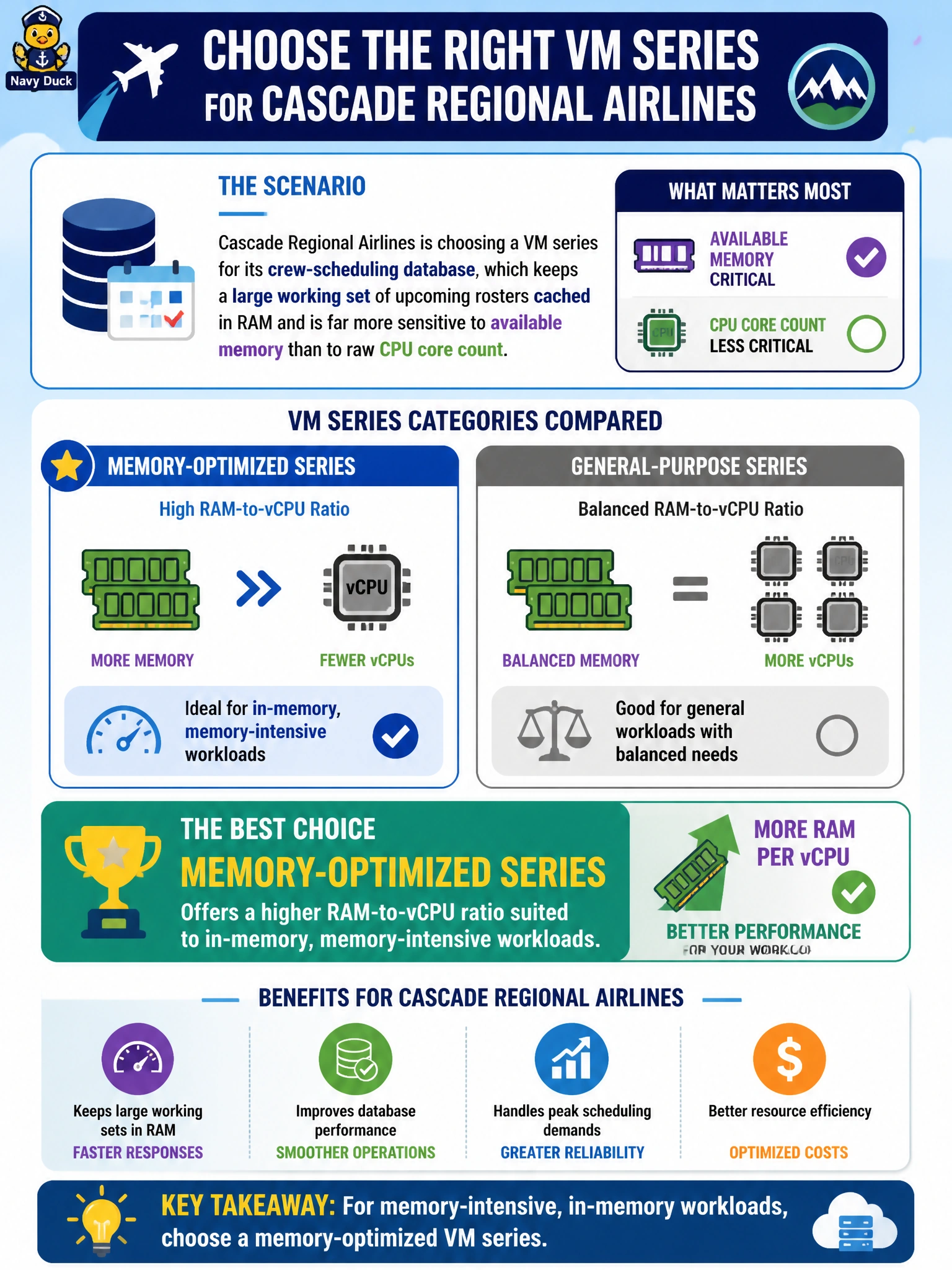
Cascade Regional Airlines is choosing a VM series for its crew-scheduling database, which keeps a large working set of upcoming rosters cached in RAM and is far more sensitive to available memory than to raw CPU core count. Which category of VM series should the team favor for this workload?
Select an answer to reveal the explanation.
Short Explanation
VM series families are grouped like tools in a toolbox — some are built with a high ratio of memory to CPU, some the reverse, some for graphics. A crew-scheduling database holding rosters in RAM cares far more about how much memory it gets per core than about raw core count. That points squarely at the memory-optimized category.
Full Explanation
Azure VM series are grouped into families by the resource ratio they're built to deliver: memory-optimized series provide a high RAM-to-vCPU ratio and are the conceptual fit for workloads like relational databases and in-memory caches that need large amounts of RAM relative to compute, exactly the crew-scheduling scenario described. A compute-optimized series instead emphasizes a high vCPU-to-RAM ratio, which suits CPU-bound work like batch processing or web front ends, not a workload whose bottleneck is memory capacity — picking it here would leave the database memory-starved relative to its CPU allocation. A storage-optimized series is built around high disk throughput and IOPS for data-intensive workloads like big data or NoSQL storage layers, which addresses a different constraint than in-memory caching. A GPU-accelerated series adds specialized hardware for graphics rendering, visualization, or massively parallel compute such as machine learning training, none of which applies to a roster database's access pattern. This is a conceptual family choice rather than a specific SKU decision, and the exact series names and their published vCPU/RAM ratios should be checked in current Azure documentation before sizing a production deployment. As an operational check, monitor the VM's memory utilization and any caching/miss ratio for the database engine to confirm the chosen family's RAM allocation is actually sufficient for the working set.