
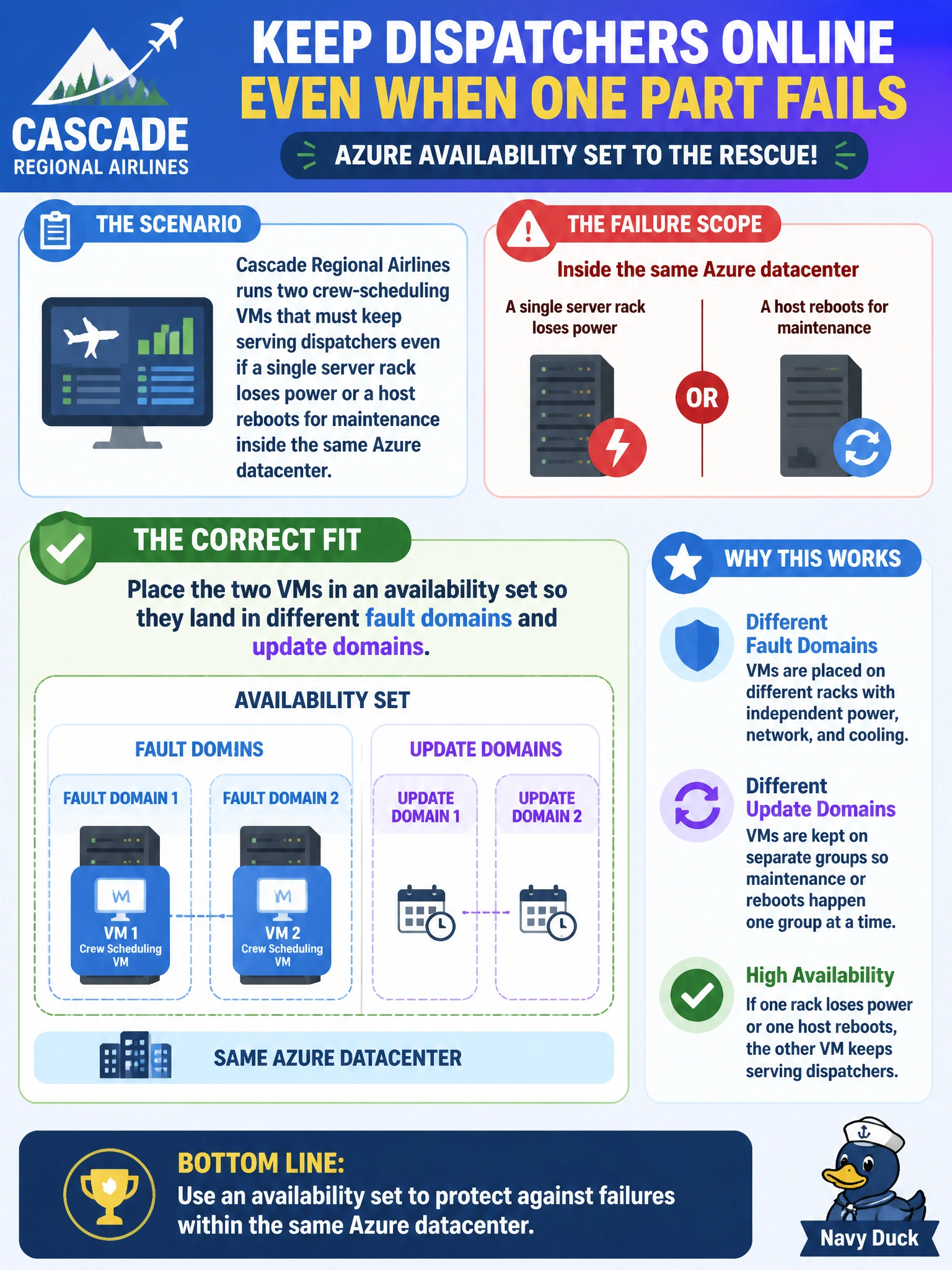
Cascade Regional Airlines runs two crew-scheduling VMs that must keep serving dispatchers even if a single server rack loses power or a host reboots for maintenance inside the same Azure datacenter. Which deployment option is the correct fit for this specific failure scope?
Select an answer to reveal the explanation.
Short Explanation
An availability set is like assigning your two backup dispatchers to different breaker panels and different shift rotations in the same building: one loses power, or one gets pulled for scheduled work, and the other keeps answering calls. Fault domains split you across separate racks and power/network paths; update domains keep planned host maintenance from touching both VMs at once. That's exactly the rack-and-maintenance scope this scenario describes.
Full Explanation
An availability set is a logical grouping within a single datacenter that spreads VMs across fault domains (separate racks, power, and network) and update domains (groups that Azure reboots one at a time during planned maintenance). That precisely matches the failure scope described: a rack losing power, or a host rebooting for maintenance, inside one datacenter. Availability zones solve a different, larger problem — they protect against the loss of an entire physically separate datacenter within a region, which is a bigger blast radius than a single rack and is not what the scenario is asking about. Two different Azure regions is bigger still; that's disaster-recovery scope for a regional outage, not routine rack or maintenance events, and it adds cross-region latency the crew-scheduling app doesn't need. Paired-region replication is also the wrong mechanism here — Microsoft uses region pairs to sequence platform updates and prioritize recovery for its own infrastructure, but it does not automatically replicate or fail over a customer's individual VMs; that requires the customer to configure something like Azure Site Recovery. As an operational check, confirm both VMs actually report different fault domain and update domain numbers after creation, not just that they were placed in the same availability set.