
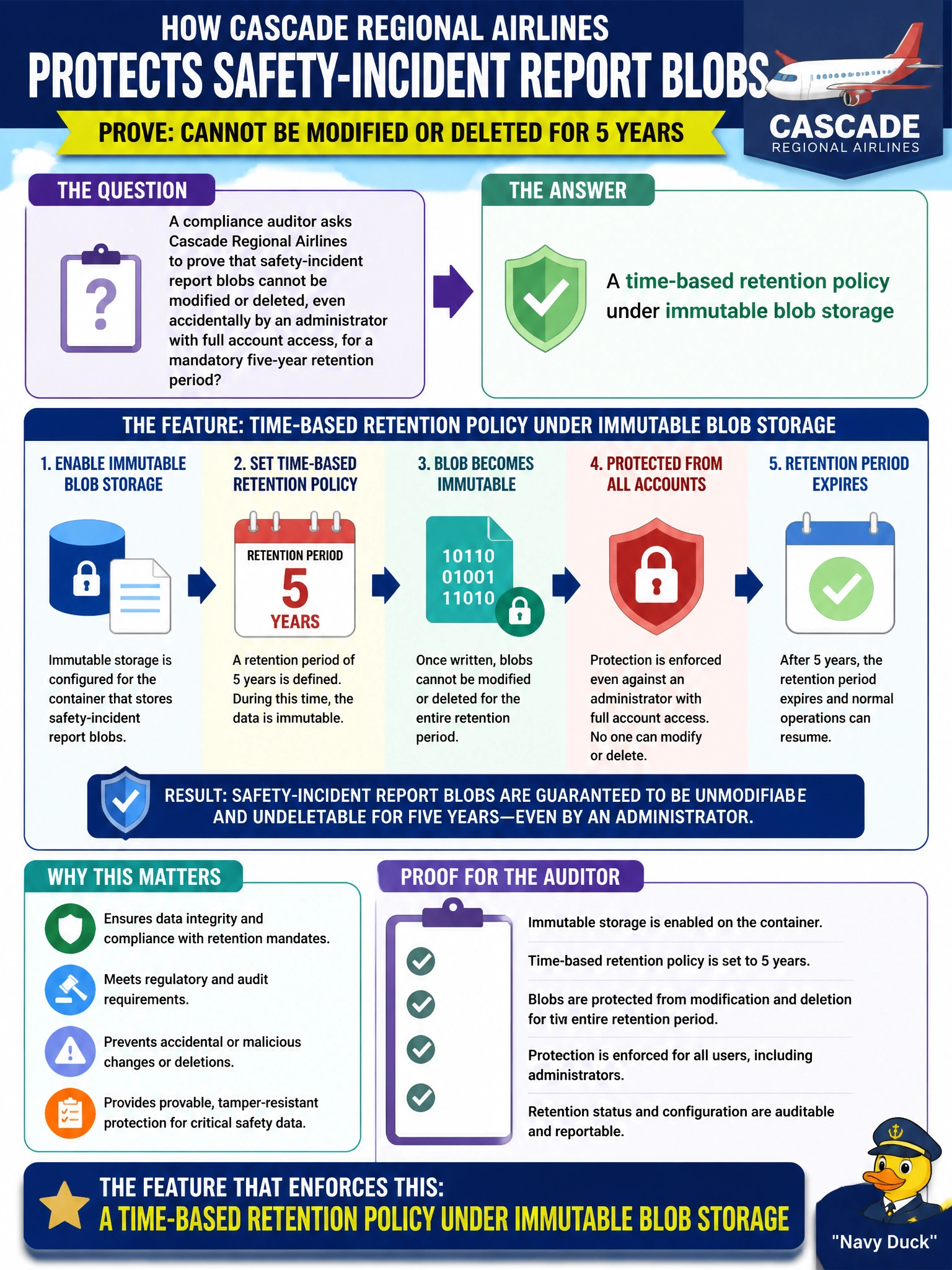
A compliance auditor asks Cascade Regional Airlines to prove that safety-incident report blobs cannot be modified or deleted, even accidentally by an administrator with full account access, for a mandatory five-year retention period? Which blob storage feature enforces this?
Select an answer to reveal the explanation.
Short Explanation
Soft delete is a safety net — it still lets someone delete or overwrite the blob, just with a recovery window. A time-based immutability policy is a lock with no key: once set, not even an owner or admin can alter or delete the blob until the retention clock runs out, which is exactly what 'cannot be modified, period' requires.
Full Explanation
Immutable blob storage with a time-based retention policy enforces write-once-read-many, or WORM, behavior at the storage-service level: once a policy is locked, the blobs it covers cannot be modified or deleted by any identity, including the storage account owner, until the retention interval elapses, which directly satisfies a mandatory five-year, tamper-proof retention requirement. Soft delete is a recovery mechanism, not a prevention mechanism — it still allows delete and overwrite operations to succeed, simply preserving a recoverable version for the configured window, so a determined or compromised administrator could still trigger changes that must later be manually reverted. Blob versioning likewise permits ongoing overwrites and captures prior versions as a history, but nothing stops the current version from being altered, and without a retention policy old versions themselves are not protected from purge. A storage account firewall rule controls network-level access to the account by source IP or virtual network, which is an access-control measure, not a content-immutability guarantee, and an authorized administrator inside the allowed network could still delete data. A concrete operational check: attempt a delete operation against a locked immutable blob from an account-owner identity in a test container and confirm the service returns an authorization failure specifically due to the retention policy.