
A DevOps engineer configuring backups for Cascade Regional Airlines' maintenance photo archive account needs the cheapest redundancy level that still protects against the loss of a single disk or server rack inside one datacenter? Which option meets that minimum bar?
Select an answer to reveal the explanation.
Short Explanation
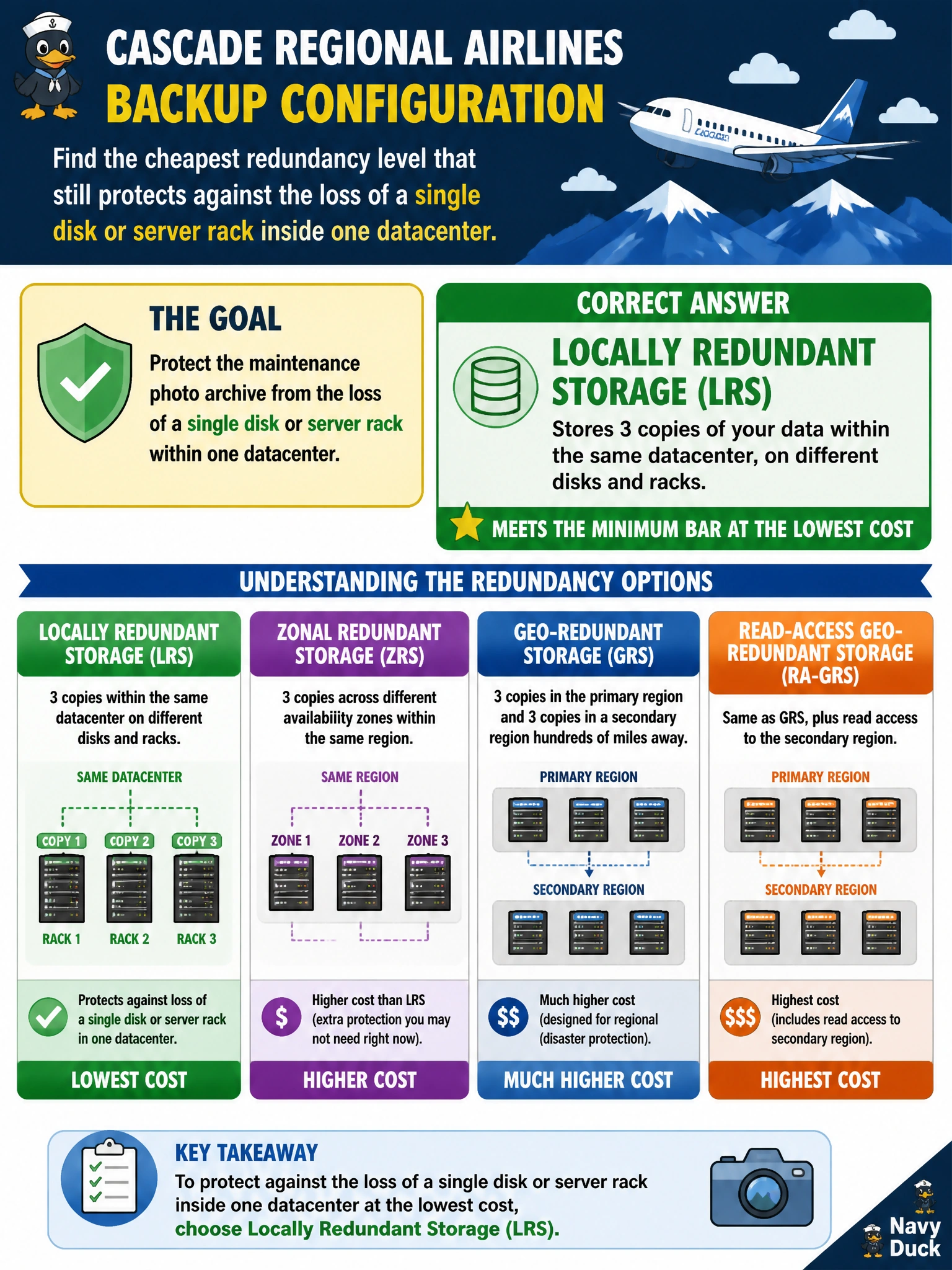
LRS is the entry-level option: three copies of your data, all within one datacenter, spread across different physical hardware so a single disk or rack failure won't take your photos with it. It's the cheapest tier that still protects against that specific, narrow failure — anything fancier is solving a bigger problem than the one described.
Full Explanation
Locally redundant storage maintains three synchronous copies of every write within a single datacenter, distributed across separate fault domains such as different racks with independent power and networking, so it protects against the failure of an individual disk, node, or rack while remaining the lowest-cost redundancy option Azure Storage offers. Zone-redundant storage solves a larger problem — datacenter-level failure — by spreading copies across separate physical datacenters, which is more protection and more cost than the stated requirement calls for. Geo-redundant storage goes further still, adding cross-region replication, which addresses a regional disaster scenario entirely outside the scope of a single-rack failure and costs correspondingly more. Read-access geo-zone-redundant storage combines zonal and geo protection plus a readable secondary, making it the most expensive and most robust of the four, again more than what a single-disk-or-rack failure requirement demands. A concrete check: review the account's monthly cost estimate for each redundancy option in the Azure pricing calculator before committing, since over-provisioning redundancy for a low-stakes archive is a common and avoidable cost mistake.