
Cascade Regional Airlines' compliance team requires that crew document scans survive the simultaneous loss of an entire Azure datacenter within the primary region, but a full cross-region failover is not required for this particular workload? Which redundancy option satisfies this requirement at the lowest cost?
Select an answer to reveal the explanation.
Short Explanation
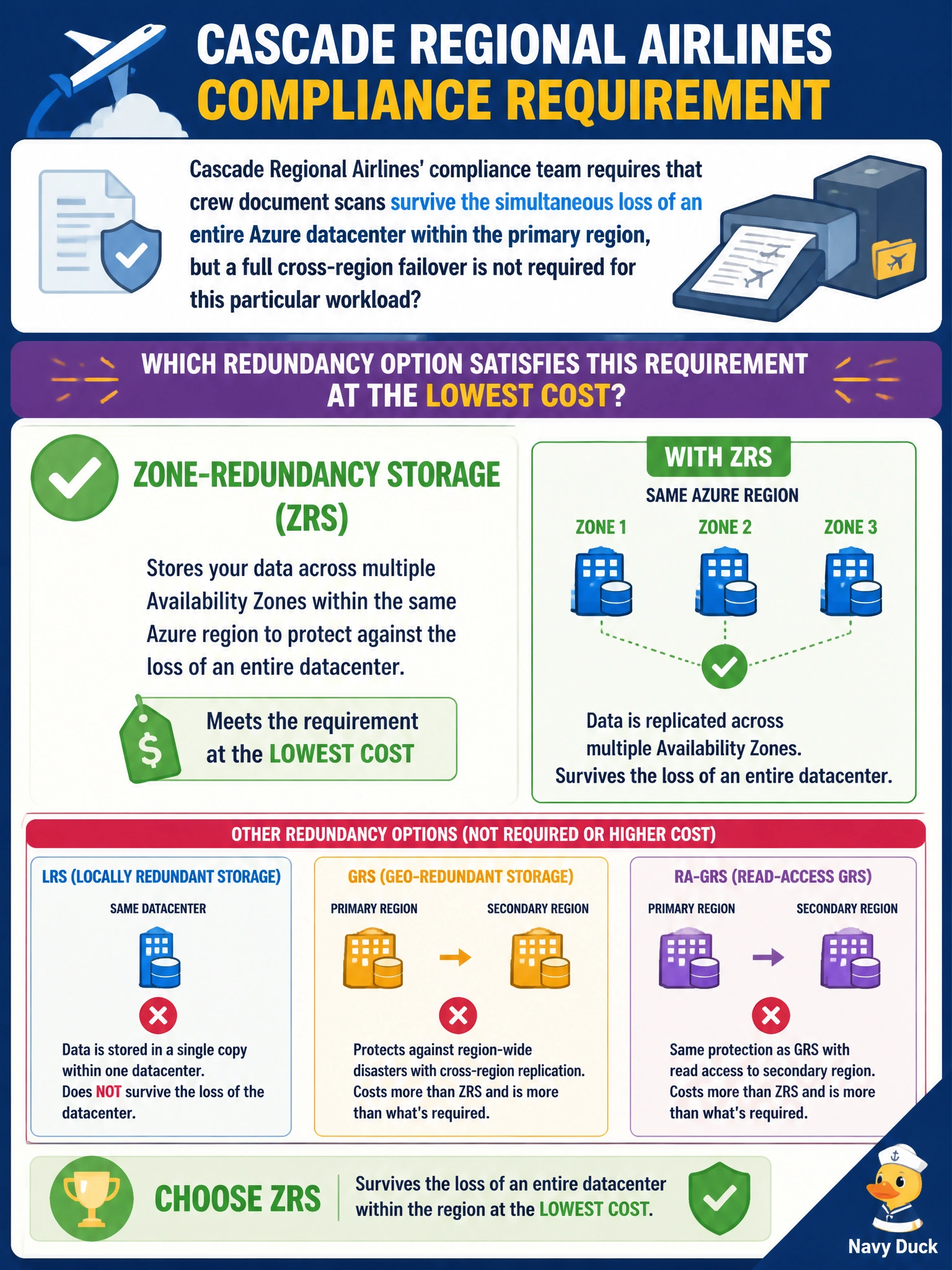
ZRS spreads three synchronous copies of your data across separate physical datacenters within the same region, so losing one building doesn't cost you a byte. Since the requirement stops at datacenter-level protection and doesn't ask for cross-region failover, ZRS covers exactly the need without paying for geo-replication nobody asked for.
Full Explanation
Zone-redundant storage synchronously replicates data across three availability zones within a single region, each zone being one or more physically separate datacenters with independent power, cooling, and networking, so the loss of an entire datacenter does not cause data loss or an availability gap for reads and writes. Locally redundant storage keeps all three copies within a single datacenter, so a datacenter-wide failure — fire, power loss, or a major hardware event — could make all copies unavailable at once, failing the stated requirement outright. Geo-zone-redundant storage adds asynchronous replication to a second region on top of zone redundancy, which does satisfy the datacenter-loss requirement but at higher cost because it also pays for cross-region replication that this workload does not need. Read-access geo-zone-redundant storage goes further still, adding a readable secondary endpoint in the second region, making it the most expensive of the four options here for a requirement that never asked for regional failover. A concrete check: confirm in the Azure portal that the target region actually offers availability zones before selecting ZRS, since not every region supports zonal deployments and the option would be unavailable there.