
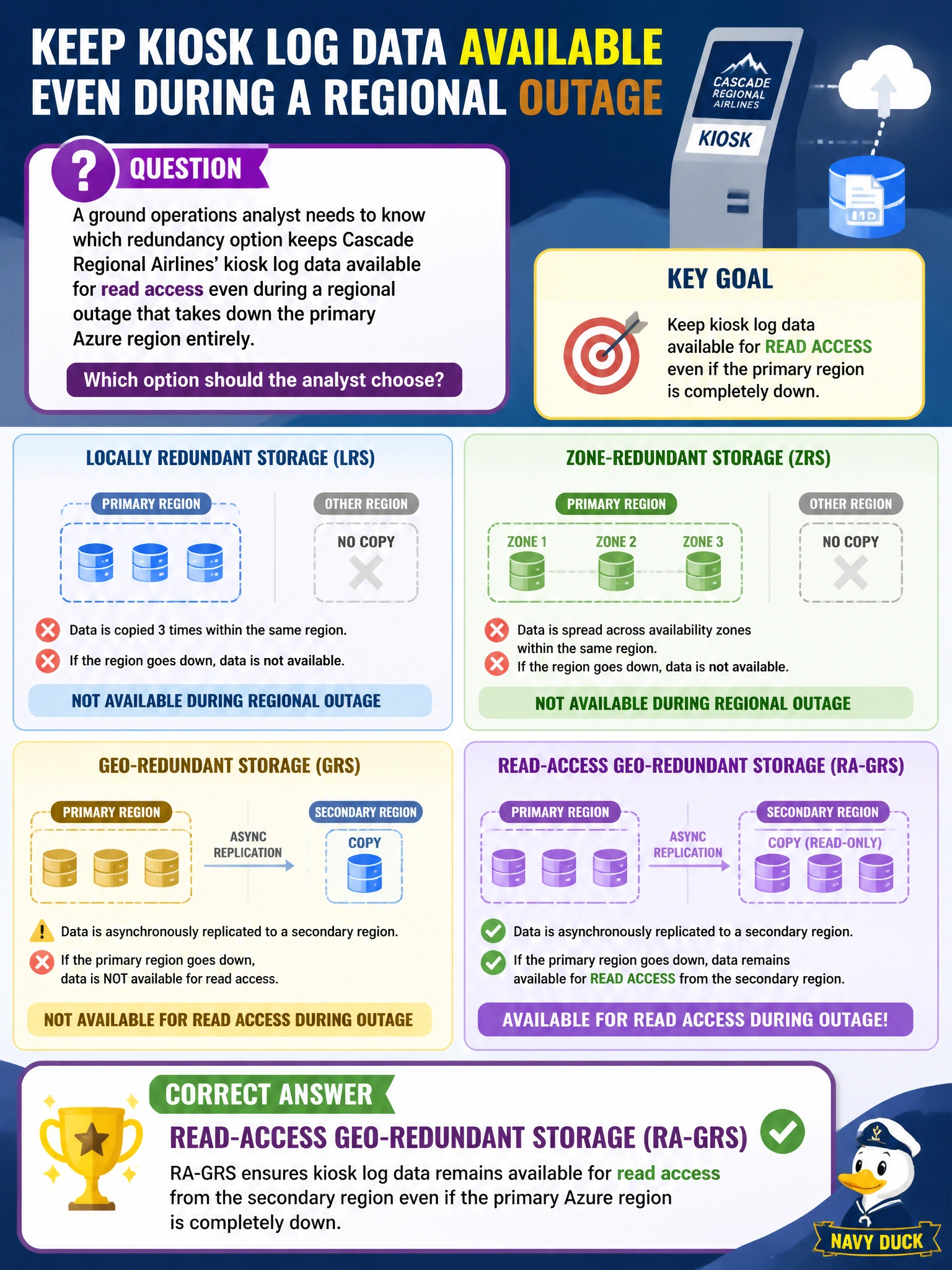
A ground operations analyst needs to know which redundancy option keeps Cascade Regional Airlines' kiosk log data available for read access even during a regional outage that takes down the primary Azure region entirely? Which option should the analyst choose?
Select an answer to reveal the explanation.
Short Explanation
LRS and ZRS both keep your copies in one region, so a full regional outage takes them offline with everything else. RA-GRS is the only one of the bunch that hands you a secondary, readable copy in a completely different region, so kiosk logs stay reachable even if the primary region goes dark.
Full Explanation
Read-access geo-redundant storage replicates data synchronously within the primary region and asynchronously to a secondary, geographically distant region, and critically it exposes that secondary copy as readable at all times, even while the primary region is healthy — and especially useful when the primary region suffers an outage. Locally redundant storage keeps three synchronous copies but all within a single datacenter, so it offers no protection against a regional-scale failure at all. Zone-redundant storage spreads copies across availability zones within one region, protecting against a datacenter-level failure, but a true regional outage affecting all zones still leaves ZRS-only data unavailable. Plain geo-redundant storage without read access does replicate to the secondary region, but that secondary copy is not accessible for reads until Microsoft initiates an account failover, so ordinary read requests would fail during the outage window rather than transparently succeeding. A concrete operational check: verify the secondary read endpoint (the -secondary suffixed URI) resolves and returns data before an incident occurs, since teams sometimes forget to actually point failover tooling or read logic at that endpoint ahead of time.