
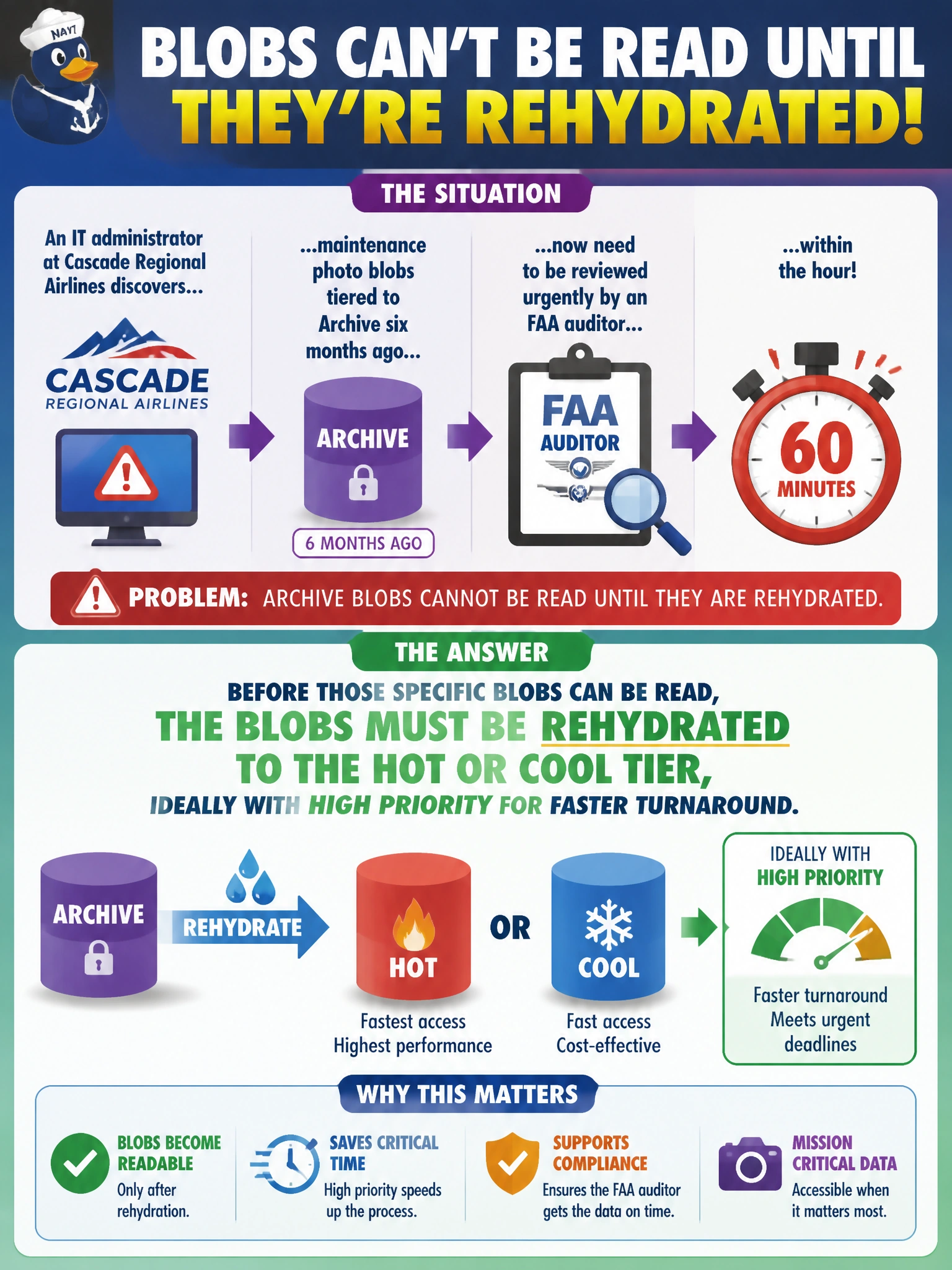
An IT administrator at Cascade Regional Airlines discovers that maintenance photo blobs tiered to Archive six months ago now need to be reviewed urgently by an FAA auditor within the hour? What must happen before those specific blobs can be read?
Select an answer to reveal the explanation.
Short Explanation
Archive is like a document sent to deep offline storage — it has to be pulled back out and re-shelved before anyone can read it, and that process is called rehydration. Choosing High priority rehydration trades extra cost for a turnaround that can fit inside an hour instead of the standard multi-hour wait.
Full Explanation
Blobs in the Archive tier are stored offline, meaning read requests fail until the blob is rehydrated, which is done by changing its access tier to Hot or Cool, or by copying it to a blob in an online tier. Rehydration priority can be set to Standard, typically completing within roughly fifteen hours, or High priority, which aims to complete in under an hour for blobs under a certain size, making High priority the option that fits an urgent one-hour audit deadline. The claim that Archive blobs remain immediately readable is simply false and misunderstands what makes Archive the cheapest tier: the low storage cost is a direct trade for that offline state. Converting performance tier from Standard to Premium is unrelated and unsupported after account creation in this direction; performance tier is fixed at creation and does not affect the rehydration mechanic. Deleting a lifecycle management policy stops future automatic tiering actions but does nothing to bring an already-Archived blob back online. A concrete operational check: query the blob's x-ms-rehydrate-priority and x-ms-archive-status properties to confirm rehydration has been requested and is in progress, since a rehydration request that silently failed to trigger would blow the audit deadline.