
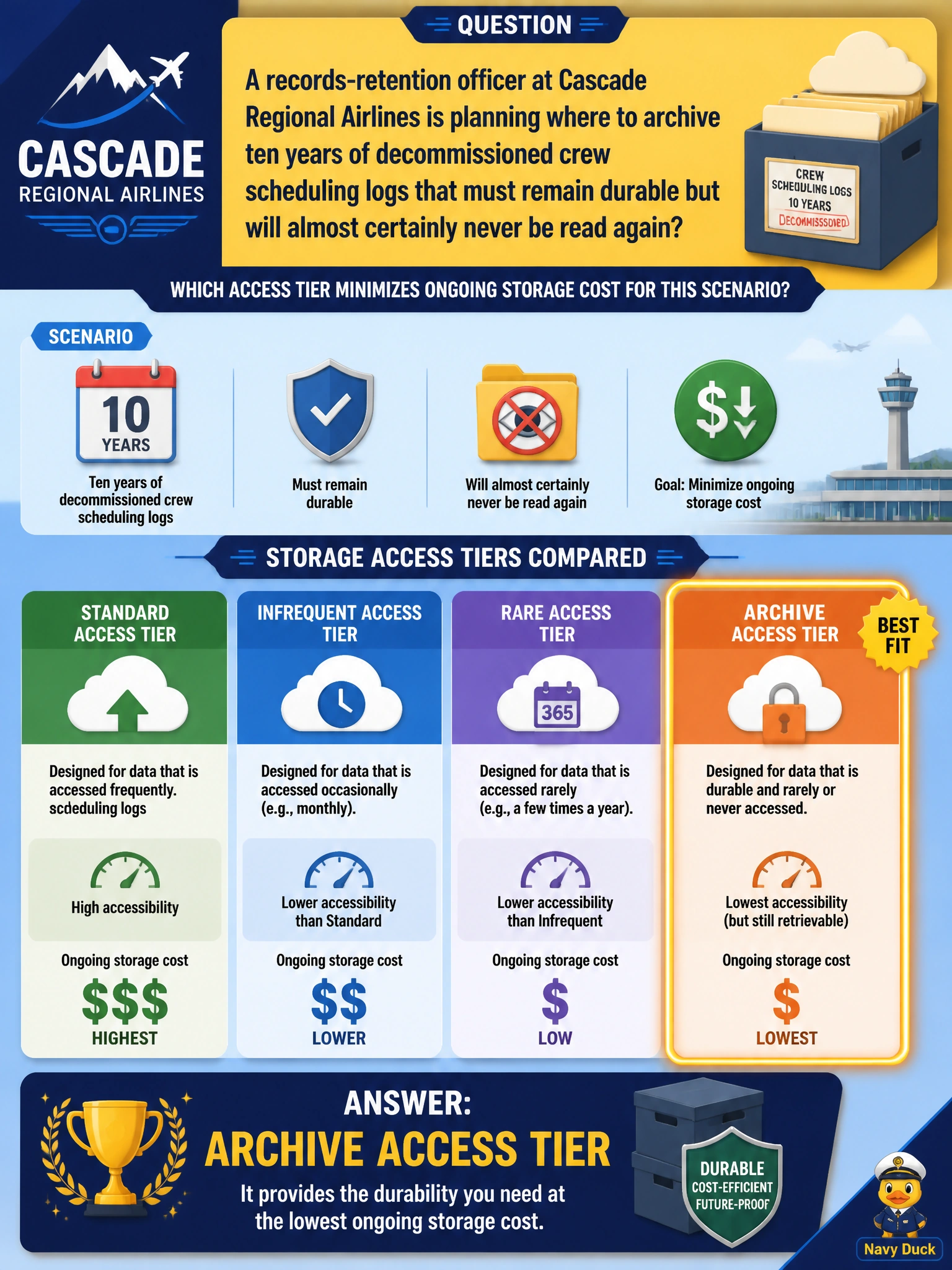
A records-retention officer at Cascade Regional Airlines is planning where to archive ten years of decommissioned crew scheduling logs that must remain durable but will almost certainly never be read again? Which access tier minimizes ongoing storage cost for this scenario?
Select an answer to reveal the explanation.
Short Explanation
Picture a deep storage vault versus a filing cabinet on your desk: Archive is that vault, built for data you almost never touch and priced accordingly with the lowest storage cost of any tier. Retrieval takes hours instead of milliseconds, but for ten-year-old logs nobody expects to open today, that trade-off is exactly right.
Full Explanation
The Archive access tier offers the lowest per-gigabyte storage cost among blob access tiers precisely because it assumes data is rarely if ever accessed, making it the correct fit for decommissioned crew scheduling logs kept only to satisfy a retention obligation. Hot is optimized for data accessed frequently and carries the highest storage cost of the tiers, which is the opposite of what this scenario calls for. Cool is not the account default in the way the option implies, and even where it is a reasonable default it targets infrequently but still periodically accessed data, not decade-old records nobody expects to open; it also carries higher storage cost than Archive. Premium performance without tiering is a different axis entirely — Premium accounts do not support Hot/Cool/Archive tiering and are priced for high-throughput low-latency access, the exact opposite cost profile of a long-term archive. Note that blobs moved to Archive are offline and must be rehydrated to Hot or Cool before they can be read, and rehydration can take several hours depending on priority. A concrete check: set a lifecycle management policy that automatically tiers blobs to Archive after a defined age threshold rather than relying on manual tiering, and confirm the retrieval SLA is acceptable to the retention officer before finalizing the policy.