
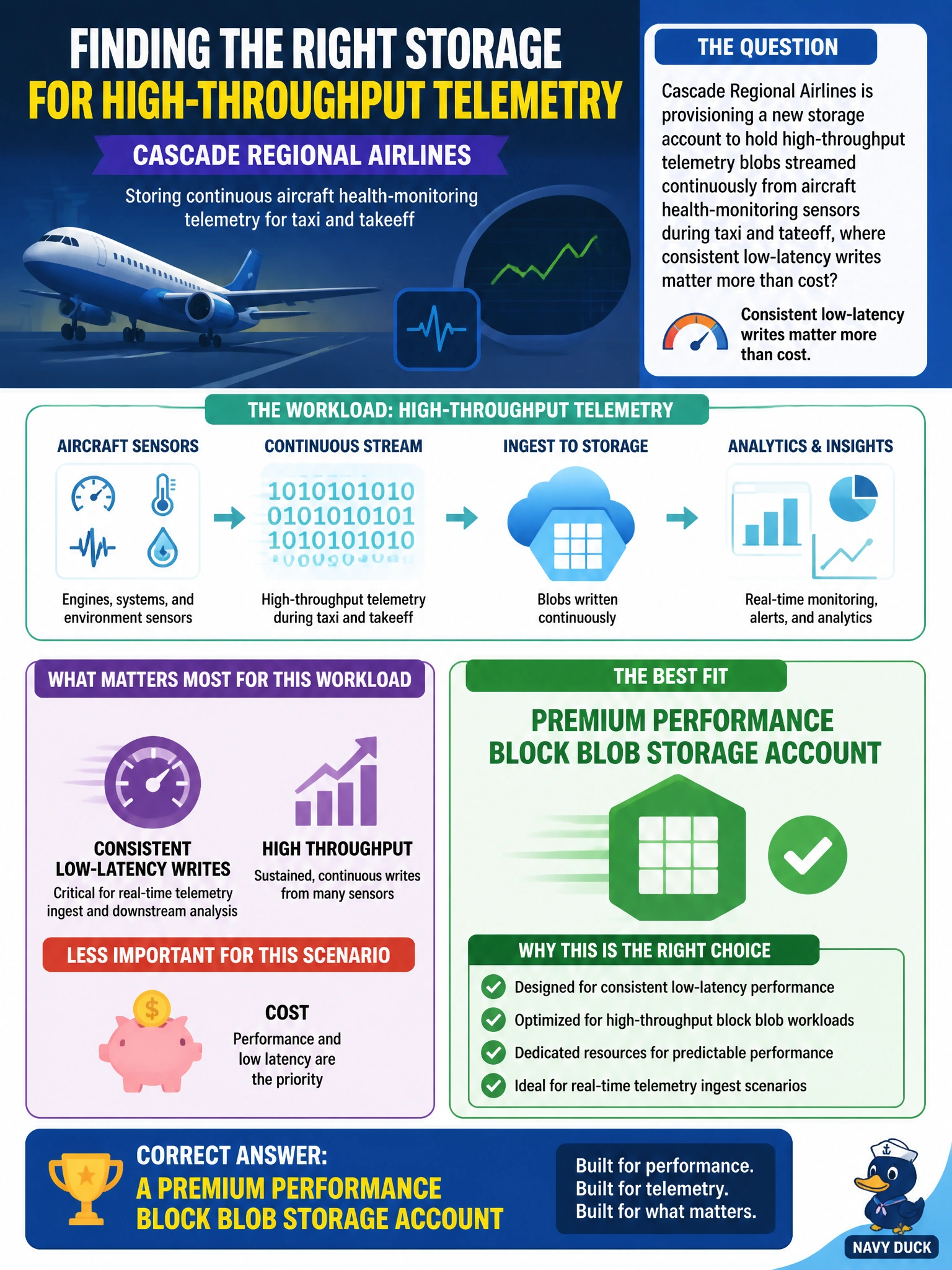
Cascade Regional Airlines is provisioning a new storage account to hold high-throughput telemetry blobs streamed continuously from aircraft health-monitoring sensors during taxi and takeoff, where consistent low-latency writes matter more than cost? Which storage account configuration best fits this workload?
Select an answer to reveal the explanation.
Short Explanation
Think of Premium block blob storage like putting the workload on an SSD instead of a spinning disk: it trades a bit of cost for consistent, low-latency reads and writes. Sensor telemetry streaming in continuously during taxi and takeoff needs that predictability, not the cheaper-but-slower behavior of a Standard tier.
Full Explanation
Premium block blob storage accounts back blobs with high-performance SSD-based hardware and are purpose-built for workloads that need consistently low latency and high transaction rates, which matches continuous telemetry ingestion from health-monitoring sensors. Standard performance accounts, whether general-purpose v2 or v1, store data on magnetic-media-backed infrastructure that optimizes for capacity and cost rather than latency consistency, so a Cool or Hot access tier on a Standard account still leaves write latency more variable than the workload wants. General-purpose v1 is additionally a legacy account type lacking the access-tier and lifecycle features of v2, so it fails on multiple fronts. A Premium file share is the wrong service entirely: it serves SMB/NFS file shares for shared file-system access, not block blob ingestion of streaming telemetry objects. Note that Premium block blob accounts only support the Hot tier concept implicitly through their performance characteristics — they do not support Cool or Archive tiering, so this choice is reserved for workloads that genuinely need the latency profile. A concrete check: review the account's transaction latency metrics in Azure Monitor and compare p99 write latency against the mission requirement before committing to Premium pricing.