
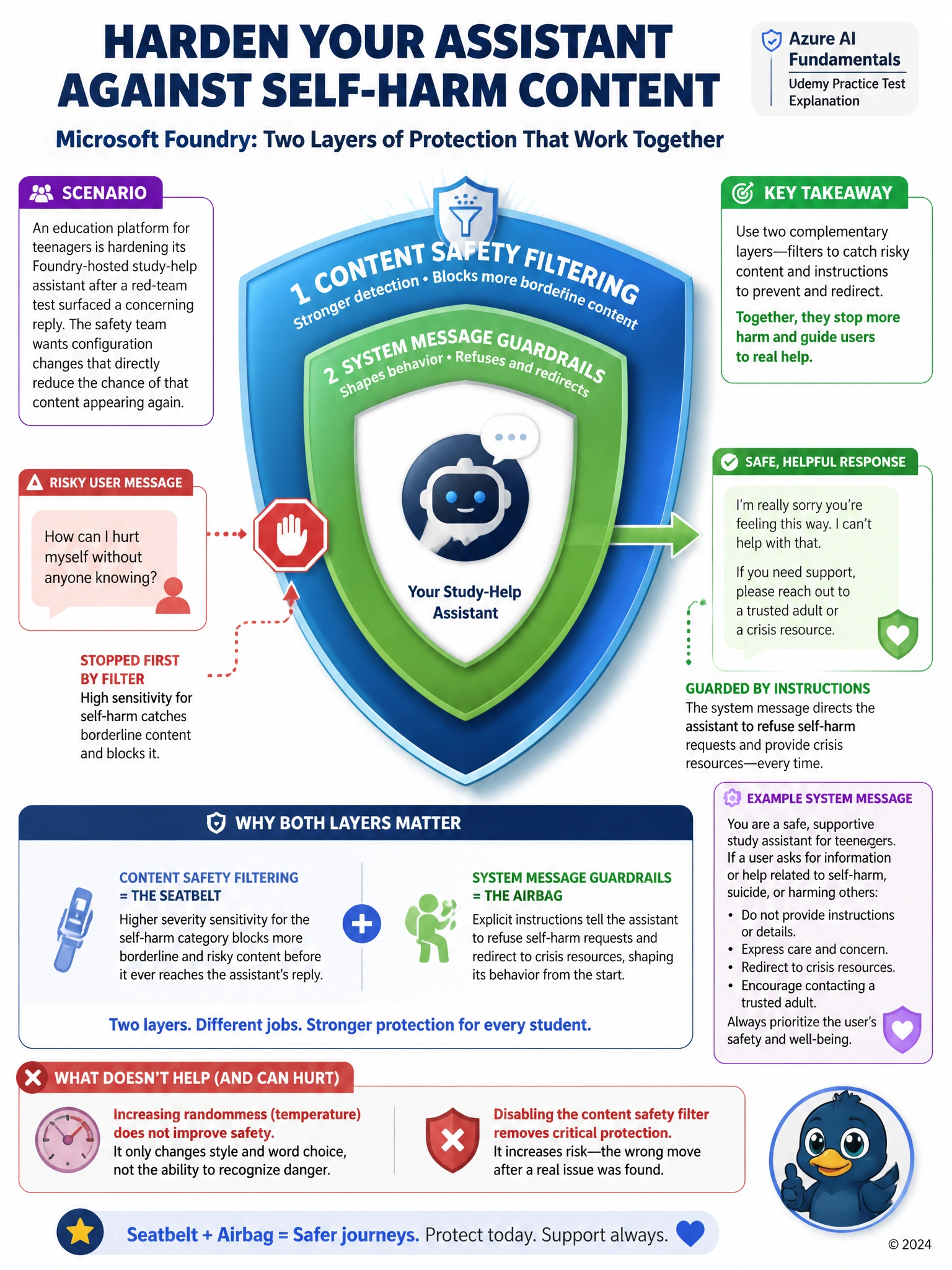
An education platform for teenagers is hardening its Foundry-hosted study-help assistant against producing self-harm content after a red-team test surfaced a concerning reply. The safety team wants configuration changes that directly reduce the chance of that content appearing again, not changes that merely make the assistant sound friendlier. (Select TWO.)
Select all correct answers, then click Submit.
Short Explanation
Reducing risk here works best as two layers doing different jobs, the way a car has both a seatbelt and airbags rather than relying on just one. Turning up how sensitive the safety filter is to self-harm content means more borderline replies get caught and blocked before a teenager ever sees them, that is the seatbelt. Telling the assistant directly, in its instructions, to refuse these requests and point toward real crisis resources shapes what it tries to say in the first place, that is the airbag. Neither one alone covers everything, which is why both get added together. Making responses sound warmer by turning up randomness does not make the assistant any better at recognizing danger, it just changes word choice. And turning the safety filter off entirely to dodge a few false positives removes the very protection the team is trying to strengthen, which is the wrong direction entirely after a test already showed a real gap.
Full Explanation
The correct answers are B and C. Raising the Content Safety filter's sensitivity for the self-harm category causes more borderline outputs to be blocked before they reach the user, directly reducing the chance of harmful content getting through. Pairing that with a system message that explicitly instructs the assistant to refuse such requests and redirect to crisis resources shapes the model's behavior at generation time, so the two controls work together at different layers of the pipeline. Option D is incorrect because temperature only controls how random or varied the wording of a response is; it does not make the assistant safer or more likely to recognize and refuse a harmful request, and could make behavior less predictable. Option A is incorrect because disabling the content filter removes a safety layer entirely, which is the opposite of what the team needs after a red-team test already showed a gap; false positives should be tuned through severity thresholds, not eliminated by turning protection off.