
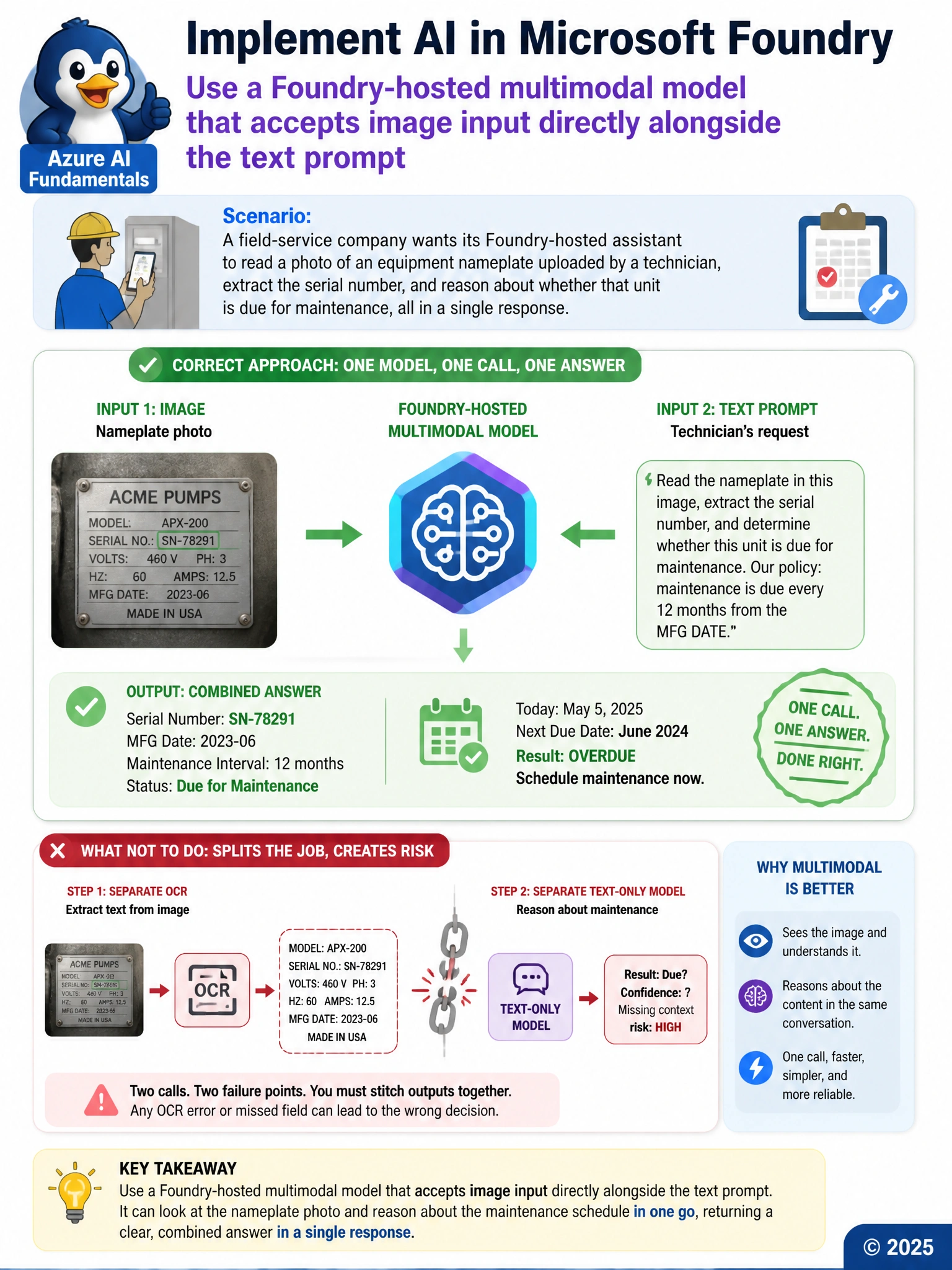
A field-service company wants its Foundry-hosted assistant to read a photo of an equipment nameplate uploaded by a technician, extract the serial number, and reason about whether that unit is due for maintenance, all in a single response. Which approach best fits this need?
Select an answer to reveal the explanation.
Short Explanation
Some tasks need a person who can both look at a picture and think about what it means, not two separate people who never talk to each other. A multimodal model does exactly that: it looks at the nameplate photo and reasons about the maintenance schedule in the same breath, one call, one coherent answer. Handing a text-only model a file path is like handing someone an envelope and asking them to describe what is inside without opening it, the words on the envelope tell it nothing about the photo itself. Running a separate text-recognition step and then bolting its output onto a completely different request splits one simple job into two fragile ones that have to be stitched together by hand. And while cropping a photo tightly before uploading is a reasonable habit, it does not by itself guarantee the extraction will be accurate, since lighting, angle, and image quality all still matter, and none of that replaces using a model that can actually see the image.
Full Explanation
The correct answer is A. A Foundry-hosted multimodal model can accept the nameplate photo directly as image input alongside the text prompt, letting it read the serial number and reason about the maintenance schedule together in one call, which matches exactly what the scenario requires. Option B is incorrect because a text-only model cannot interpret pixel data from a file path string; a path is just text and gives the model no visual information to read. Option C is incorrect because manually running a separate OCR step and stitching its output into a second unrelated request adds unnecessary integration complexity and a second point of failure when a single multimodal call already handles both extraction and reasoning together. Option D is incorrect because cropping alone does not guarantee accurate extraction; image quality, lighting, and angle also affect legibility, and cropping is a helpful practice, not a substitute for using a model actually capable of reading images.