
A SaaS company's Foundry-hosted model deployment starts returning 429 rate-limit errors during a marketing campaign that drove a sudden spike in chatbot traffic. The model's output quality was fine before the spike; the requests are simply being throttled. What is the most direct way to address this?
Select an answer to reveal the explanation.
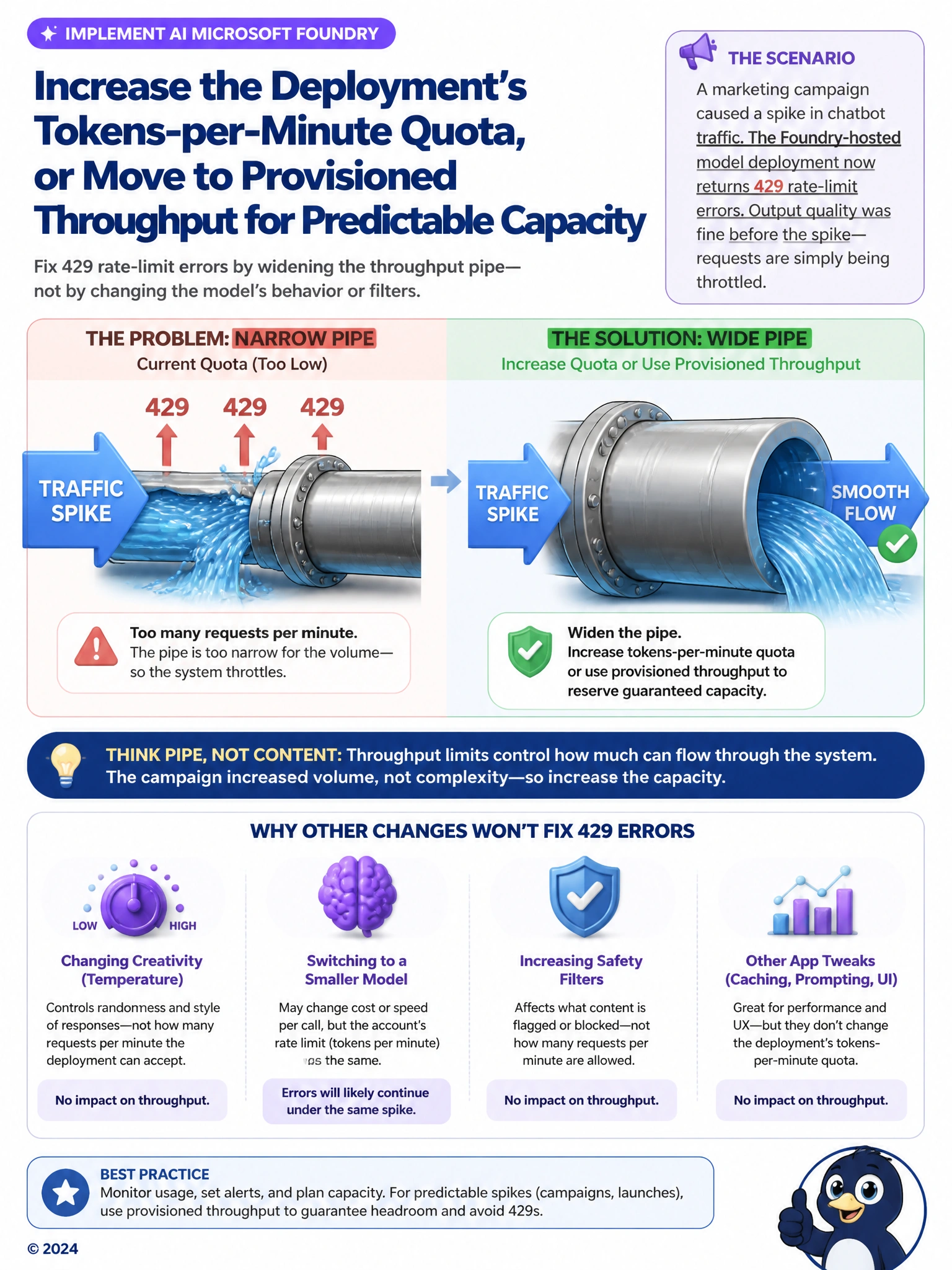
Short Explanation
A 429 error is the system saying the pipe is too narrow for how much water is trying to flow through it right now, not that anything is wrong with the water itself. The campaign drove a burst of traffic, and the deployment simply was not sized to handle that many requests per minute, so the fix has to widen the pipe: raise the tokens-per-minute allowance, or move to a provisioned throughput deployment that reserves guaranteed capacity for exactly this kind of predictable spike. Fiddling with how creative or random the responses are does not touch throughput at all, so it will not stop the throttling. Swapping to a smaller model might make individual calls a bit cheaper or faster, but the account is still capped at the same rate limit, so the errors would likely keep showing up under the same spike. And turning up safety filtering only changes what content gets flagged, not how many requests per minute the deployment is allowed to accept.
Full Explanation
The correct answer is C. A 429 error indicates the deployment's request or token rate has exceeded its configured limit, so the direct fix is to raise the tokens-per-minute quota for the current deployment or move to provisioned throughput, which reserves dedicated capacity sized for the expected spike. Both approaches address the actual bottleneck, which is available throughput, not model behavior. Option A is incorrect because temperature controls the randomness of generated text and has no effect on throughput, request rate limits, or generation speed. Option B is incorrect because swapping to a smaller model may reduce per-call cost but does nothing on its own to raise the account or deployment's rate limit, so 429 errors would likely continue during the same traffic spike. Option D is incorrect because content filtering strictness governs safety moderation of request and response content, not how many requests per minute the deployment is permitted to process, so it would not resolve throttling.