
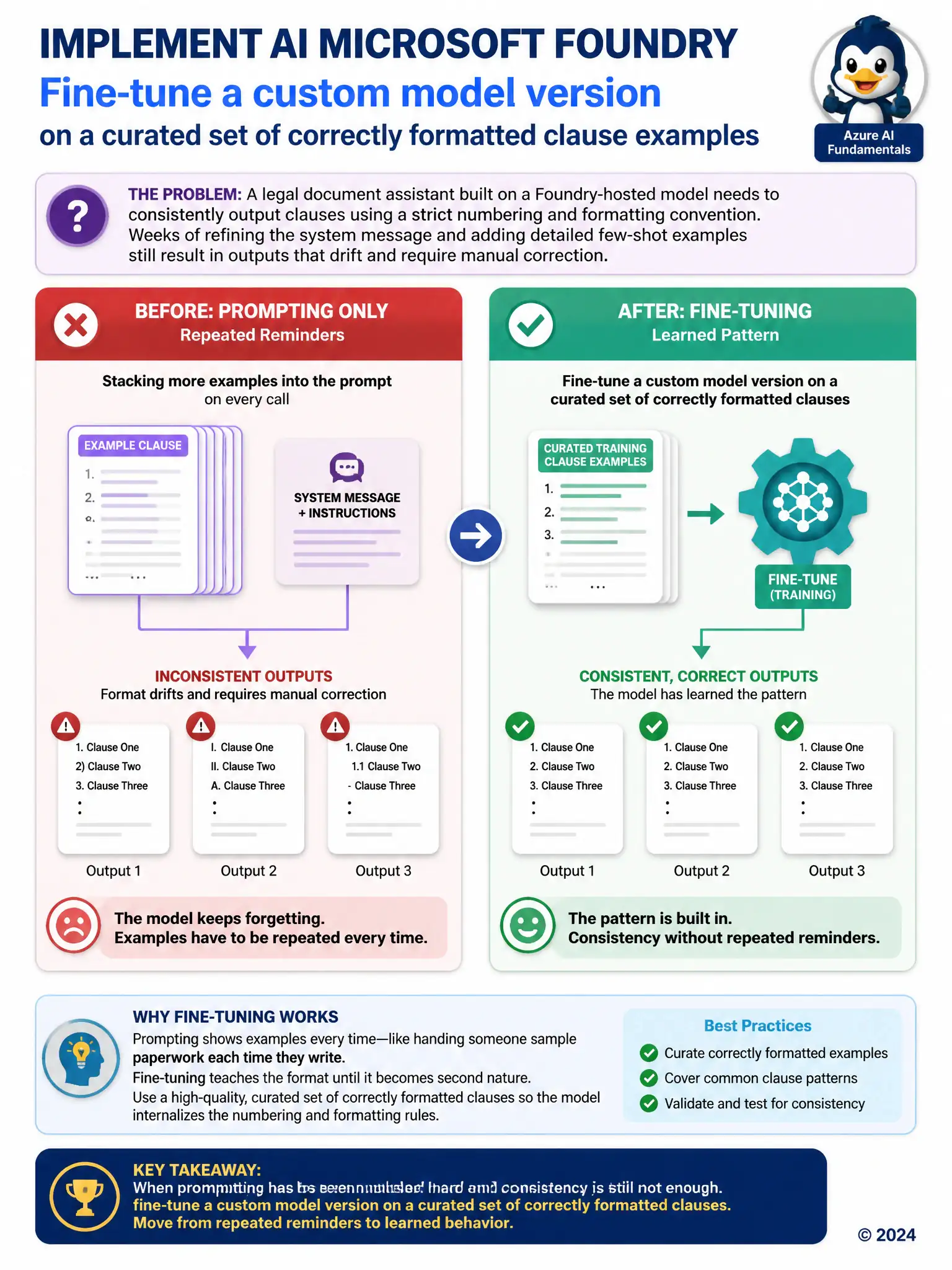
A legal document assistant built on a Foundry-hosted model needs to consistently output clauses using a strict numbering and formatting convention. The team has spent weeks refining the system message and adding detailed few-shot examples, but outputs still drift from the required format often enough to require manual correction. What should they try next?
Select an answer to reveal the explanation.
Short Explanation
When you've pushed prompting and few-shot examples for weeks and the format still drifts, you need to teach the pattern directly. Fine-tuning on a curated set of correctly formatted clause examples makes the numbering and formatting second nature. Longer outputs or looser safety filters won't fix clause formatting.
Full Explanation
When extensive prompt engineering, including detailed few-shot examples, has already been tried and the model still cannot reliably reproduce a strict, specific output format, fine-tuning on a curated set of correctly formatted examples directly teaches the model that pattern, making the behavior far more consistent than instructions alone can achieve. Increasing the model's max output token limit is incorrect because the problem described is formatting drift, not responses being truncated, so raising the output token limit does not address the actual failure mode. Lowering the content filter's strictness setting is incorrect because content filtering strictness controls safety moderation of potentially harmful content, which is unrelated to whether legal clauses follow a numbering convention. Adding even more few-shot examples to the already long prompt on every request is incorrect because the team has already tried extensive few-shot examples without success, and piling on more examples in every request increases prompt length, cost, and latency while offering diminishing returns on a formatting problem prompting has already failed to solve.