
A financial company deploys an Azure Function that calls a Foundry-hosted model to generate transaction summaries. A security review flags that the function's API key is stored as a plain application setting, creating risk if that setting is ever exposed. The team wants to remove the standing secret entirely while still letting the function call the model. What should they configure?
Select an answer to reveal the explanation.
Short Explanation
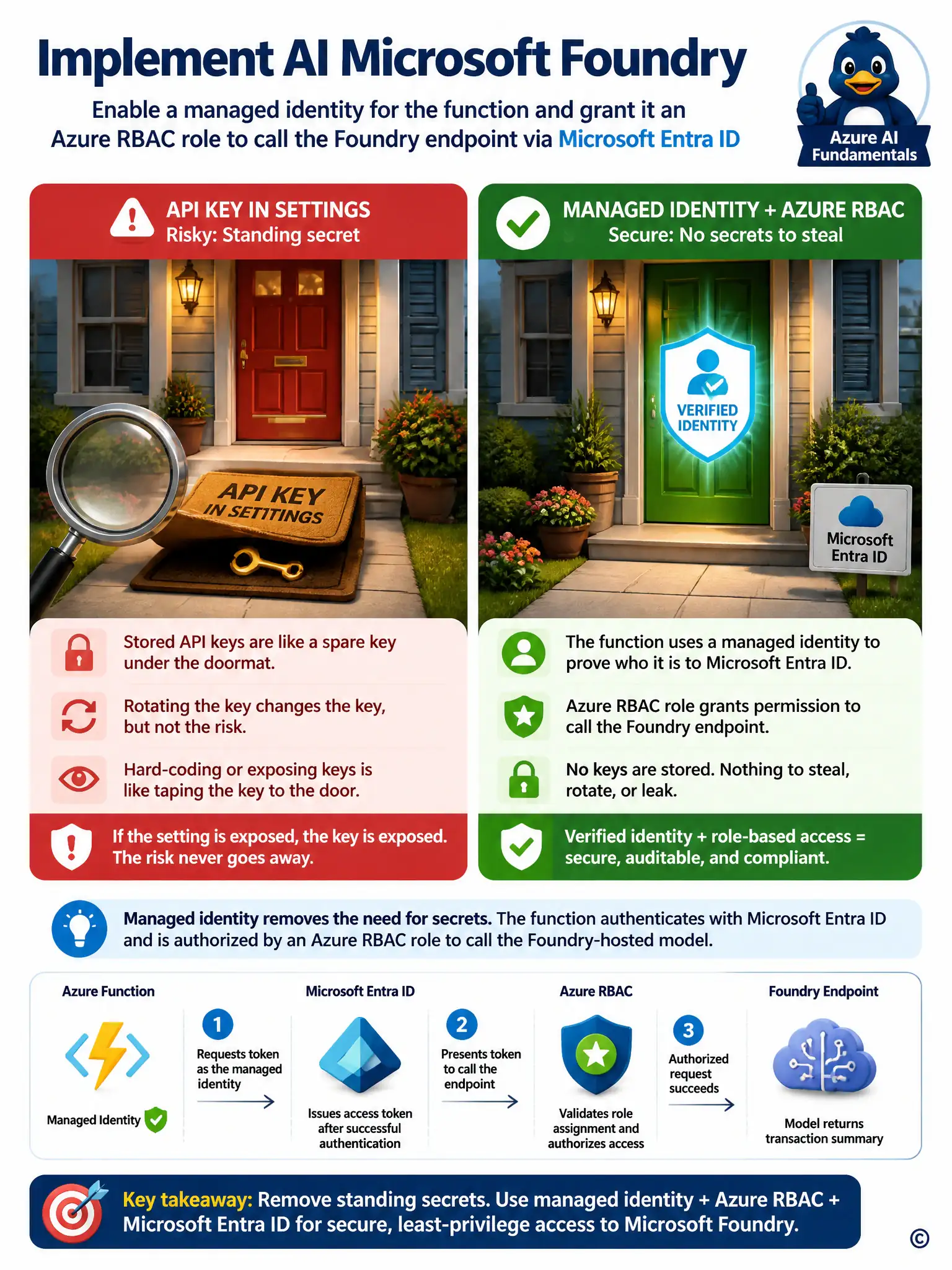
Storing an API key in a setting is like keeping a spare house key under the doormat: convenient, but anyone who finds the mat finds the key. Managed identity solves the actual problem: it lets the function prove who it is to Microsoft Entra ID and get permission to call the model based on its own verified identity and an assigned role, so there's no physical key sitting anywhere for someone to find. That's the difference between hiding a secret better and removing the need for a secret entirely, which is what a security review flagging a standing key is really asking for.
Full Explanation
The correct answer is the managed identity option. Enabling a managed identity lets the function authenticate to the Foundry endpoint using Microsoft Entra ID and an assigned Azure RBAC role, so no API key needs to exist in application settings, code, or configuration at all. This eliminates the standing secret the security review flagged, rather than just managing it more carefully. The weekly rotation option is incorrect because rotating the key on a schedule still leaves a live secret sitting in application settings between rotations, which does not remove the underlying exposure risk the review identified. The code comment option is incorrect because moving the key into a code comment does not reduce exposure; source code is typically more widely accessible than application settings, especially in shared repositories, making this worse rather than better. The client-side JavaScript option is incorrect because placing an API key in client-side JavaScript sends it to every end user's browser, making it trivially visible to anyone who inspects the page, a far more severe exposure than the original setting.