
A retail company's Foundry-hosted chatbot experiences a sudden traffic spike during a flash sale, and many requests begin failing with HTTP 429 'too many requests' errors from the model deployment. The engineering team needs to both keep the application resilient right now and prevent this from recurring during future sales events. (Select TWO.)
Select all correct answers, then click Submit.
Short Explanation
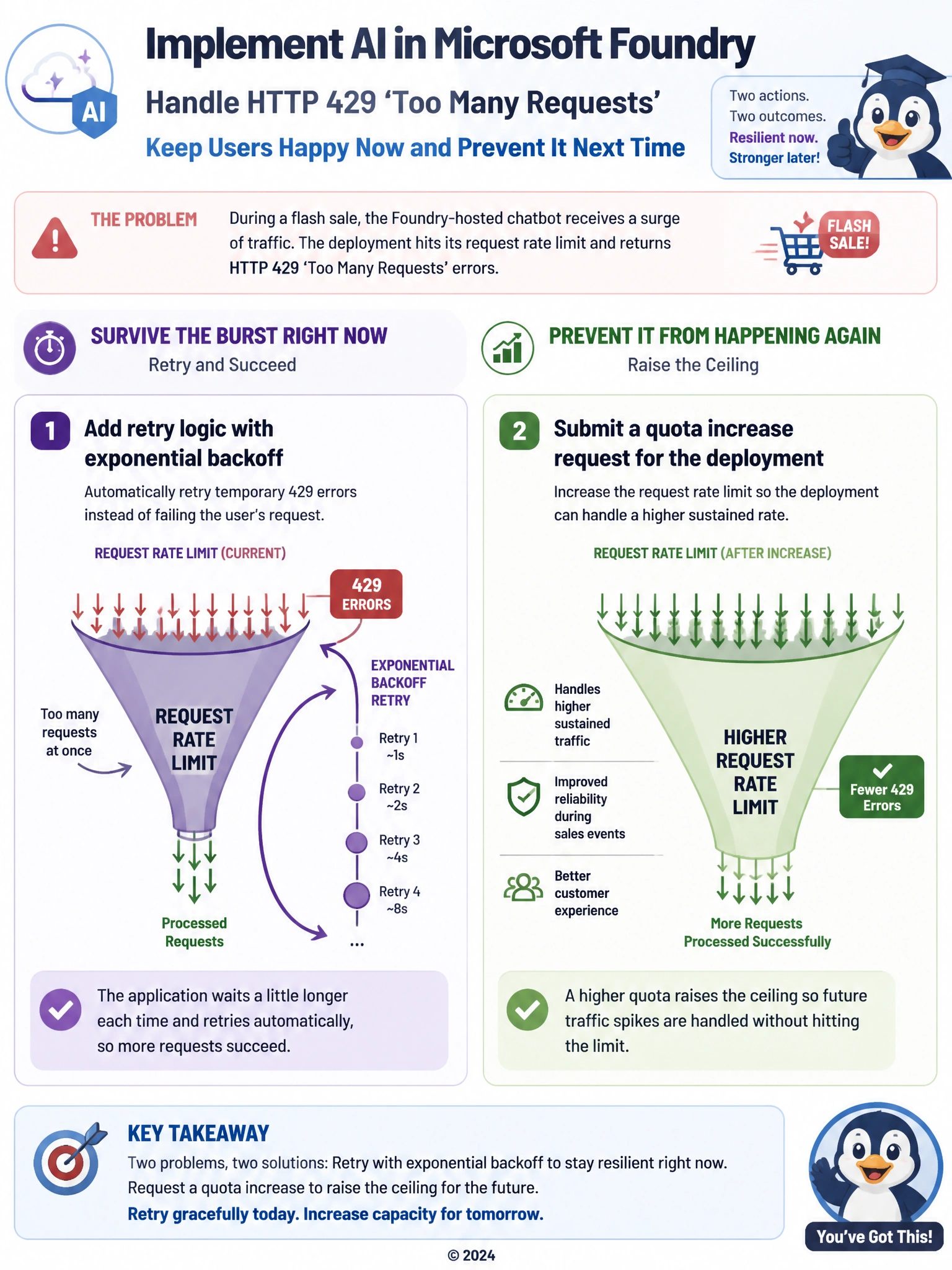
When a deployment starts throwing 'too many requests' errors during a burst of traffic, there are really two separate problems to solve: surviving the burst that is happening right now, and making sure it does not keep happening at every future sales event. For surviving right now, the app should catch those temporary failures and automatically try again after a short, increasing pause instead of just failing the customer's request outright. For preventing recurrence, the underlying ceiling on how many requests the deployment is allowed to handle per minute needs to actually go up, which means asking for a higher allowance for that deployment. Neither of the other two ideas touches the actual bottleneck: adjusting how random or deterministic the wording sounds has nothing to do with how many requests get through, and changing whether the response streams in gradually or arrives all at once is purely about delivery style, not about how many requests are hitting the deployment per second. The real fix is retrying gracefully now and raising the ceiling for next time.
Full Explanation
The correct answers are B and C. Retry logic with exponential backoff addresses the immediate resilience problem by automatically retrying requests that fail with a temporary 429 instead of surfacing an error to the user, smoothing over short bursts above the rate limit. Requesting a quota increase addresses the recurrence problem directly by raising the deployment's allowed request rate so future traffic spikes of similar size stay under the limit in the first place. Option D is incorrect because temperature controls the randomness and variety of the model's generated text; it has no effect on how many requests per minute the deployment can accept, so lowering it does nothing to reduce or prevent 429 errors. Option A is incorrect because streaming versus non-streaming changes how the response is delivered to the client, token by token versus all at once, but it does not change the number of requests being sent to the deployment or the rate limit governing them, so switching formats leaves the underlying throttling issue untouched. Together, backoff and a quota increase form a complete answer: one absorbs short-term spikes gracefully, and the other raises the ceiling so the same spike is less likely to trigger throttling again.