
An expense-management startup wants employees to photograph paper receipts with their phones and have a Foundry-hosted assistant automatically read the merchant name, date, and total amount directly from the image, without an employee typing anything. Which type of model deployment should the team choose from the Foundry model catalog?
Select an answer to reveal the explanation.
Short Explanation
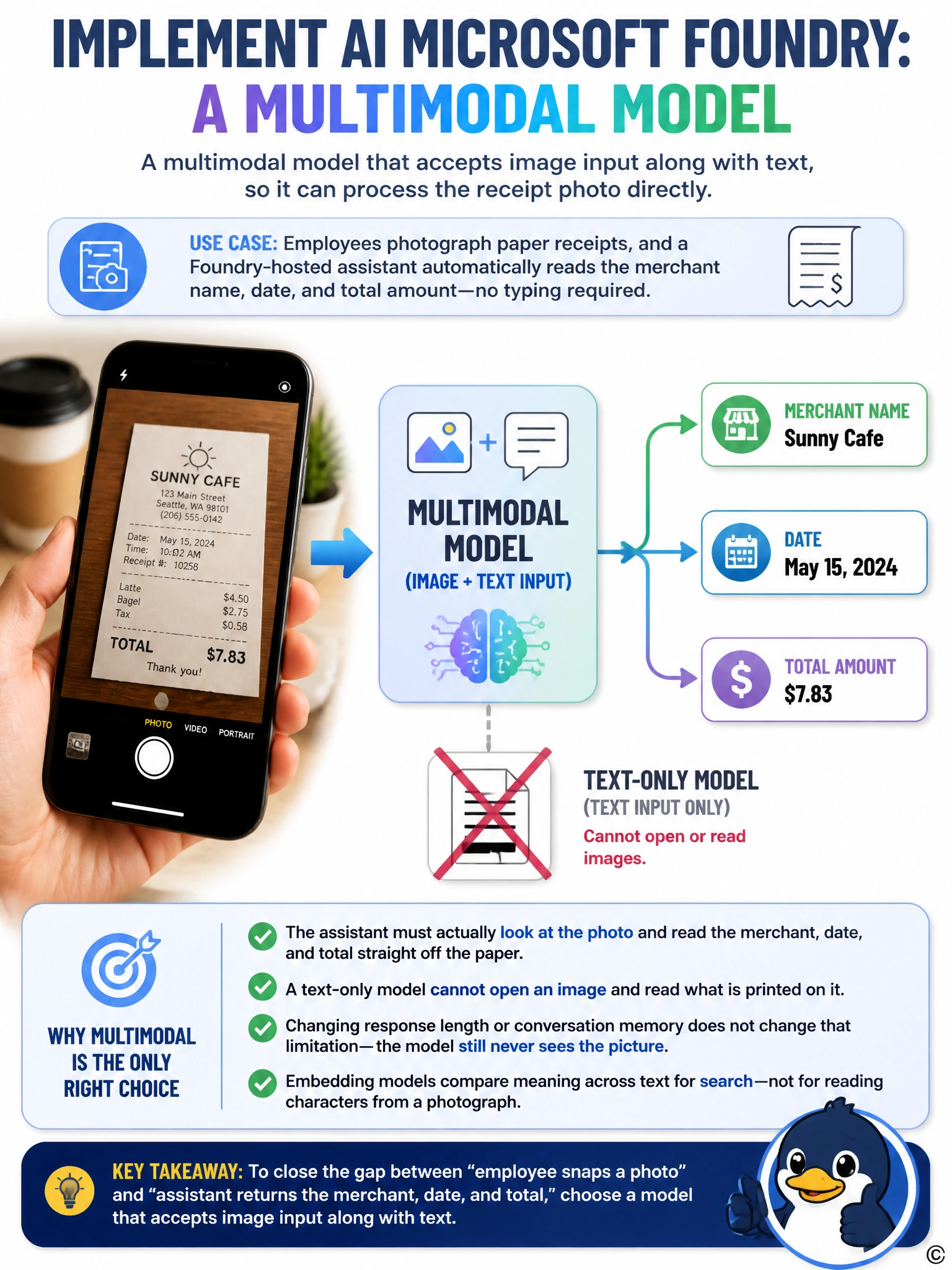
The whole point of this feature is that nobody wants to type anything, the assistant needs to actually look at the photo and read the merchant, date, and total straight off the paper. That means the deployment has to accept pictures as input in the first place, not just text. A model that only understands text, no matter how you tune it, simply cannot open an image and read what is printed on it, so tweaking how long its responses can be or how much conversation history it remembers does not change that fundamental limitation, it still never sees the picture. And a model built for turning text into numeric vectors for search is solving a completely different problem, comparing meaning across pieces of text, not reading characters off a photograph. The only option that actually closes the gap between 'employee snaps a photo' and 'assistant returns the merchant, date, and total' is choosing a model built to take images as input alongside text.
Full Explanation
The correct answer is B. The task requires reading information directly out of a photograph, which means the model must be able to accept an image as input; a multimodal model that handles both image and text input can look at the receipt photo and extract the merchant name, date, and total without any employee transcribing it first. Option A is incorrect because an embedding model converts text into numeric vectors for similarity comparison and search, it has no ability to interpret pixels in an image or read printed text off a receipt. Option C is incorrect because increasing max_tokens only changes how much text the model can produce in a response; a text-only model still cannot accept an image as input no matter how the output length is configured, so it never sees the receipt at all. Option D is incorrect for the same core reason: a longer context window lets a text-only model retain more conversation history, but context length does not add the ability to process visual input, so the receipt photo still could not reach the model in a usable form. Extracting data from an image is fundamentally an input-modality requirement, and only a model built to accept image input can satisfy it.