
A newsletter platform wants to flag incoming subscriber emails as spam or not-spam before they reach the send queue, processing on the order of five million emails per day. The task is a straightforward two-category classification, and the team is under pressure to keep the per-request cost as low as possible without hosting their own infrastructure. Which choice from the Foundry model catalog best fits this situation?
Select an answer to reveal the explanation.
Short Explanation
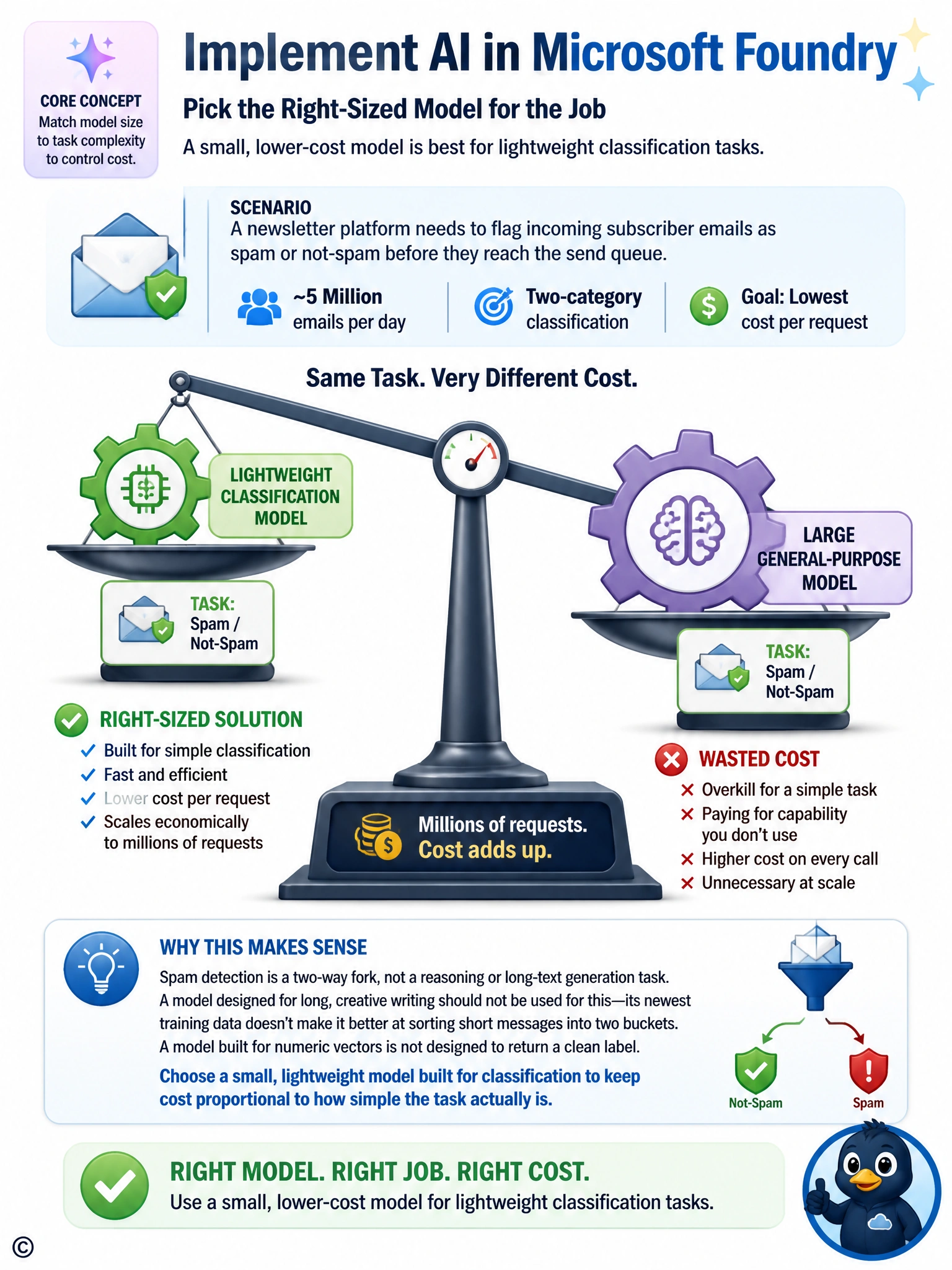
This one comes down to matching the size of the tool to the size of the job. Deciding whether an email is spam or not is about as simple as classification tasks get, it is a two-way fork, not something that needs deep reasoning or long generated text. At millions of requests a day, reaching for the biggest, most capable model in the catalog just because it scores highest on hard benchmarks means paying a premium on every single one of those millions of calls for capability the task never uses. A model built for generating long, creative writing is aimed at a totally different job and its 'newest training data' does not make it any better suited to sorting short messages into two buckets. And a model meant for producing numeric vectors for search is not really built to hand back a clean label when prompted that way. The sensible move is picking a smaller, lighter, cheaper model that is sized for exactly this kind of lightweight classification work, so cost stays proportional to how simple the task actually is.
Full Explanation
The correct answer is D. A binary spam classification task is well within the capability of a small, lower-cost model, and at a volume of five million requests per day, choosing a smaller model sized for lightweight tasks keeps per-request cost low while still meeting the accuracy the task actually requires. Option A is incorrect because embedding models are designed to output numeric vector representations of text for tasks like search and similarity comparison; they are not built to be prompted for a direct classification label, and using one this way is not their intended function or a reliable pattern. Option B is incorrect because assuming higher accuracy is always worth the cost ignores the actual requirement in the scenario, keeping per-request cost as low as possible, and applying the largest general-purpose model to a simple two-category task multiplies cost at high volume without a corresponding benefit for such a straightforward decision. Option C is incorrect because a model optimized for long-form creative generation is tuned for a completely different capability, producing extended original text, which has no relevance to sorting short emails into two categories, and recency of training data does not compensate for the mismatch in task fit. Matching model size to task complexity is the deciding factor here, not simply picking the newest or largest available option.