
A customer service agent built in Foundry needs to tell customers the real-time status of their flight, including delays that change minute to minute. The model itself has no built-in access to live flight data. Which approach lets the agent provide accurate, current flight status?
Select an answer to reveal the explanation.
Short Explanation
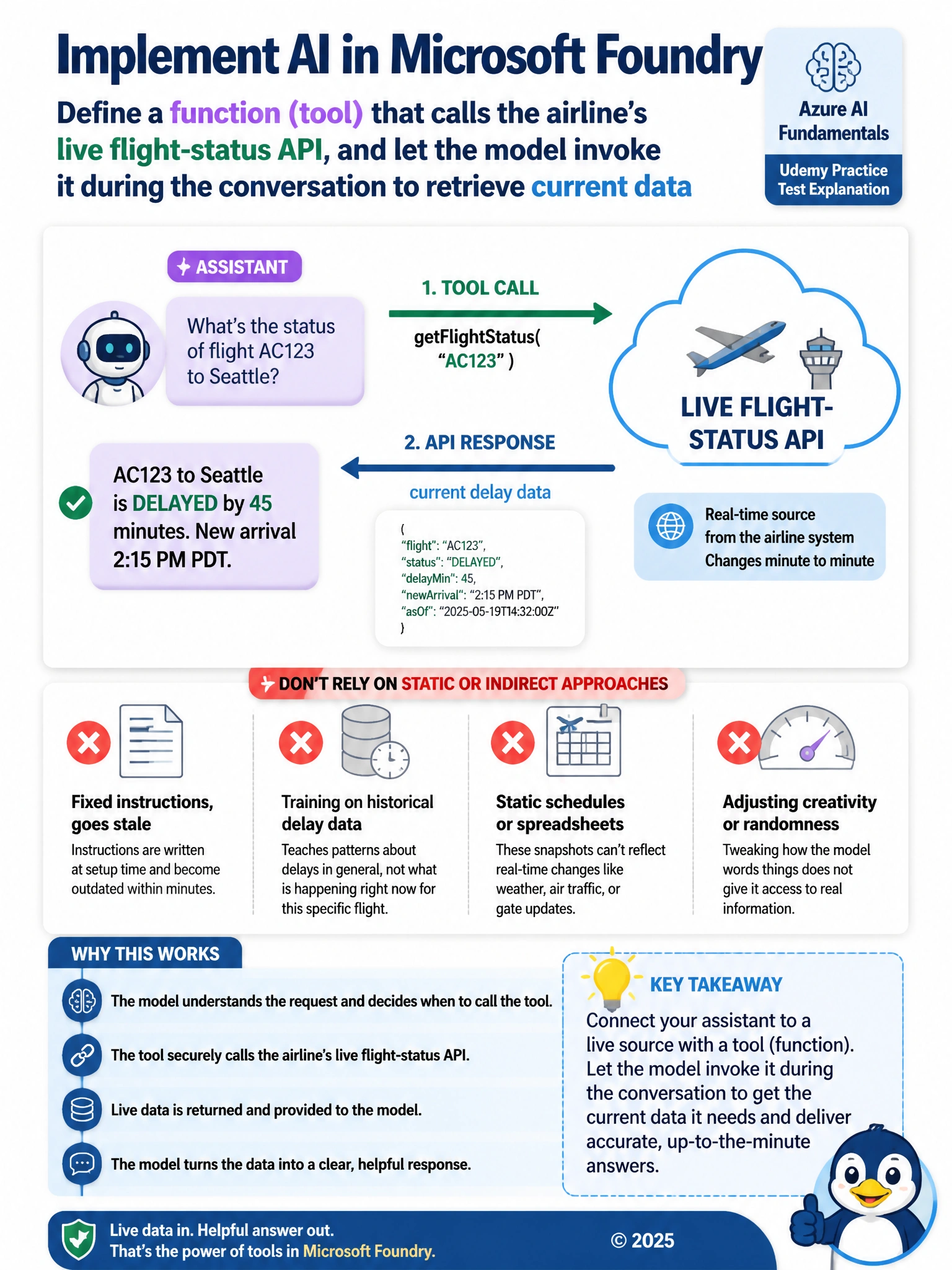
A language model is great at understanding what someone is asking and turning data into a helpful sentence, but it has no idea what is happening in the real world right now unless something tells it. For something that changes by the minute, like a flight's status, the answer is to give the assistant a way to reach out and ask a live source directly, mid-conversation, and then use whatever comes back to write its reply. That is very different from just writing the flight schedule into the assistant's standing instructions, since those instructions are fixed at setup time and would be outdated within minutes. It is also different from training the model on a pile of historical delay records, which would only teach it general patterns about which flights tend to run late, not what is actually happening with this specific flight right now. And tweaking how random or creative the model's wording is has nothing to do with whether it can access real information at all. The fix is connecting it to a live lookup, not adjusting how it writes.
Full Explanation
The correct answer is A. Defining a function that calls the airline's live status API and letting the model invoke that tool during a conversation gives the agent a way to fetch genuinely current data at the moment it is needed, which is exactly what a fast-changing value like flight status requires. Option B is incorrect because temperature controls how random or varied the model's word choices are; it has no connection to whether the model has access to real, current data, and increasing it could make responses less accurate, not more. Option C is incorrect because the system message is fixed text set at deployment time; flight status changes minute to minute, so anything written into it would be stale almost immediately and could not be refreshed on every request. Option D is incorrect because fine-tuning bakes patterns from historical data into the model's weights, producing a model that can talk about past trends but cannot know today's actual delay for a specific flight, which is the opposite of what is needed here. Tool calling is the mechanism built for exactly this situation, connecting a language model to a live, authoritative external source rather than trying to make the model itself the source of fast-changing facts.