
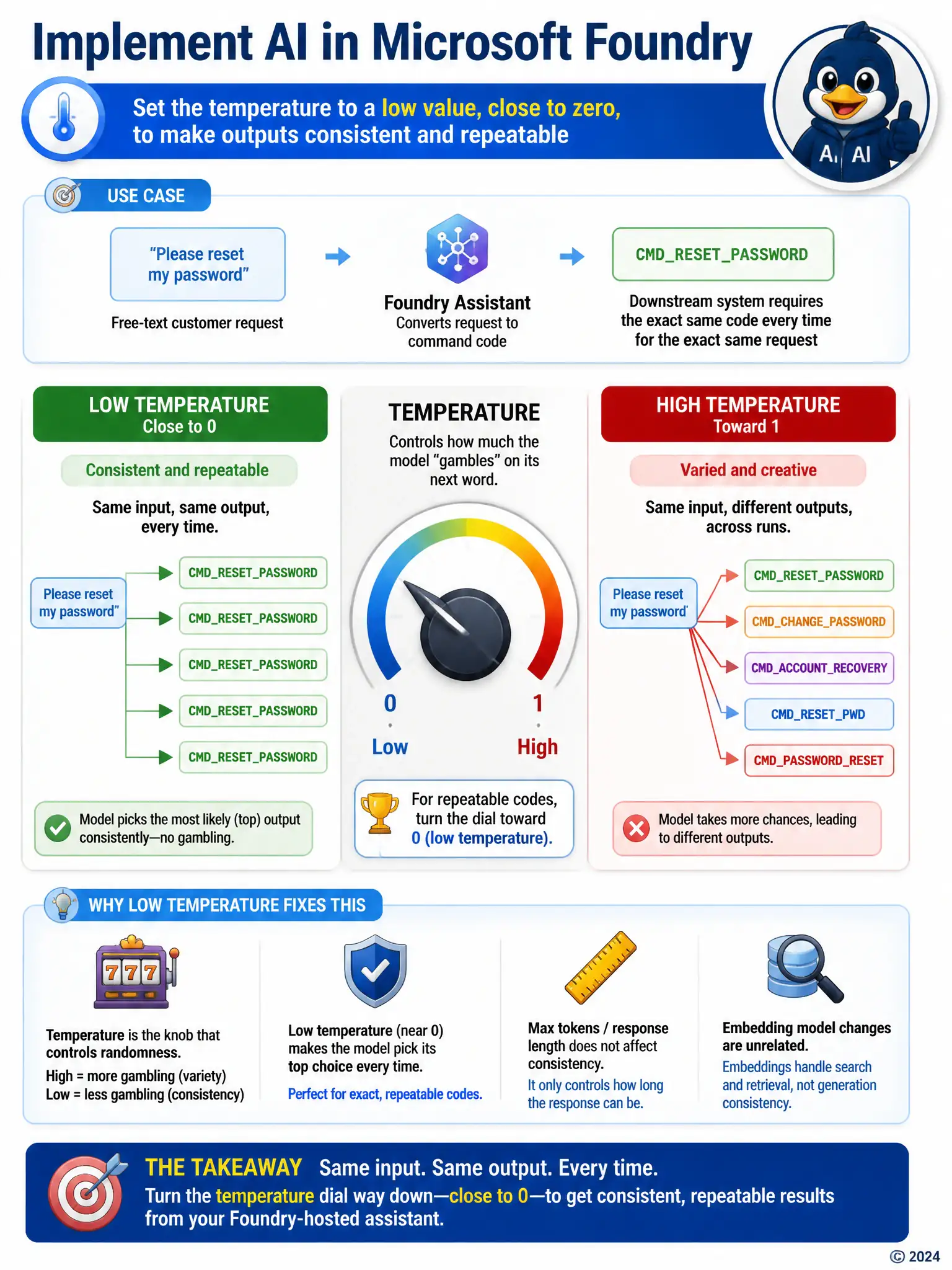
A team built a Foundry-hosted assistant that converts free-text customer requests into one of a small set of fixed command codes for a downstream system. Given the same input, the downstream system requires the exact same code every time, with no creative variation between runs. Which adjustment to the model's generation settings addresses this?
Select an answer to reveal the explanation.
Short Explanation
You need the model to stop gambling on its next word and just pick the safest, most likely one. Set temperature close to zero so the same input gives the same command code every run. Turning randomness up, making responses longer, or swapping embeddings won't make generation repeatable.
Full Explanation
The correct choice is setting the temperature to a low value, close to zero, to make outputs consistent and repeatable. Temperature controls how much randomness the model introduces when choosing its next output tokens; setting it to a low value near zero makes the model consistently favor its highest-probability output, which produces the same command code for the same input run after run, exactly what the downstream system requires. Increasing both temperature and top_p to encourage more varied phrasing is incorrect because raising temperature and top_p increases randomness and variety in the output, which moves the assistant away from repeatable behavior and toward the opposite of what a fixed-code use case needs. Increasing the maximum output token limit so longer responses are possible is incorrect because the max token limit controls how long a response is allowed to be, not how deterministic the model's word choices are; a longer allowed response does nothing to make a short command code consistent between runs. Switching to a different embedding model to improve retrieval consistency is incorrect because embedding models are used for representing text as vectors for retrieval or search tasks, not for controlling the generation behavior of the chat model producing the command codes, so changing the embedding model has no effect on output determinism. Because this task calls for stable, repeatable, low-variation output rather than creative variety, tuning temperature toward zero is the setting that directly targets the requirement.