
A customer-service team already has a Foundry-hosted chat model that summarizes written transcripts. They now want to summarize recorded phone calls instead of typed chats, starting from the raw audio recordings. What must they add to their solution to make this possible?
Select an answer to reveal the explanation.
Short Explanation
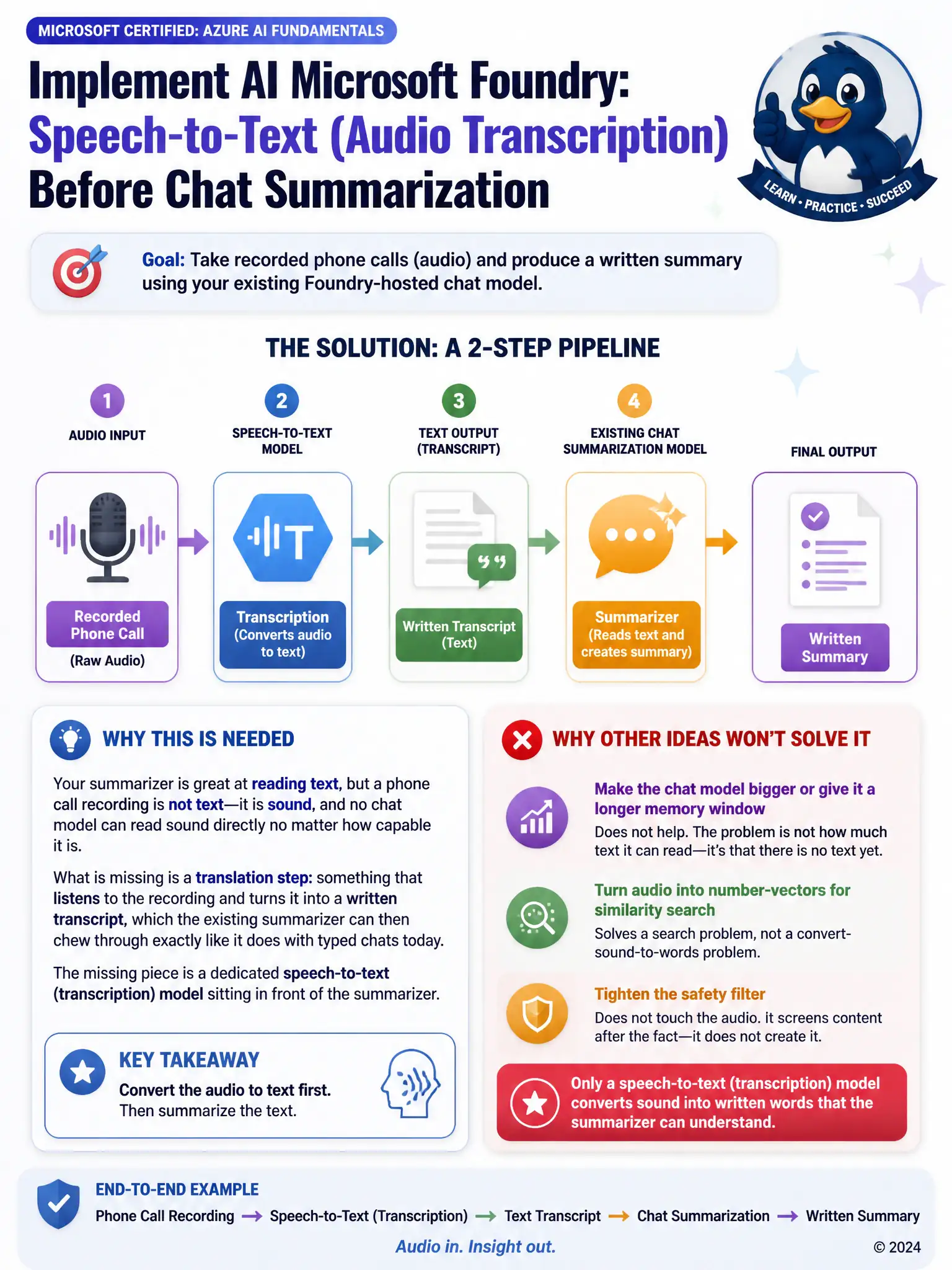
Your existing summarizer reads text, but phone audio isn't text yet. You need a speech-to-text model to transcribe the recordings first, then pass that transcript to the chat model. A bigger chat model, embeddings, or safety filters don't turn sound into words.
Full Explanation
The correct answer is the speech-to-text (audio transcription) model that converts the recordings into text before the chat model summarizes them. The existing chat model summarizes text, but raw audio recordings are not text, so a speech-to-text model must first transcribe the recordings into written form; the chat model can then summarize that transcript exactly as it already does for typed chats. The option proposing a larger version of the same chat model with a longer context window is incorrect because a longer context window only changes how much text a model can read at once; it does not give a text-based chat model any ability to interpret audio input, so the recordings would still be unreadable to it. The option proposing a higher-dimensional embedding model to represent the audio as vectors is incorrect because an embedding model converts input into numeric vectors for similarity search or retrieval, not into readable transcript text, so it does not solve the need to produce a summary. The option proposing a stricter content safety filter configured for the audio modality is incorrect because content safety filtering screens generated or submitted content for policy violations; it has no role in converting audio into text and would not enable summarization even if applied. Because typed chat text and recorded audio are fundamentally different modalities, the pipeline needs a dedicated transcription step before the existing summarization step can work on call recordings the same way it already works on chat transcripts.