
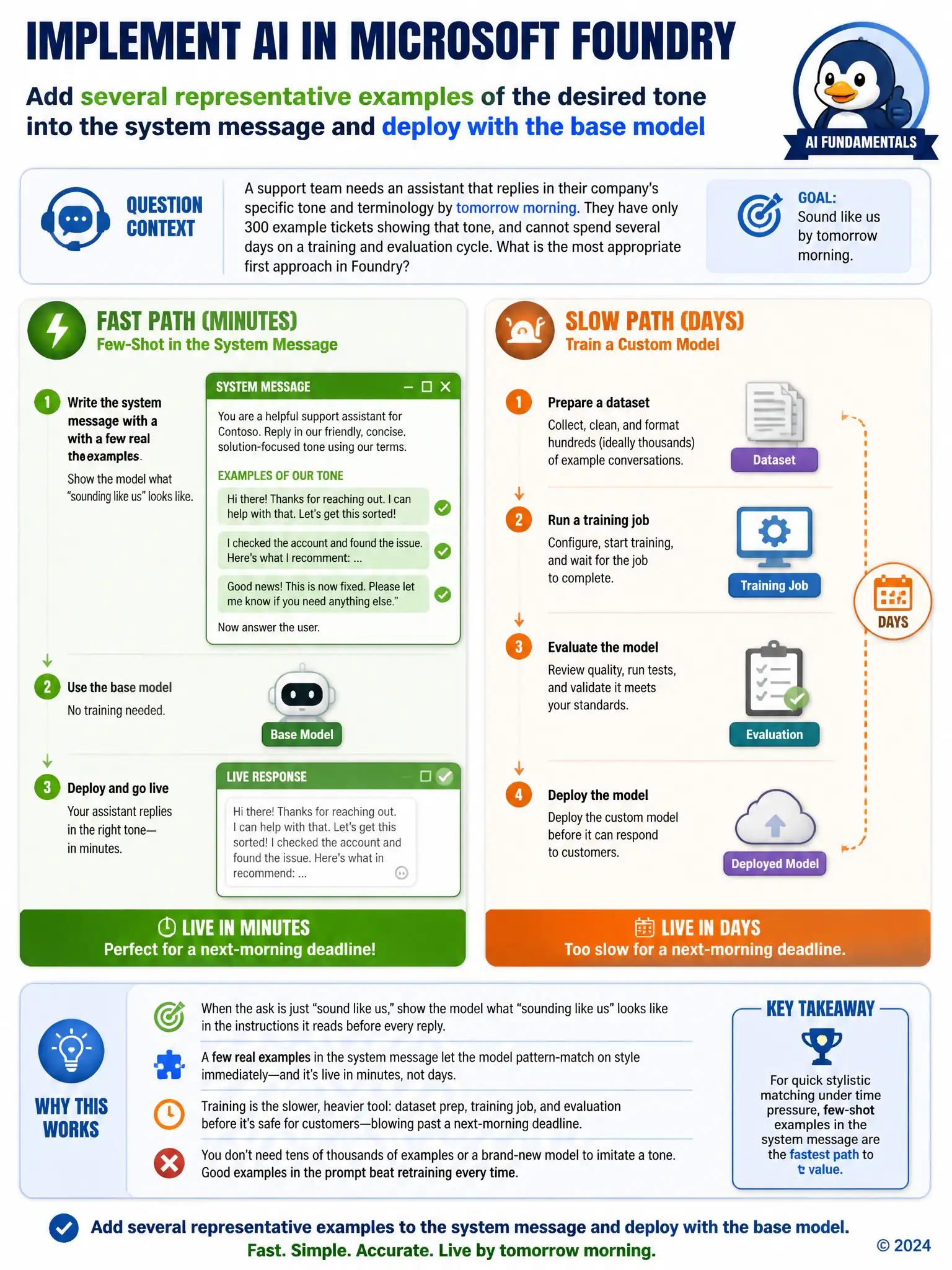
A support team needs an assistant that replies in their company's specific tone and terminology by tomorrow morning. They have only 300 example tickets showing that tone, and cannot spend several days on a training and evaluation cycle. What is the most appropriate first approach in Foundry?
Select an answer to reveal the explanation.
Short Explanation
When the ask is just 'sound like us,' you don't need to retrain anything. Drop a few real examples of the tone into the system message so the base model can pattern-match style immediately, and you're live in minutes, not days. Kicking off a full training job is the slower, heavier tool, and it blows past a next-morning deadline.
Full Explanation
The correct approach is adding several representative examples of the desired tone directly in the system message, letting the base model imitate that style immediately, with no training pipeline, evaluation cycle, or waiting period, which fits both the tight deadline and the modest example count. The fine-tuning approach is incorrect because it involves preparing a training job, running it, and evaluating the resulting model before it can be trusted in production, a process that reliably takes longer than one day even with only 300 examples. The wait-until-10,000-labeled-examples approach is incorrect because it abandons the deadline entirely and is unnecessary; few-shot prompting can demonstrate a tone convincingly with far fewer samples than a fine-tuning job would need to be worthwhile. The train-an-entirely-new-model-architecture-from-scratch approach is incorrect because it requires vastly more data, compute, and time than either fine-tuning or prompting, and is never appropriate for a same-day turnaround. When time is short and the goal is stylistic imitation rather than teaching new facts or complex behavior, few-shot examples in the prompt are the fastest lever available in Foundry, with fine-tuning reserved for cases where prompting has been tried and still falls short.