
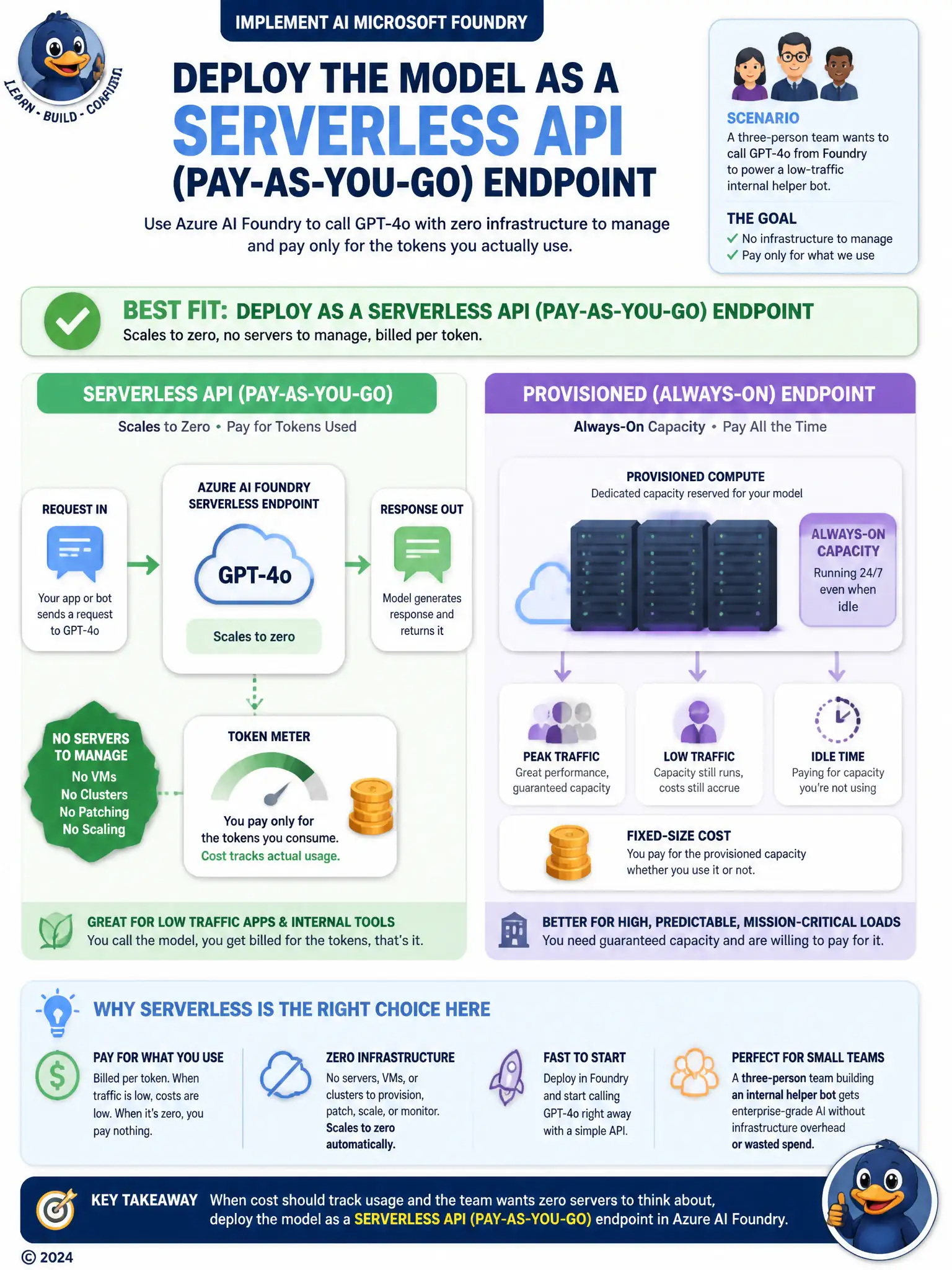
A three-person team wants to call GPT-4o from Foundry to power a low-traffic internal helper bot. They do not want to provision or manage any compute instances, and they want to pay only for the tokens they actually consume. Which deployment option in Azure AI Foundry best fits this need?
Select an answer to reveal the explanation.
Short Explanation
You don't want to babysit servers, and a low-traffic bot shouldn't pay for idle capacity. The serverless pay-as-you-go endpoint lets you call the model and pay only for the tokens you use, with no VM or cluster to manage.
Full Explanation
The correct choice is the serverless API deployment in Azure AI Foundry. It lets the team call the model over a managed endpoint without provisioning or maintaining any compute, billing only for the tokens the low-traffic bot actually consumes, which matches both stated constraints. The managed compute provisioned online endpoint sized for peak traffic is incorrect because it requires selecting and paying for a fixed instance size that keeps running, and costing money, whether or not requests arrive, which is the opposite of pay-per-token. The self-managed AKS cluster with autoscaling is incorrect because standing up and autoscaling a Kubernetes cluster means the team must patch, monitor, and size nodes themselves, directly contradicting the requirement to avoid managing compute. The batch endpoint that processes a queue once per day is incorrect because it introduces hours of latency between when a request is submitted and when a result is available, which does not suit an interactive helper bot that needs a near-immediate reply. For a small team with unpredictable, low-volume traffic, the serverless pay-as-you-go model removes infrastructure ownership entirely while keeping cost proportional to actual usage, which is exactly the tradeoff this scenario calls for.