
A marketing team wants a tool that takes a one-paragraph creative brief describing a new product and produces several original draft variations of ad copy in different tones for the team to choose from and edit. Which type of AI workload does this capability represent?
Select an answer to reveal the explanation.
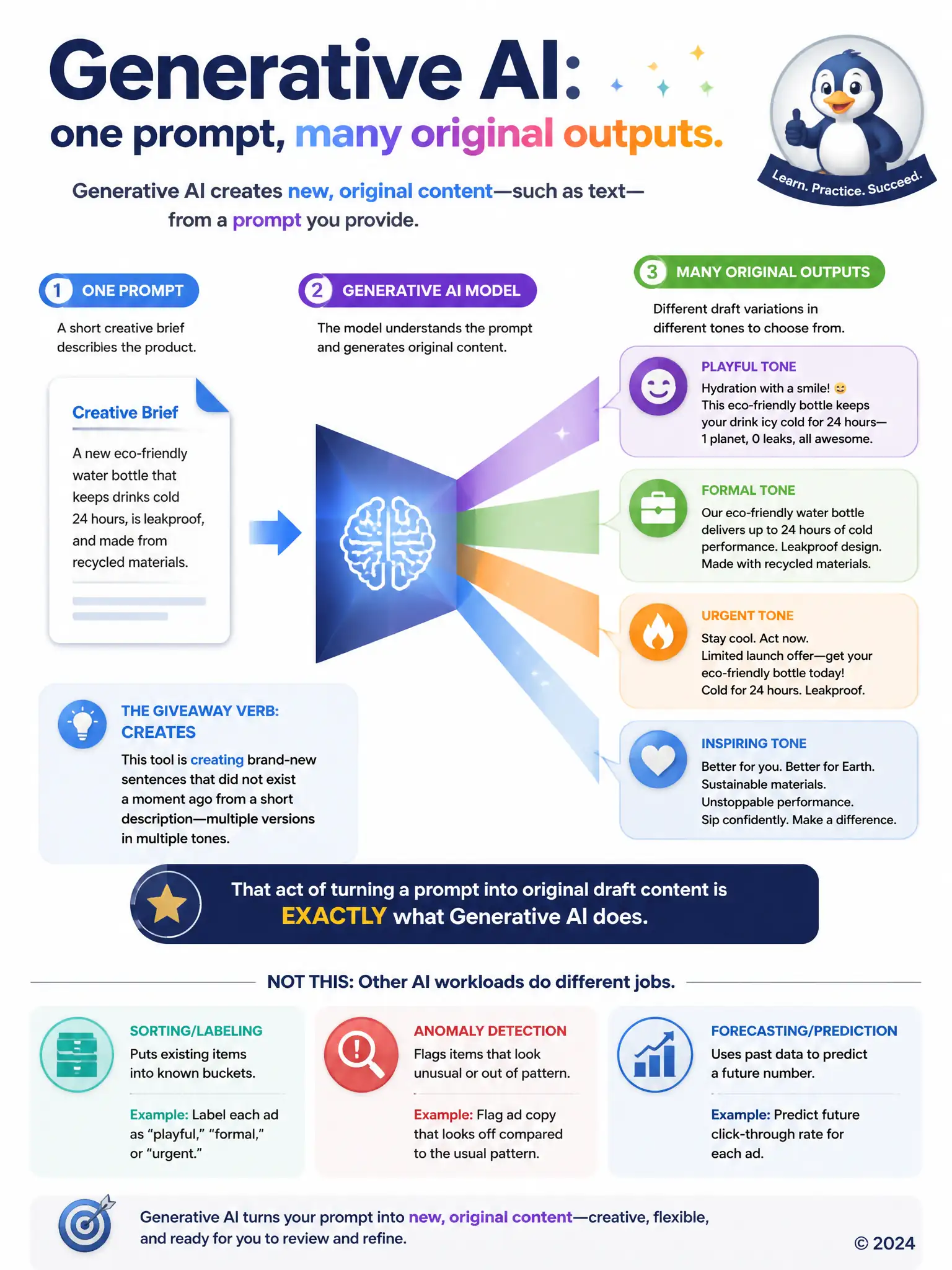
Short Explanation
The giveaway is the verb doing the work: this tool creates brand-new ad copy from a brief, not sorting, flagging, or predicting. You are looking at a generative AI workload because it turns a prompt into several original drafts in different tones. The other tasks only judge, spot outliers, or project numbers.
Full Explanation
The correct answer is generative AI, producing new original content such as text from a prompt. Taking a short creative brief as a prompt and producing multiple original, previously-nonexistent pieces of ad copy in different tones is the defining behavior of a generative AI workload, which creates new content rather than sorting, scoring, or predicting against existing data. The classification option is incorrect because classification would involve assigning each piece of ad copy to one of a fixed set of predefined categories, such as tagging copy as 'promotional' or 'informational', not authoring the copy itself. The anomaly detection option is incorrect because anomaly detection looks for data points or patterns that deviate from an expected baseline, such as flagging an unusually worded ad, rather than producing new drafts. The forecasting option is incorrect because forecasting predicts a future numeric value from a historical time series, such as projecting next quarter's ad spend, which has nothing to do with drafting creative text. The marketing team's tool is defined by its act of creation, generating several original variations from a prompt, which is the hallmark of generative AI.