
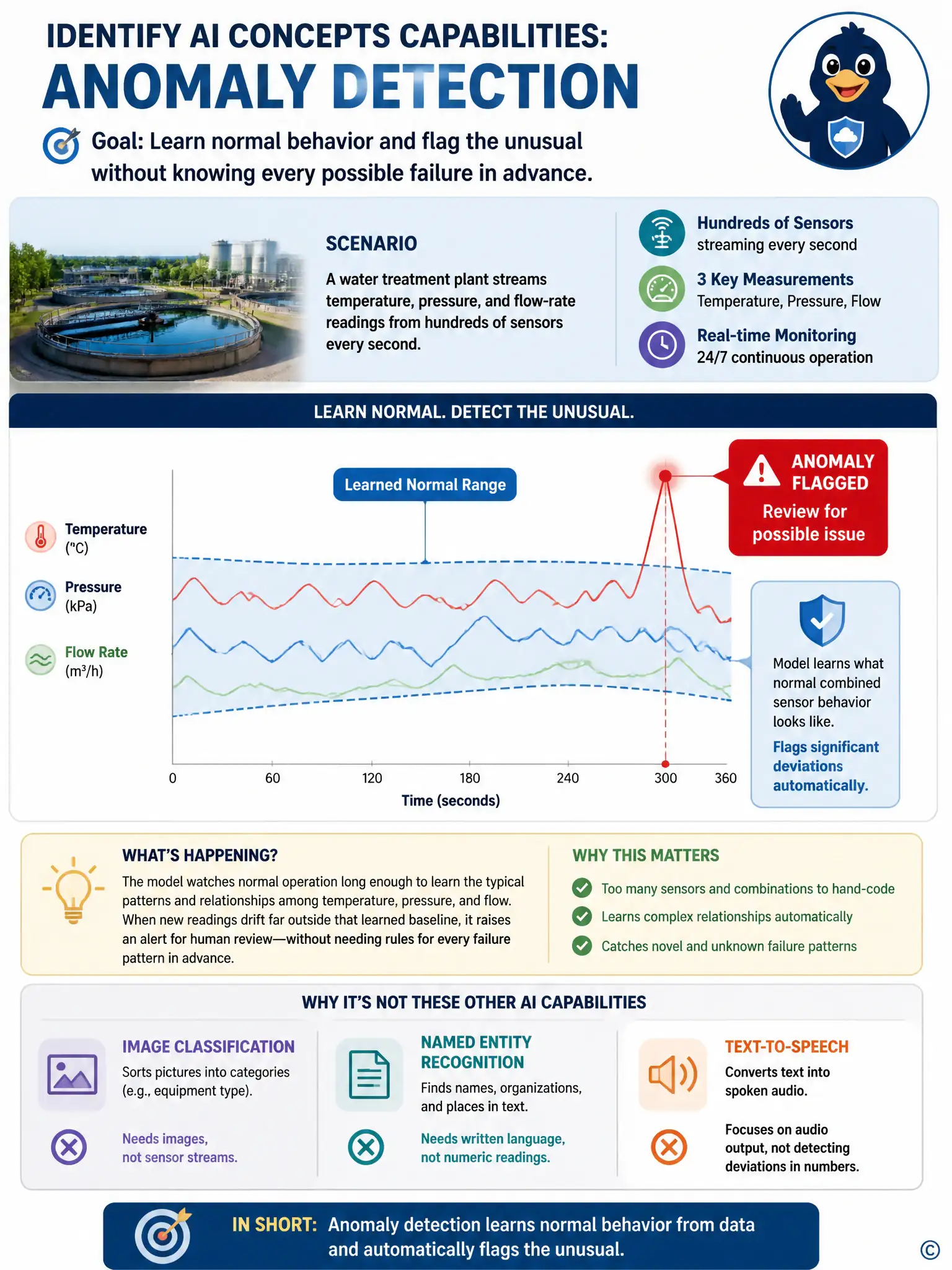
A water treatment plant streams temperature, pressure, and flow-rate readings from hundreds of sensors every second. Engineers do not want to define every possible failure pattern in advance; instead they want a model that learns what normal combined sensor behavior looks like and automatically flags any reading pattern that deviates significantly from that learned norm for human review. Which AI capability does this describe?
Select an answer to reveal the explanation.
Short Explanation
You can't predefine every combination of temperature, pressure, and flow that might signal trouble. You need a model that learns normal combined sensor behavior and flags deviations for review, which is anomaly detection.
Full Explanation
The correct capability is anomaly detection. A model that learns what normal combined sensor behavior looks like from streaming data and flags readings that deviate significantly from that learned norm, without every failure pattern being defined in advance, is performing anomaly detection. Image classification is incorrect because it assigns labels to pictures, and the plant's data consists of numeric sensor streams rather than images. Named entity recognition is incorrect because it extracts people, organizations, and similar entities from written text, which has no role in interpreting temperature, pressure, and flow-rate readings. Speech synthesis is incorrect because it converts text into spoken audio output, an unrelated capability to monitoring sensor data for unusual patterns. The plant's requirement, letting the system learn a baseline of normal combined readings and surface deviations for human review rather than relying on a predefined list of failure conditions, is exactly the problem anomaly detection is designed to solve, since it generalizes to failure modes nobody explicitly anticipated.