
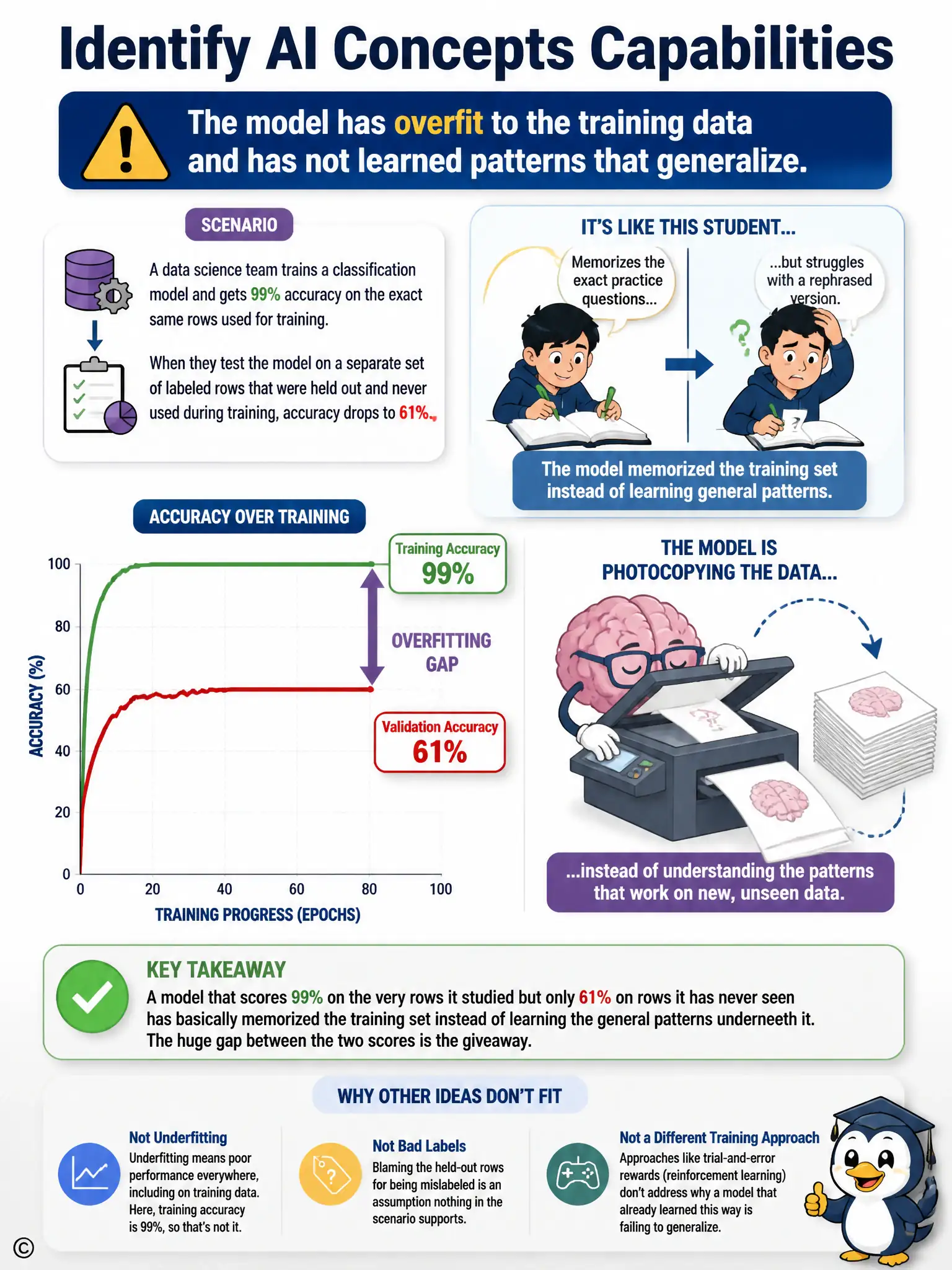
A data science team trains a classification model on a labeled dataset and achieves 99% accuracy when they evaluate it on the exact same rows used for training. When they run the same model against a separate set of labeled rows that were held out and never used during training, accuracy drops to 61%. What does this gap between the two accuracy figures most likely indicate?
Select an answer to reveal the explanation.
Short Explanation
You've got a model that scores 99% on the rows it studied but only 61% on rows it never saw, so it's basically memorized the training set instead of learning patterns that generalize. That huge train-versus-holdout gap is the giveaway.
Full Explanation
The option stating that the model has overfit to the training data and has not learned patterns that generalize is correct. A model that scores 99% on the exact rows it trained on but only 61% on data it has never seen has memorized specifics of the training set rather than learning patterns that generalize, which is the classic signature of overfitting. The option saying the model is underfit and needs a more complex architecture is incorrect because underfitting would produce poor performance on the training data as well as on new data, and this model performed extremely well on the training rows, ruling out underfitting. The option claiming the held-out data was mislabeled and should be discarded is incorrect because assuming the held-out data is mislabeled is not supported by anything in the scenario; a large accuracy gap between training and held-out performance is the expected symptom of overfitting, not evidence of a labeling error. The option saying the model requires reinforcement learning instead of supervised learning is incorrect because switching to a reward-based training approach does not address the underlying cause of the gap, which is that the current model captured noise and specifics of the training rows instead of general patterns, a problem tied to model complexity or training data rather than the category of learning algorithm. The large train-versus-holdout gap is the key diagnostic detail pointing to overfitting.