
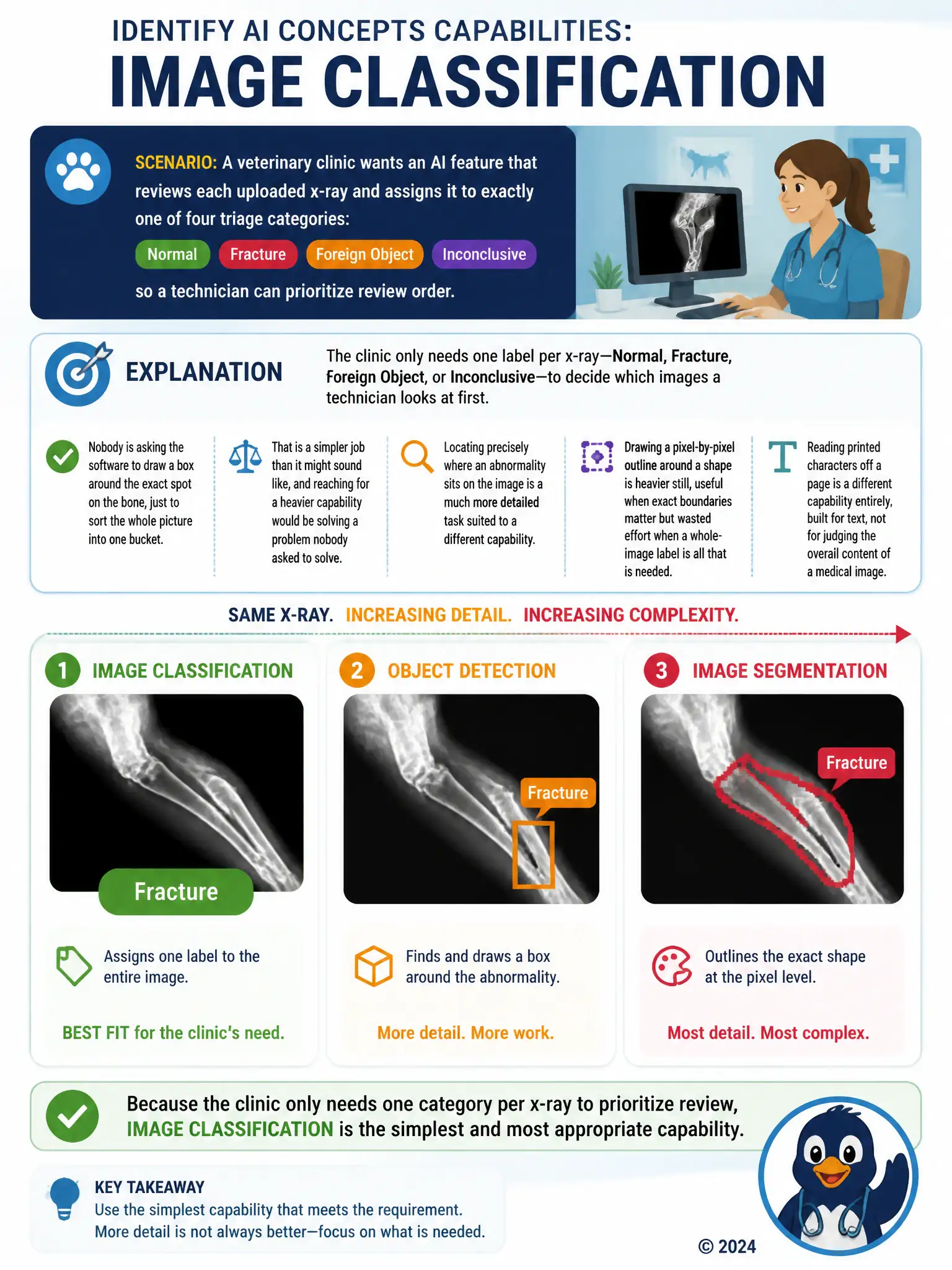
A veterinary clinic wants an AI feature that reviews each uploaded x-ray image and assigns it to exactly one of four triage categories, normal, fracture, foreign object, or inconclusive, so a technician can prioritize review order. The clinic does not need the software to mark where on the x-ray any abnormality appears, only which single category best describes the whole image. Which computer vision capability is the simplest fit?
Select an answer to reveal the explanation.
Short Explanation
You only need one label per x-ray—normal, fracture, foreign object, or inconclusive—to decide review order. Since nobody needs to know where the abnormality sits, whole-image classification is the simplest fit. Reaching for detection, segmentation, or text reading solves a problem nobody asked for.
Full Explanation
Assigning each x-ray to exactly one of four categories based on the image as a whole, without needing to indicate where on the image any abnormality appears, is a straightforward image classification task, since only a single whole-image label is required. Object detection is incorrect because it returns the location of one or more objects within an image, typically as bounding boxes, which is more detail than the clinic's triage workflow requires. Image segmentation is incorrect because it produces a pixel-level outline of regions within an image, an even more granular and computationally heavier capability than the clinic needs for a single triage label. Optical character recognition is incorrect because it reads printed or handwritten text within an image, which is unrelated to interpreting the visual content of an x-ray. Since the clinic only needs a single category per image to prioritize technician review, and has no requirement to localize an abnormality, the simplest capability that satisfies the need is whole-image classification rather than a more detailed localization or text-reading capability.