
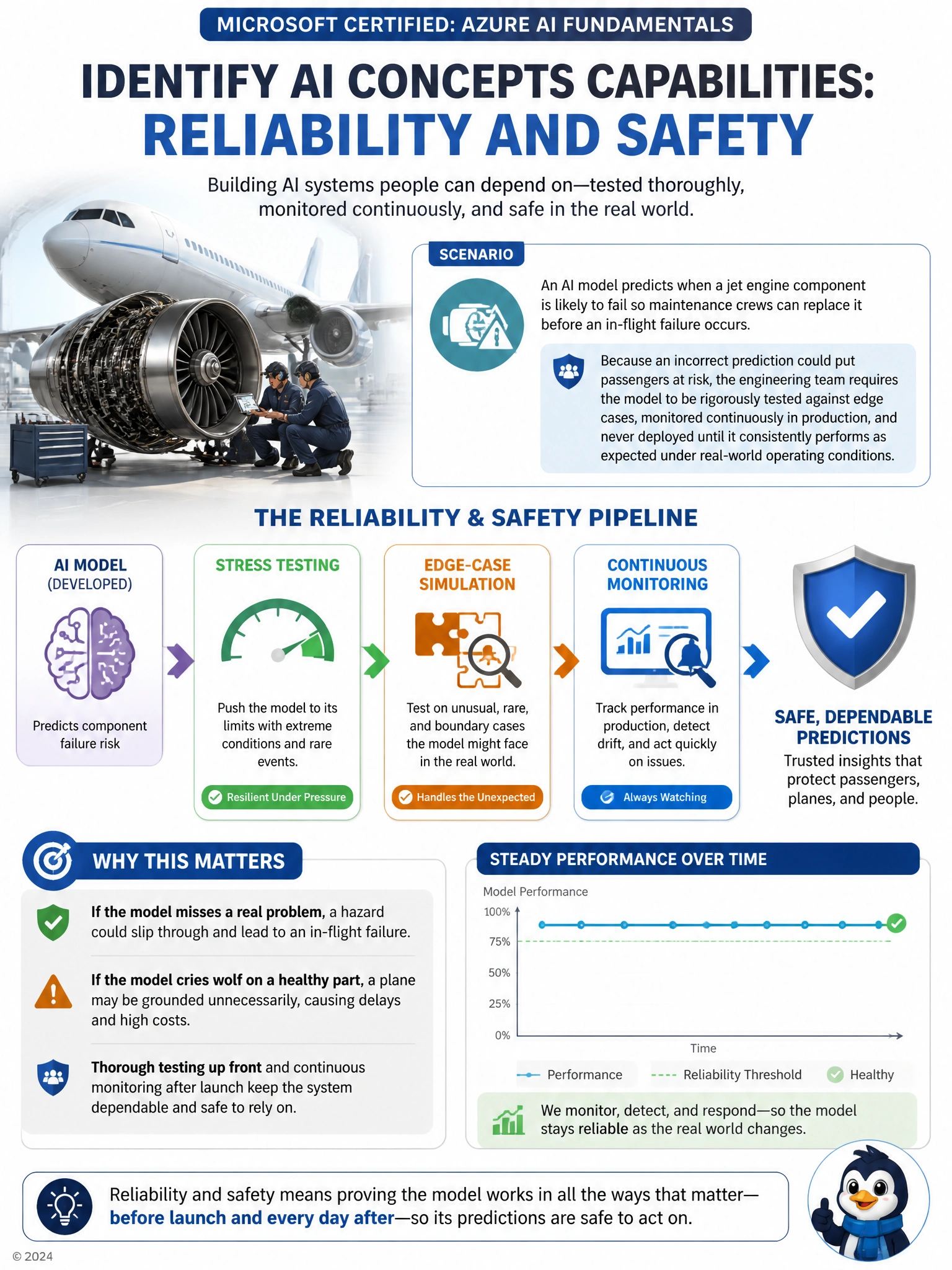
An aviation manufacturer is building an AI system that predicts when a jet engine component is likely to fail so that maintenance crews can replace it before an in-flight failure occurs. Because an incorrect prediction could put passengers at risk, the engineering team requires the model to be rigorously tested against edge cases, monitored continuously in production, and never deployed until it consistently performs as expected under real-world operating conditions. Which Microsoft responsible AI principle is the team primarily applying by requiring this level of testing and monitoring?
Select an answer to reveal the explanation.
Short Explanation
Think about what happens if a system meant to catch a failing engine part gets it wrong, either missing a real problem or crying wolf on a fine part. In aviation, that mistake either lets a hazard slip through or grounds a plane that did not need it. So before anyone lets a prediction model near real maintenance decisions, it has to prove itself against every weird edge case the engineers can throw at it, and then keep proving itself with ongoing monitoring once it is live. That discipline, testing thoroughly up front and watching performance continuously after launch, is what keeps a system dependable and safe to rely on. The tempting wrong turns here are picking an answer about serving a wide range of users, which is a different concern about who benefits from the system, or an answer about protecting stored data, which has nothing to do with how consistently the predictions perform, or an answer about explaining the model's reasoning, which is about openness rather than dependability.
Full Explanation
The correct answer is A. Requiring rigorous testing against edge cases and continuous monitoring after deployment is precisely how an organization operationalizes reliability and safety: the goal is a system that performs consistently and predictably under real operating conditions, and failing to meet that bar in aviation maintenance could put passengers at risk. Option B is incorrect because inclusiveness concerns whether the system works well for a broad range of users and contexts, not how thoroughly the model's predictions have been validated before release. Option C is incorrect because privacy and security concerns protecting the data the system collects and stores, such as sensor logs or maintenance records, and nothing in the scenario describes a data-protection requirement. Option D is incorrect because transparency concerns disclosing how and why the system reaches its conclusions to the people affected by them, whereas the engineering team's requirement here is about validated performance and ongoing monitoring, not explainability. The scenario centers entirely on proving the model behaves dependably before and after it is trusted with a safety-relevant task, which is the defining concern of reliability and safety among the responsible AI principles.