
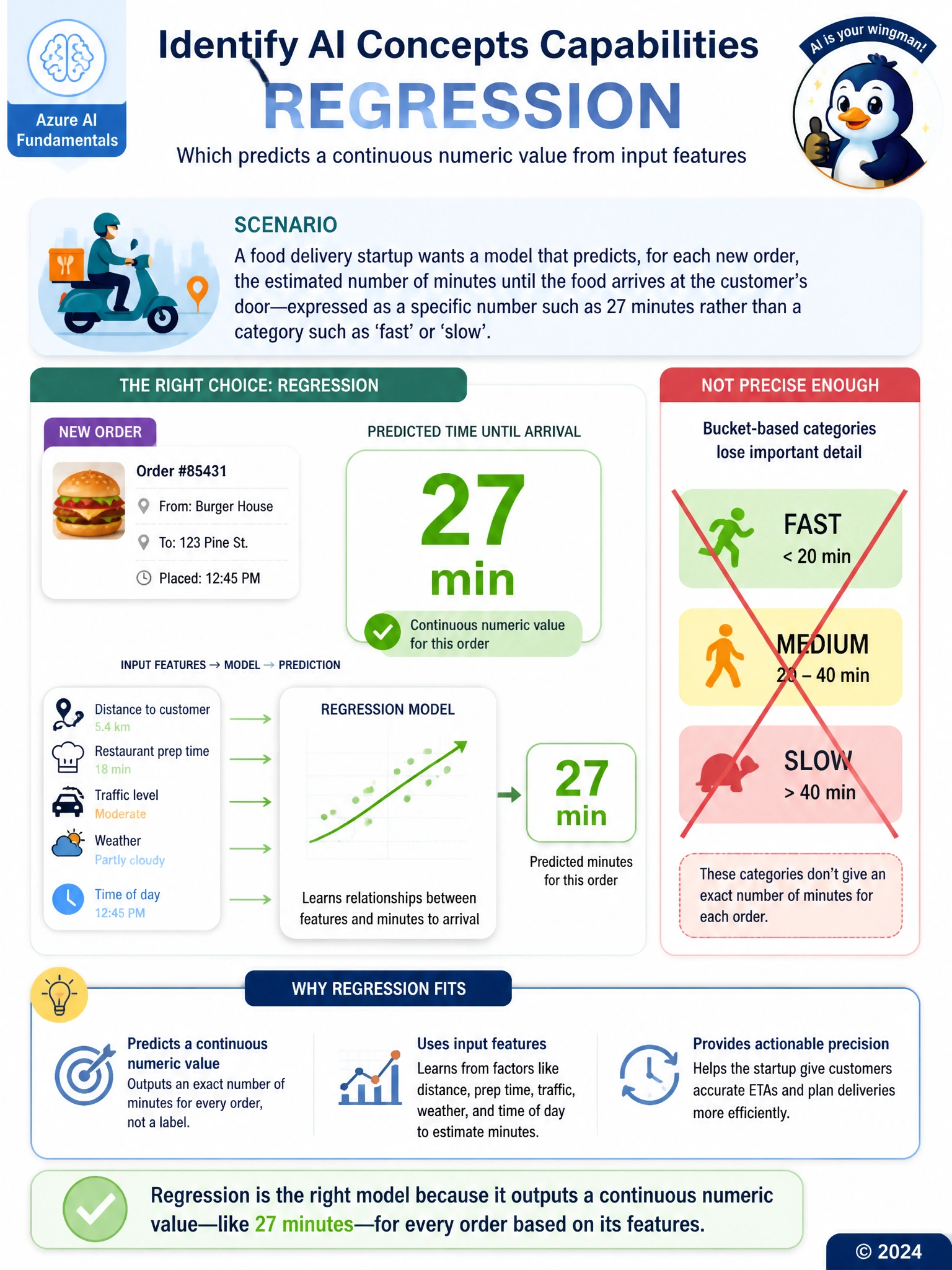
A food delivery startup wants a model that predicts, for each new order, the estimated number of minutes until the food arrives at the customer's door, expressed as a specific number such as 27 minutes rather than a category such as 'fast' or 'slow'. Which type of machine learning model fits this requirement?
Select an answer to reveal the explanation.
Short Explanation
The giveaway in this scenario is the shape of the answer the startup wants: not a category picked from a short list, but an exact number of minutes for every single order. That distinction matters because sorting things into buckets like 'fast' or 'slow' throws away the precision of an actual minute count, so a bucket-based approach doesn't fit. Grouping similar orders together doesn't produce any prediction at all, it just clusters things by similarity. And flagging unusual orders is about catching outliers, not about estimating a number for every normal order that comes through. What the startup needs is a model built specifically to output a continuous numeric value from the details of each order, which is the only option here that actually produces a minutes-until-arrival estimate.
Full Explanation
The correct answer is D. The startup wants a specific numeric estimate, such as 27 minutes, rather than a label chosen from a fixed set, and predicting a continuous numeric value from input features is exactly what a regression model is built to do. Option A is incorrect because classification would assign each order to one of a predefined set of discrete buckets, such as 'fast' or 'slow', which loses the precision of an exact minute count that the startup explicitly wants. Option B is incorrect because clustering groups similar orders together based on shared characteristics, but it has no target value to predict at all, and grouping orders into segments would not tell a customer how many minutes to expect. Option C is incorrect because anomaly detection is built to flag orders that fall outside a typical pattern for review, which addresses outlier detection, not the routine task of estimating a delivery time for every order. Because the requirement is a precise numeric prediction for every order, regression is the model type that fits.